Culture Ark · D-1663 · Holidays and traditions · Browse the gallery · The full 2,000-pick list
Original educational diagram, not a photograph. These original symbols explain selected rites in named clergy and temple sources. They do not reconstruct a private wedding or prescribe a universal order.
Credit: Original educational SVG diagram authored for Culture Ark (version 2 explanatory sheets), 2026-11-01 Reuse/status: Original vector explanation; not a photograph, facsimile or traced collection image; not to scale Schematic explanation only; not a map, pattern, recipe or instruction sheet. Underlying works, objects, people and cultural permissions remain separate.
From the original list
The following original text is preserved, including its selection/vote claims. Preservation is not independent verification of every assertion.
Why: A multi-day ceremony where couples circle a sacred fire seven times.
What to preserve: saptapadi steps, mehndi, baraat procession
Year and origin: ancient · India
Vote: 5/9 (historian 2 · future kid 1 · curator 2)
Learn more: Hindu wedding on Wikipedia
Explanatory sheets
2 original explanatory sheets prepared for this pick, each with its own diagram. Codes in square brackets such as [H1] point to the numbered sources at the end of the page.
Ritual objects express a relationship
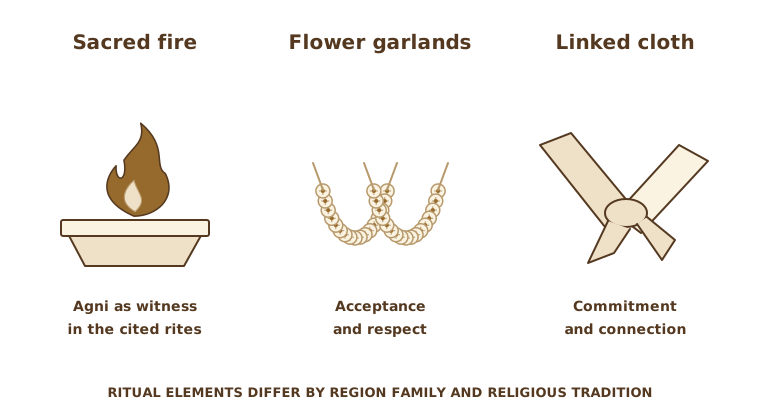
A union with religious and family dimensions. A Hindu clergy guide describes marriage as linking families and establishing a householder’s responsibilities. In many Vedic-style rites, the couple’s commitment is made with Agni, the sacred fire, as witness. That is a religious understanding of the fire, not a claim that all Hindu weddings use the same rites or objects. [H1]
Gestures carry meanings. Ireland Vinayaka Temple’s account interprets exchanged garlands as acceptance and respect, and tied scarves as a bond of commitment. These material actions make relationships visible to those present. Its own introduction notes that family rituals can differ; the examples are not a checklist that every Hindu couple must follow. [H2]
Mehndi, processions, clothing and celebration length vary; “multi-day” and “seven circles” are not universal definitions.
Seven steps are not automatically seven circuits
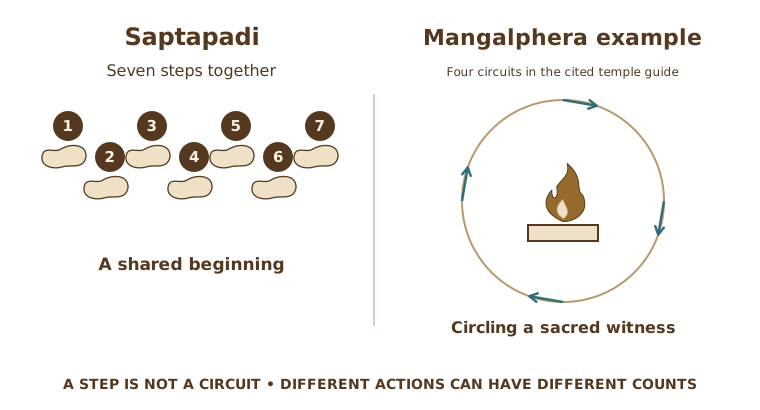
The seven foot symbols count steps. The circular illustration represents the four-circuit form described by Ireland Vinayaka Temple; it is not a route or complete ceremony.
Distinguish the units being counted. Saptapadi means seven steps together. A Hindu clergy guide describes a form with seven small rice heaps, showing that stepping and circling need not be the same movement. Its inclusion of different regional wedding versions also makes clear that a single diagram cannot represent every Hindu marriage tradition. [H1]
One temple account keeps them separate. Ireland Vinayaka Temple lists four mangalpheras around the fire and a separate saptapadi. It relates the circuits to dharma, artha, kama and moksha, and the steps to shared commitments. Other communities use different forms. The useful distinction is between a step, a complete circuit and the meaning attached to each. [H2]
This is cultural explanation, not a claim about the legal validity of any marriage.
Where to learn more
- https://apiarybee.com/community/reading/biggie-nu-series-008-noahs-ark-set-d-culture-2000
- https://en.wikipedia.org/wiki/Hindu_wedding
Sources and rights
- H1 · Australian Council of Hindu Clergy — The Hindu Sacrament of Marriage — Clergy interpretation, regional forms, fire symbolism and steps; cultural sections only, not legal guidance.
- H2 · Ireland Vinayaka Temple — Wedding rites description — Pages 5–6: garlands, cloth bond, four circuits and seven steps; no booking, prices or instructions reproduced.
Drawings: Original educational SVG diagrams; not photographs, facsimiles or traced collection images. Sources consulted 2026-11-01. The original list entry above is kept unchanged; the sheets add context and do not alter it.
Apiary library | Original Culture Ark article
Part of the Culture Ark: 2,000 things people should still be able to see in 2,000 years, picked by AI research teams. This page keeps the original list entry for D-1663 word for word and adds context. Browse the gallery. The Culture Ark is an Artificial Mind Hive (AMH) project. AMH is owned by Austin Little.

Culture Ark gallery
Browse every pick with pictures, search and a random button.
Open the gallery →