Culture Ark · D-1662 · Holidays and traditions · Browse the gallery · The full 2,000-pick list
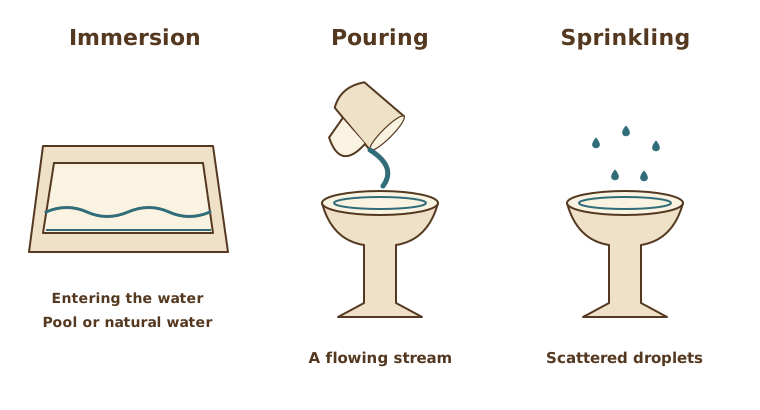
Original educational diagram, not a photograph. These are descriptive water-form symbols, not instructions for conducting a baptism. Vessels and settings vary.
Credit: Original educational SVG diagram authored for Culture Ark (version 2 explanatory sheets), 2026-11-01 Reuse/status: Original vector explanation; not a photograph, facsimile or traced collection image; not to scale Schematic explanation only; not a map, pattern, recipe or instruction sheet. Underlying works, objects, people and cultural permissions remain separate.
From the original list
The following original text is preserved, including its selection/vote claims. Preservation is not independent verification of every assertion.
Why: Water marks a person's entry into the Christian faith.
What to preserve: rite text, fonts, immersion vs sprinkling
Year and origin: 1st century · Middle East
Vote: 5/9 (historian 2 · future kid 1 · curator 2)
Learn more: Baptism on Wikipedia
Explanatory sheets
2 original explanatory sheets prepared for this pick, each with its own diagram. Codes in square brackets such as [B1] point to the numbered sources at the end of the page.
Water has more than one ritual form
Shared material different practice. Baptism uses water within Christian worship, but the form and theology are not identical across churches. United Methodist teaching permits sprinkling, pouring or immersion. The Catholic Catechism describes immersion and pouring. A font’s shape alone therefore cannot establish the denomination or the age of the person baptized. [B1, B3]
Who is baptized also matters. United Methodists baptize infants as well as older people and connect baptism with divine grace and a nurturing community. The Southern Baptist statement identifies baptism as a believer’s immersion and an act of obedience expressing faith in Christ’s death and resurrection. These are distinct theological accounts, not merely preferences for different quantities of water. [B1, B2]
The named examples do not cover every Christian denomination or local practice.
Objects make theological meanings visible
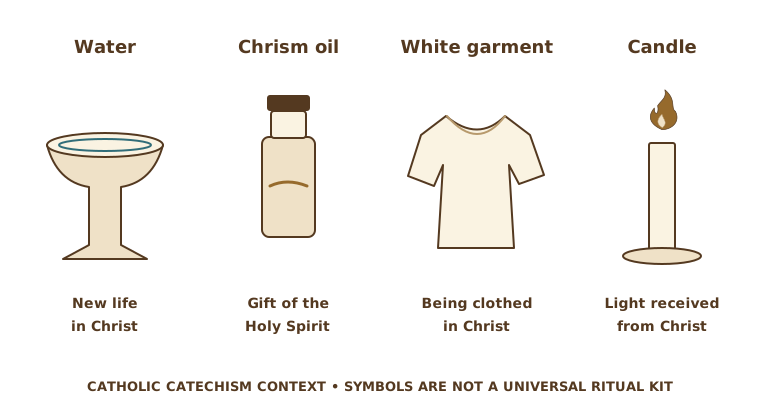
The object set follows the Catholic Catechism’s explanation of signs. Plain invented forms avoid copying a particular church’s vessels or garments.
A visible language of belonging. In the Catholic account, baptism signifies entry into life in Christ. Chrism anointing signifies the Holy Spirit; the white garment expresses a new identity in Christ; and a candle lit from the Easter candle signifies illumination. These are meanings attributed by the tradition, not physical effects of oil, fabric or flame. [B3]
Initiation extends beyond one moment. Catholic initiation links baptism with confirmation and the Eucharist, while the timing differs between Latin and Eastern rites and between infants and adults. United Methodist teaching likewise connects infant baptism with caregivers and congregations who nurture later faith and learning. A baptismal celebration therefore belongs within a longer communal religious life. [B1, B3]
This page explains named traditions; it does not offer a liturgical script or adjudicate which practice is valid.
Where to learn more
- https://apiarybee.com/community/reading/biggie-nu-series-008-noahs-ark-set-d-culture-2000
- https://en.wikipedia.org/wiki/Baptism
Sources and rights
- B1 · United Methodist Discipleship Ministries — Baptism FAQs — Three water forms, infants and adults, sacrament and communal nurture.
- B2 · Southern Baptist Convention — Baptist Faith and Message Article VII — Believer’s immersion, obedience and death-and-resurrection symbolism.
- B3 · Vatican — Catechism paragraphs 1229–1245 — Catholic baptismal forms, signs and differing initiation contexts.
Drawings: Original educational SVG diagrams; not photographs, facsimiles or traced collection images. Sources consulted 2026-11-01. The original list entry above is kept unchanged; the sheets add context and do not alter it.
Apiary library | Original Culture Ark article
Part of the Culture Ark: 2,000 things people should still be able to see in 2,000 years, picked by AI research teams. This page keeps the original list entry for D-1662 word for word and adds context. Browse the gallery. The Culture Ark is an Artificial Mind Hive (AMH) project. AMH is owned by Austin Little.

Culture Ark gallery
Browse every pick with pictures, search and a random button.
Open the gallery →