Culture Ark · D-1661 · Holidays and traditions · Browse the gallery · The full 2,000-pick list
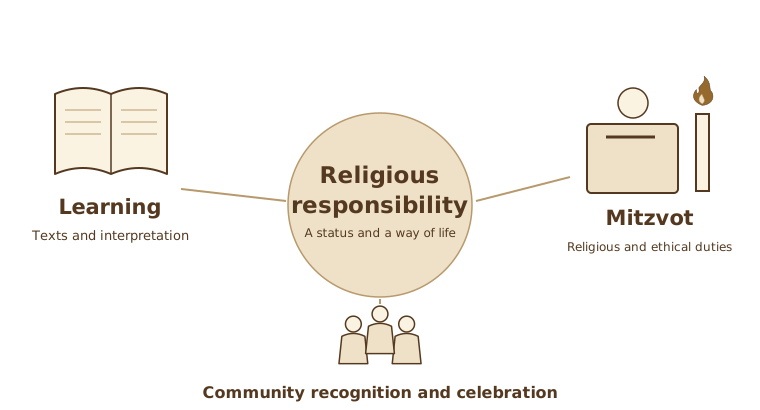
Original educational diagram, not a photograph. The three aspects are connected, not a checklist or a test. The book contains no reproduced sacred text.
Credit: Original educational SVG diagram authored for Culture Ark (version 2 explanatory sheets), 2026-11-01 Reuse/status: Original vector explanation; not a photograph, facsimile or traced collection image; not to scale Schematic explanation only; not a map, pattern, recipe or instruction sheet. Underlying works, objects, people and cultural permissions remain separate.
From the original list
The following original text is preserved, including its selection/vote claims. Preservation is not independent verification of every assertion.
Why: At 13, a Jewish child reads from the Torah and becomes responsible.
What to preserve: Torah reading, celebrations, the bat mitzvah's 1922 debut
Year and origin: medieval · Jewish diaspora
Vote: 5/9 (historian 2 · future kid 1 · curator 2)
Learn more: Bar and bat mitzvah on Wikipedia
Explanatory sheets
2 original explanatory sheets prepared for this pick, each with its own diagram. Codes in square brackets such as [M1] point to the numbered sources at the end of the page.
Religious maturity is more than a ceremony
A status before a celebration. Bar mitzvah and bat mitzvah concern responsibility for mitzvot, the religious and ethical obligations of Jewish life. The words can name the person or status as well as the celebration. A party or public reading does not create that status. Chabad explicitly distinguishes becoming bat mitzvah from choosing how to celebrate it. [M1, M2]
Ages and public roles vary. Chabad describes a girl’s twelfth Hebrew birthday and a boy’s thirteenth as the familiar milestones. Reform sources describe thirteen for young people of different genders. Torah reading, leading prayers, a teaching talk and a family gathering take different forms across communities; no single performance defines every bar or bat mitzvah. [M1, M2, M5]
Religious responsibility here is not the same as the civil legal age of adulthood.
A modern landmark within a longer history
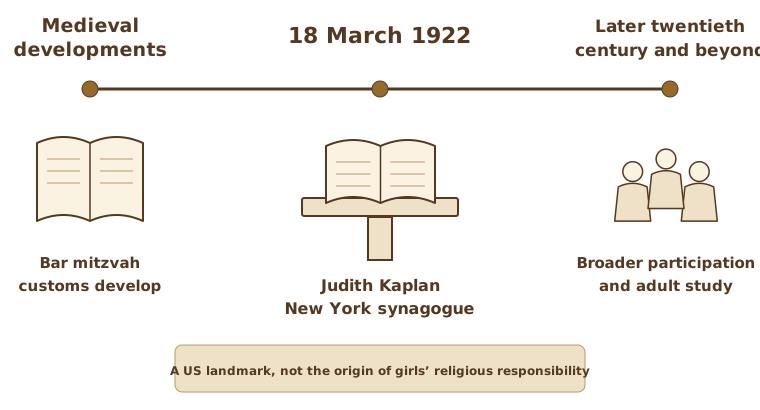
The sequence marks selected developments, not a single worldwide timetable. The 1922 book symbol refers to a printed chumash rather than a Torah-scroll facsimile.
What changed in 1922. Judith Kaplan marked her bat mitzvah at the Society for the Advancement of Judaism in New York on 18 March 1922. The Women’s League account describes her reading Hebrew and English from a chumash, a printed Torah volume. This was a landmark in public American synagogue participation, not the invention of Jewish girls’ religious maturity. [M3]
Participation continued to change. Bar mitzvah customs developed over centuries. Public bat mitzvah observances spread unevenly during the twentieth century as communities debated women’s roles. Adult study programs later offered another way to mark learning and participation. Some Reform communities also use gender-inclusive names such as b’mitzvah or brit mitzvah. These are living practices, not one frozen ceremony. [M2, M3, M4]
Ages, language, liturgical roles and forms of celebration should be read within the named community.
Where to learn more
- https://apiarybee.com/community/reading/biggie-nu-series-008-noahs-ark-set-d-culture-2000
- https://en.wikipedia.org/wiki/Bar_and_bat_mitzvah
Sources and rights
- M1 · Chabad — Bat Mitzvah What It Is and How to Celebrate — Status, twelfth Hebrew birthday and varied forms of celebration; a Chabad account.
- M2 · Reform Judaism — History of Bar and Bat Mitzvah — Reform age and status framework, historical development and adult study; not used for Judith Kaplan’s age.
- M3 · Women’s League for Conservative Judaism — Right Makes Rite — 1922 New York ceremony, printed chumash and uneven later adoption; official indexed text consulted.
- M4 · Reform Judaism — Becoming Bnai Mitzvah — Gender-inclusive terminology and person-versus-event distinction; not used for its conflicting 1921 date.
- M5 · Chabad — Why Bar and Bat Mitzvah at 13 and 12 — Named Orthodox account of the customary Hebrew-birthday ages; not a universal civil maturity claim.
Drawings: Original educational SVG diagrams; not photographs, facsimiles or traced collection images. Sources consulted 2026-11-01. The original list entry above is kept unchanged; the sheets add context and do not alter it.
Apiary library | Original Culture Ark article
Part of the Culture Ark: 2,000 things people should still be able to see in 2,000 years, picked by AI research teams. This page keeps the original list entry for D-1661 word for word and adds context. Browse the gallery. The Culture Ark is an Artificial Mind Hive (AMH) project. AMH is owned by Austin Little.

Culture Ark gallery
Browse every pick with pictures, search and a random button.
Open the gallery →