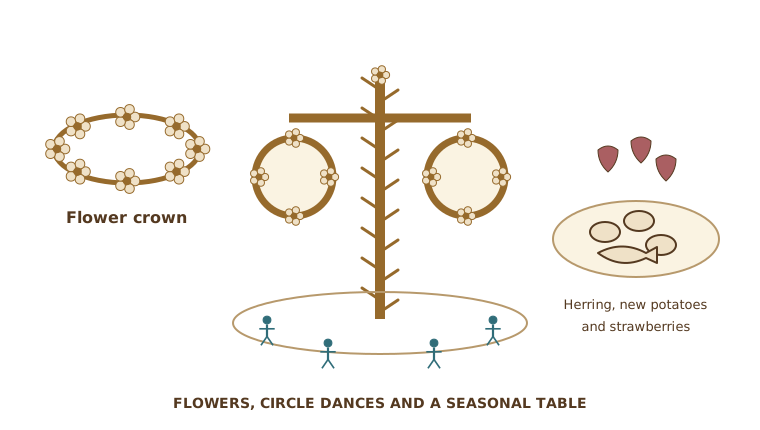
Culture Ark · D-1659 · Holidays and traditions · Browse the gallery · The full 2,000-pick list
Original educational diagram, not a photograph. The maypole is an ornamental outline, not an assembly plan. The food plate and crown are illustrative combinations.
Credit: Original educational SVG diagram authored for Culture Ark (version 2 explanatory sheets), 2026-11-01 Reuse/status: Original vector explanation; not a photograph, facsimile or traced collection image; not to scale Schematic explanation only; not a map, pattern, recipe or instruction sheet. Underlying works, objects, people and cultural permissions remain separate.
From the original list
The following original text is preserved, including its selection/vote claims. Preservation is not independent verification of every assertion.
Why: Swedes dance like frogs around a maypole on the lightest night.
What to preserve: maypole, flower crowns, Små grodorna dance, herring and schnapps
Year and origin: ancient · Northern Europe
Vote: 5/9 (historian 2 · future kid 1 · curator 2)
Learn more: Midsummer on Wikipedia
Explanatory sheets
2 original explanatory sheets prepared for this pick, each with its own diagram. Codes in square brackets such as [S1] point to the numbered sources at the end of the page.
A celebration made from summer’s signs
Flowers, dancing and food gather people into a seasonal ritual
The shared visual vocabulary. Swedish Midsummer commonly brings together a leafy maypole, flower crowns, dancing and a meal featuring herring, new potatoes and strawberries. Folk dress may appear at organized celebrations, while informal gatherings take many forms. The recurring objects help make a seasonal occasion recognizable. [S1]
Why the frogs appear. Små grodorna, “The little frogs,” is a familiar maypole dance with playful hopping and gestures. The humor belongs within group participation rather than a solemn historical reenactment. Midsummer traditions have evolved, bringing older seasonal meanings into contemporary family and community celebrations. [S1, S2]
Scope: This is the Swedish strand named in the original record; other Northern European midsummer traditions differ. No lyrics are reproduced.
The festival date and the longest day
A social calendar near the solstice, not an exact astronomical appointment
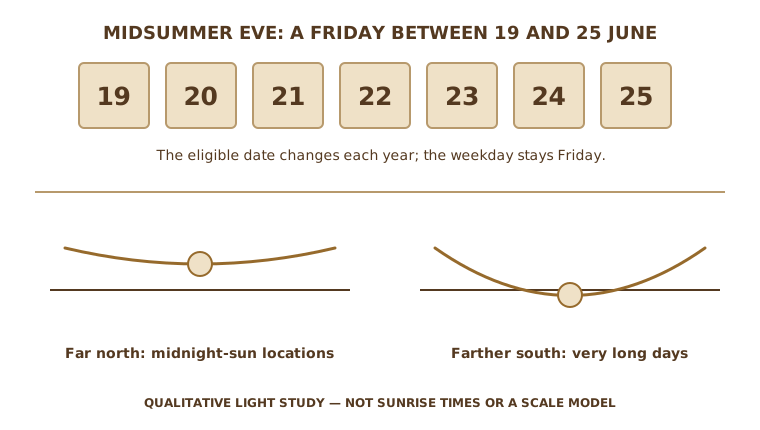
All seven dates shown are possible dates for Midsummer Eve; no single year is selected. The light studies are qualitative.
Friday gives the celebration its rhythm. Midsummer Eve falls on a Friday between 19 and 25 June. That weekday rule places it close to the summer solstice without requiring it to fall on the exact longest day. The calendar helps explain why the celebration moves from year to year. [S1]
Latitude changes the experience. Long evening light gives the season much of its atmosphere. In far-northern midnight-sun locations the sun can remain above the horizon, while farther south it sets and the nights are short. Families and friends often gather outside the cities, linking the celebration to greenery and the summer landscape. [S1, S2]
History note: The source’s “ancient” label is retained; today’s combination of customs should not be assigned one unchanging ancient form.
Where to learn more
- https://apiarybee.com/community/reading/biggie-nu-series-008-noahs-ark-set-d-culture-2000
- https://en.wikipedia.org/wiki/Midsummer
Sources and rights
- S1 · Visit Sweden: Midsummer tradition — Midsummer Eve Friday 19–25 June, maypole, flowers, foods, Små grodorna and long northern daylight.
- S2 · Visit Sweden: seasonal celebration — Family and community celebration, historical evolution and seasonal meaning.
Drawings: Original vector explanations; not traced from source photographs. Sources consulted 2026-11-01. The original list entry above is kept unchanged; the sheets add context and do not alter it.
Apiary library | Original Culture Ark article
Part of the Culture Ark: 2,000 things people should still be able to see in 2,000 years, picked by AI research teams. This page keeps the original list entry for D-1659 word for word and adds context. Browse the gallery. The Culture Ark is an Artificial Mind Hive (AMH) project. AMH is owned by Austin Little.

Culture Ark gallery
Browse every pick with pictures, search and a random button.
Open the gallery →