Culture Ark · D-1658 · Holidays and traditions · Browse the gallery · The full 2,000-pick list
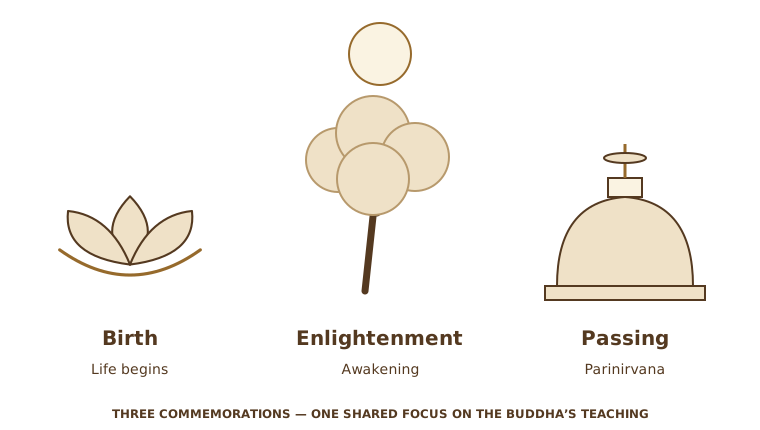
Original educational diagram, not a photograph. The lotus, tree and memorial form are interpretive symbols, not archaeological reconstructions or a depiction of the Buddha.
Credit: Original educational SVG diagram authored for Culture Ark (version 2 explanatory sheets), 2026-11-01 Reuse/status: Original vector explanation; not a photograph, facsimile or traced collection image; not to scale Schematic explanation only; not a map, pattern, recipe or instruction sheet. Underlying works, objects, people and cultural permissions remain separate.
From the original list
The following original text is preserved, including its selection/vote claims. Preservation is not independent verification of every assertion.
Why: Buddhists mark the birth, enlightenment and death of the Buddha on one day.
What to preserve: lanterns, temple offerings, almsgiving
Year and origin: ancient · South Asia
Vote: 5/9 (historian 2 · future kid 1 · curator 2)
Learn more: Vesak on Wikipedia
Explanatory sheets
2 original explanatory sheets prepared for this pick, each with its own diagram. Codes in square brackets such as [B1] point to the numbered sources at the end of the page.
Three moments remembered together
Vesak connects a life story with ethical reflection
What the day commemorates. Vesak brings together remembrance of the Buddha’s birth, enlightenment and passing for many Buddhist communities. The United Nations presents the observance in relation to the May full moon and emphasizes compassion, peace and service to humanity. Its 1999 recognition was international acknowledgment of an existing religious tradition. [B1]
A shared focus with local calendars. The lunar month and its conversion to a civil date are interpreted through regional calendars and traditions. Buddhist communities also differ in how they mark events in the Buddha’s life. The three-part diagram explains Vesak’s common framing; it is not a claim that every Buddhist observes one identical day. [B1, B2]
Date note: Traditional life chronologies are not treated here as a securely established modern historical birth date.
Devotion takes visible and social forms
A festival of light is also a time of teaching and generosity
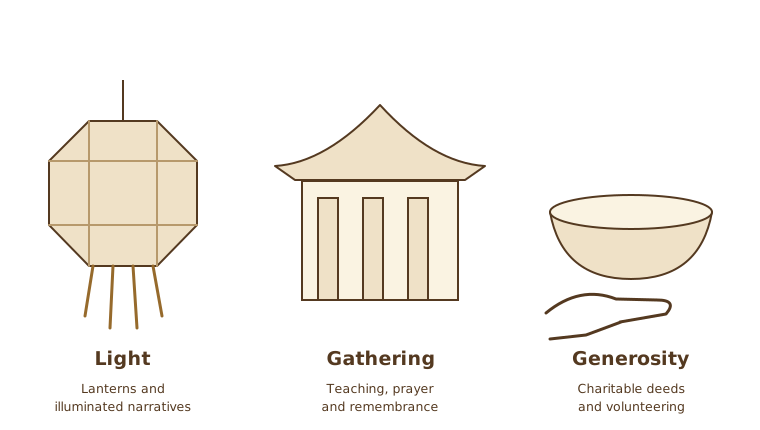
The lantern, temple and bowl are original explanatory symbols. Their combination compares practices rather than reconstructing one ceremony.
Light can carry a story. Sri Lanka Tourism describes Colombo’s Vesak lanterns and illuminated pandols, whose scenes tell stories associated with the Buddha’s previous lives. The display is therefore more than decoration: it can make religious narrative visible in public space. Designs and settings change from place to place. [B3]
Community work behind the display. Singapore’s National Heritage Board describes temple volunteers, religious talks, offerings, charitable deeds and the bathing of Buddha statues among local observances. Different Buddhist traditions organize their own events, while some activities bring communities together. Learning and service sit alongside the festival’s most photographed objects. [B2]
Regional view: Sri Lankan and Singaporean examples illustrate variety; neither is a complete template for Buddhist practice worldwide.
Where to learn more
- https://apiarybee.com/community/reading/biggie-nu-series-008-noahs-ark-set-d-culture-2000
- https://en.wikipedia.org/wiki/Vesak
Sources and rights
- B1 · United Nations: Day of Vesak — Birth, enlightenment and passing commemorated; May full-moon framing; international recognition in 1999.
- B2 · Singapore National Heritage Board: Vesak — Singapore community practices: temple visits, offerings, charity, volunteering and varied Buddhist traditions.
- B3 · Sri Lanka Tourism: Vesak lights — Colombo lanterns and illuminated narrative pandols; historical descriptive page, not current event advice.
Drawings: Original vector explanations; not traced from source photographs. Sources consulted 2026-11-01. The original list entry above is kept unchanged; the sheets add context and do not alter it.
Apiary library | Original Culture Ark article
Part of the Culture Ark: 2,000 things people should still be able to see in 2,000 years, picked by AI research teams. This page keeps the original list entry for D-1658 word for word and adds context. Browse the gallery. The Culture Ark is an Artificial Mind Hive (AMH) project. AMH is owned by Austin Little.

Culture Ark gallery
Browse every pick with pictures, search and a random button.
Open the gallery →