Culture Ark · D-1657 · Holidays and traditions · Browse the gallery · The full 2,000-pick list
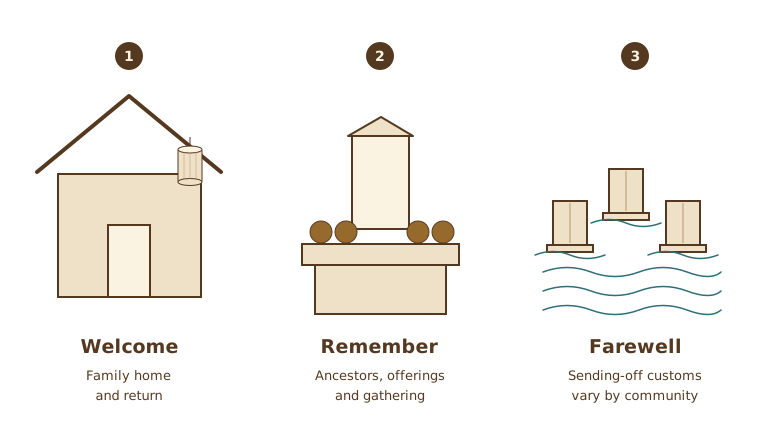
Original educational diagram, not a photograph. The images summarize meanings. Floating lanterns are one regional farewell custom, not an activity performed everywhere.
Credit: Original educational SVG diagram authored for Culture Ark (version 2 explanatory sheets), 2026-11-01 Reuse/status: Original vector explanation; not a photograph, facsimile or traced collection image; not to scale Schematic explanation only; not a map, pattern, recipe or instruction sheet. Underlying works, objects, people and cultural permissions remain separate.
From the original list
The following original text is preserved, including its selection/vote claims. Preservation is not independent verification of every assertion.
Why: Japan welcomes ancestral spirits home with dances and floating lanterns.
What to preserve: Bon Odori dances, toro nagashi lanterns
Year and origin: medieval · Japan
Vote: 5/9 (historian 2 · future kid 1 · curator 2)
Learn more: Obon on Wikipedia
Explanatory sheets
2 original explanatory sheets prepared for this pick, each with its own diagram. Codes in square brackets such as [O1] point to the numbered sources at the end of the page.
Welcoming and remembering ancestors
Obon joins household memory with a shared season
Return, remembrance and departure. Obon is a time to honor ancestors, whose spirits are believed to return to the family home. Offerings and welcoming or sending-off lights express hospitality and farewell. Web Japan describes the customs as combining Buddhist ideas with Indigenous Japanese practices rather than having one simple origin. [O1]
A season of living family ties. Remembrance also brings living relatives together. JNTO describes mid-August Obon as a major period of family reunion and community festivities. Home visits, temple observances and local events belong to different parts of the same season; not every household follows an identical set of customs. [O3]
Local practice: Lantern releases and flames require local organization and environmental controls; the drawing is not an instruction to release or light anything.
Dance forms and dates vary by place
A shared season does not mean a single national choreography
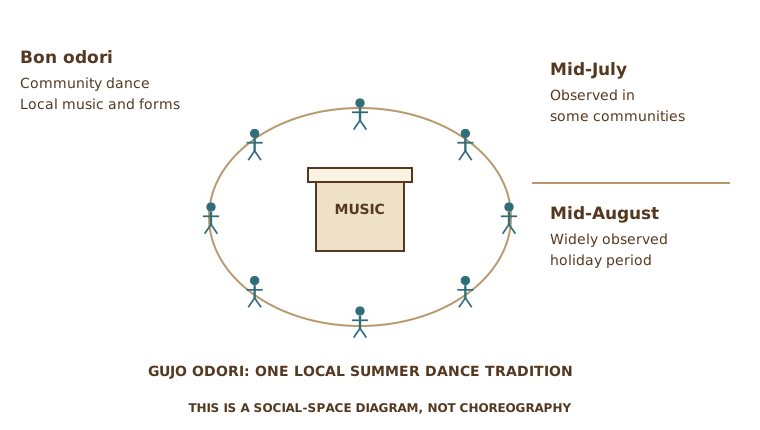
Dancer icons show a gathering around music, not body positions or required steps. The calendar labels are alternatives, not two rounds everyone must attend.
Why July and August both appear. The older observance followed the seventh month of Japan’s traditional calendar. Some communities use mid-July while others observe Obon in mid-August. That calendar history helps explain different dates without making either local practice a mistake. [O1]
A close view of one dance tradition. JNTO describes Gujo Odori as a longstanding community festival with ten dances across a July-to-September season. This example makes a larger point: Bon-season dancing has local repertoires and histories. The social role of gathering can be shared even when music, movement and festival length differ. [O2]
Variant note: Not every Bon dance uses a circle or the same music platform; this is one common spatial idea, not a universal plan.
Where to learn more
- https://apiarybee.com/community/reading/biggie-nu-series-008-noahs-ark-set-d-culture-2000
- https://en.wikipedia.org/wiki/Obon
Sources and rights
- O1 · Web Japan: Bon holidays — Ancestor remembrance, welcome and farewell, offerings, July/August variants and Bon odori.
- O2 · JNTO: Gujo Odori — Local example: longstanding community dance festival, ten dances and summer season.
- O3 · JNTO: Japan in August — Mid-August Obon, family reunion and Kyoto Gozan Okuribi on August 16.
Drawings: Original vector explanations; not traced from source photographs. Sources consulted 2026-11-01. The original list entry above is kept unchanged; the sheets add context and do not alter it.
Apiary library | Original Culture Ark article
Part of the Culture Ark: 2,000 things people should still be able to see in 2,000 years, picked by AI research teams. This page keeps the original list entry for D-1657 word for word and adds context. Browse the gallery. The Culture Ark is an Artificial Mind Hive (AMH) project. AMH is owned by Austin Little.

Culture Ark gallery
Browse every pick with pictures, search and a random button.
Open the gallery →