Culture Ark · D-1656 · Holidays and traditions · Browse the gallery · The full 2,000-pick list
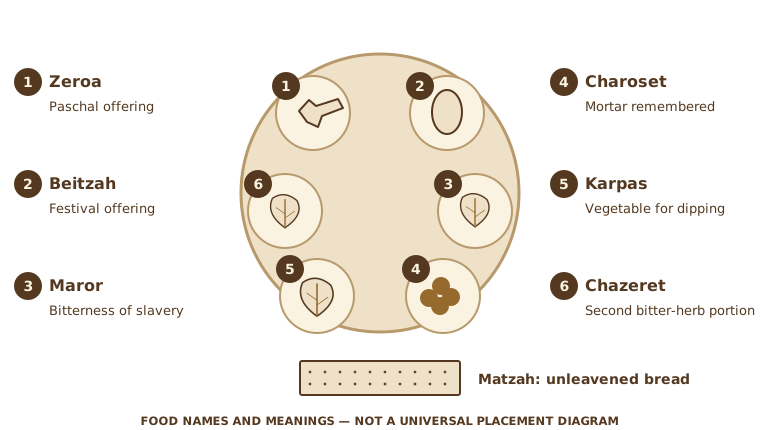
Original educational diagram, not a photograph. Six numbered foods are shown in a teaching arrangement, not the layout of a particular community. Matzah sits outside the circle for clarity.
Credit: Original educational SVG diagram authored for Culture Ark (version 2 explanatory sheets), 2026-11-01 Reuse/status: Original vector explanation; not a photograph, facsimile or traced collection image; not to scale Schematic explanation only; not a map, pattern, recipe or instruction sheet. Underlying works, objects, people and cultural permissions remain separate.
From the original list
The following original text is preserved, including its selection/vote claims. Preservation is not independent verification of every assertion.
Why: A meal that retells a liberation story every year for over 3,000 years.
What to preserve: the Seder plate, Haggadah text, matzah
Year and origin: ancient · Ancient Israel
Vote: 5/9 (historian 2 · future kid 1 · curator 2)
Learn more: Passover on Wikipedia
Explanatory sheets
2 original explanatory sheets prepared for this pick, each with its own diagram. Codes in square brackets such as [P1] point to the numbered sources at the end of the page.
A plate that makes memory tangible
Symbolic foods bring the Exodus story to the table
Food as a language of remembrance. In Chabad’s account, zeroa recalls the paschal sacrifice and the egg a festival offering. Bitter herbs evoke slavery’s bitterness; charoset recalls mortar. Karpas is a vegetable used in dipping, while chazeret provides another bitter-herb portion. Matzah is the unleavened bread central to the meal. [P1]
One table, many inherited forms. The objects carry meanings through discussion and action, not simply through display. Communities differ in ingredients, arrangements and added symbols. The diagram distinguishes customary names from one fixed recipe or plate design; it is an explanation of symbolism, not a substitute for a family’s own practice. [P1, P3]
Variant note: Chabad and Reform sources represent distinct Jewish perspectives. No one plate or Haggadah stands for all Jewish communities.
A meal structured around questions
The Haggadah links speech, food and shared memory
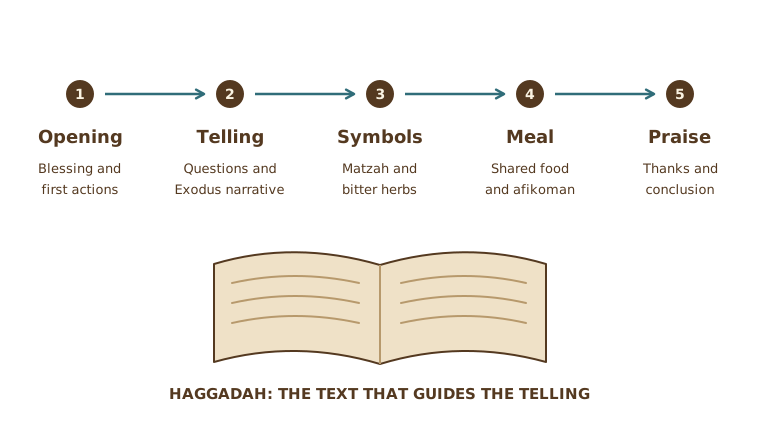
Five thematic groups summarize the traditional fifteen-part Seder. This is a narrative map, not a complete liturgical script.
Why the order matters. Seder means order. Questions and the Exodus narrative are interwoven with symbolic foods, a meal, gratitude and praise. The Haggadah guides this participation; different editions emphasize children’s involvement, commentary, history or contemporary questions. Repetition gives each generation a role in the telling. [P2, P3]
An ancient story, a developing form. Passover’s liberation story is ancient, but the home-centered Seder developed over time, especially after the Second Temple’s destruction. Its present forms should not be pictured as one unchanged meal repeated for three millennia. First-night and additional-night observances also vary among communities. [P3, P4]
Text note: No prayers or song lyrics are reproduced; the open book is an original symbolic drawing.
Where to learn more
- https://apiarybee.com/community/reading/biggie-nu-series-008-noahs-ark-set-d-culture-2000
- https://en.wikipedia.org/wiki/Passover
Sources and rights
- P1 · Chabad: symbolic Seder foods — Traditional food names and meanings; Chabad perspective, not a universal placement rule.
- P2 · Chabad: the fifteen-part Seder — Traditional order, story, symbolic foods, meal and praise. No liturgical text reproduced.
- P3 · Reform Judaism: customs and ritual — Seder, Haggadah, household and community observance, varied editions and participation.
- P4 · Reform Judaism: Passover history — Home-centered observance and development of Seder traditions after the Second Temple.
Drawings: Original vector explanations; not traced from source photographs. Sources consulted 2026-11-01. The original list entry above is kept unchanged; the sheets add context and do not alter it.
Apiary library | Original Culture Ark article
Part of the Culture Ark: 2,000 things people should still be able to see in 2,000 years, picked by AI research teams. This page keeps the original list entry for D-1656 word for word and adds context. Browse the gallery. The Culture Ark is an Artificial Mind Hive (AMH) project. AMH is owned by Austin Little.

Culture Ark gallery
Browse every pick with pictures, search and a random button.
Open the gallery →