Culture Ark · D-1655 · Holidays and traditions · Browse the gallery · The full 2,000-pick list
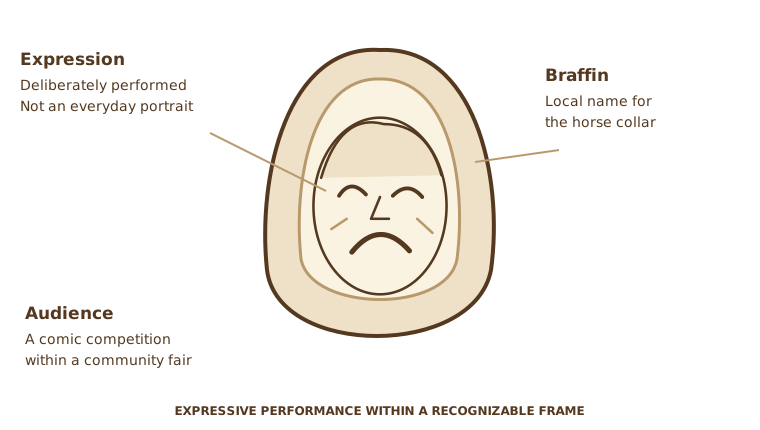
Original educational diagram, not a photograph. The adult face and collar are newly drawn. The picture explains a framing convention, not a winning technique.
Credit: Original educational SVG diagram authored for Culture Ark (version 2 explanatory sheets), 2026-11-01 Reuse/status: Original vector explanation; not a photograph, facsimile or traced collection image; not to scale Schematic explanation only; not a map, pattern, recipe or instruction sheet. Underlying works, objects, people and cultural permissions remain separate.
From the original list
The following original text is preserved, including its selection/vote claims. Preservation is not independent verification of every assertion.
Why: Contestants pull the ugliest face through a horse collar.
What to preserve: winning faces
Year and origin: 1267 · England
Vote: 6/9 (historian 1 · future kid 3 · curator 2)
Learn more: Gurn on Wikipedia
Explanatory sheets
2 original explanatory sheets prepared for this pick, each with its own diagram. Codes in square brackets such as [G1] point to the numbered sources at the end of the page.
The face and its frame
Gurning as an intentional comic performance
What the contestant presents. At Egremont’s Crab Fair, gurning is performed with the face framed by a horse collar, locally called a braffin. The organizer describes a contest of exaggerated facial expression. Here, the frame concentrates attention on a chosen performance rather than on the person’s usual appearance. [G1]
Why context matters. A still image of a comic expression can look very different when separated from its event. The useful comparison is between intention, framing and audience response, not between supposedly “better” or “worse” human faces. The diagram uses a fictional adult so it does not turn a real participant into a caricature.
Respect: Treat entrants as performers. Do not infer health, disability, character or ordinary appearance from a competition image.
A medieval fair, a less certain contest history
Separate the charter from later evidence for gurning
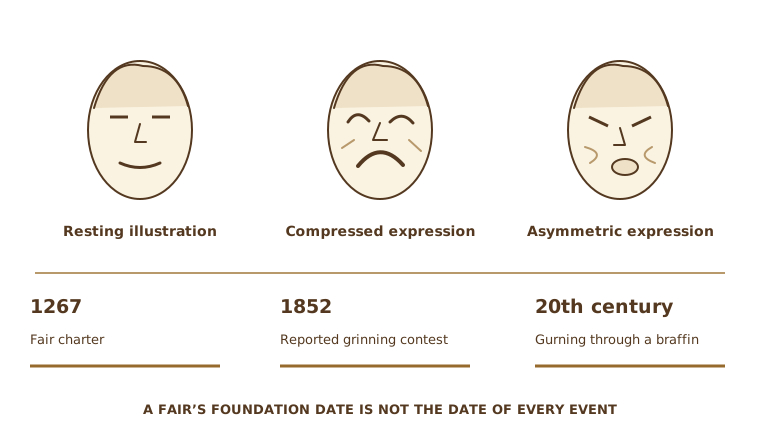
The face studies are not ranked and are not exercise instructions. Dates below them are separate historical evidence, not stages of a face.
What 1267 actually dates. The organizer’s history records Henry III’s 1267 charter for Egremont’s market and fair. It calls gurning’s origin obscure, while citing a newspaper description from 1852 and a later twentieth-century name referring to the braffin. The archive’s 1267 label should therefore not be read as a proven gurning origin. [G1]
Reading expression as performance. The same invented face looks different when eyebrows, mouth and cheek lines change. This close view shows why lighting, camera timing and the chosen instant affect the resulting image. It explains visual emphasis without prescribing strain, dental changes or a method for winning a contest.
History view: Selected dated evidence, not a continuous year-by-year record of the competition.
Where to learn more
- https://apiarybee.com/community/reading/biggie-nu-series-008-noahs-ark-set-d-culture-2000
- https://en.wikipedia.org/wiki/Gurn
Sources and rights
- G1 · Egremont Crab Fair: organizer history — 1267 fair charter versus obscure gurning origins; horse collar; nineteenth-century descriptions.
Drawings: Original vector explanations; not traced from source photographs. Sources consulted 2026-11-01. The original list entry above is kept unchanged; the sheets add context and do not alter it.
Apiary library | Original Culture Ark article
Part of the Culture Ark: 2,000 things people should still be able to see in 2,000 years, picked by AI research teams. This page keeps the original list entry for D-1655 word for word and adds context. Browse the gallery. The Culture Ark is an Artificial Mind Hive (AMH) project. AMH is owned by Austin Little.

Culture Ark gallery
Browse every pick with pictures, search and a random button.
Open the gallery →