Culture Ark · D-1654 · Holidays and traditions · Browse the gallery · The full 2,000-pick list
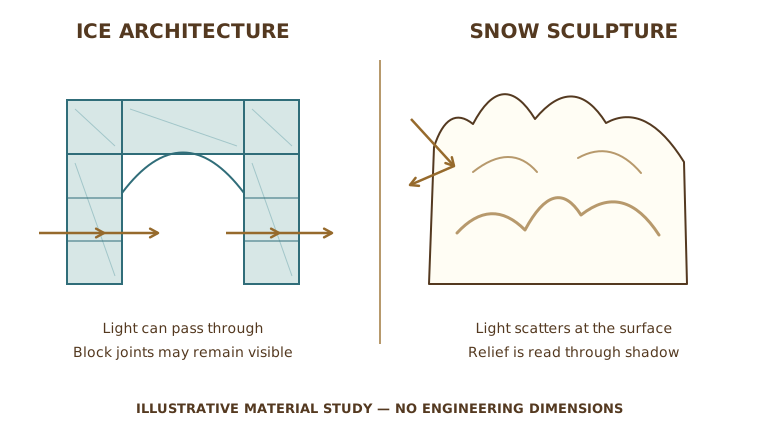
Original educational diagram, not a photograph. Gold arrows indicate light in this original material study. The forms are imaginary, not replicas of festival sculptures.
Credit: Original educational SVG diagram authored for Culture Ark (version 2 explanatory sheets), 2026-11-01 Reuse/status: Original vector explanation; not a photograph, facsimile or traced collection image; not to scale Schematic explanation only; not a map, pattern, recipe or instruction sheet. Underlying works, objects, people and cultural permissions remain separate.
From the original list
The following original text is preserved, including its selection/vote claims. Preservation is not independent verification of every assertion.
Why: A city of ice palaces glows in the Chinese winter.
What to preserve: ice architecture, lighting
Year and origin: 1963 · China
Vote: 6/9 (historian 1 · future kid 3 · curator 2)
Learn more: Harbin International Ice and Snow Sculpture Festival on Wikipedia
Explanatory sheets
2 original explanatory sheets prepared for this pick, each with its own diagram. Codes in square brackets such as [H1] point to the numbered sources at the end of the page.
Two materials, two kinds of light
Reading ice architecture beside carved snow
Ice makes light part of the object. Ice displays can combine block-like architectural forms with illumination, turning transparent or translucent surfaces into nighttime color. In this schematic, joints and light paths explain why an ice arch reads differently from a solid stone building. The comparison is a visual interpretation, not a building method.
Snow makes form through shadow. Snow sculpture is more opaque: relief, silhouette and surface texture become legible through reflected light and shadow. Harbin’s winter culture includes both ice-lantern displays and snow-sculpture exhibitions. They are related attractions, but they should not be treated as one identical medium or venue. [H1, H2]
Material view: Appearance varies with weather, surface treatment, viewing angle and lighting. No carving, structural or electrical instructions are supplied.
Three dates that should not be collapsed
The source’s 1963 label describes a precursor, not every later attraction
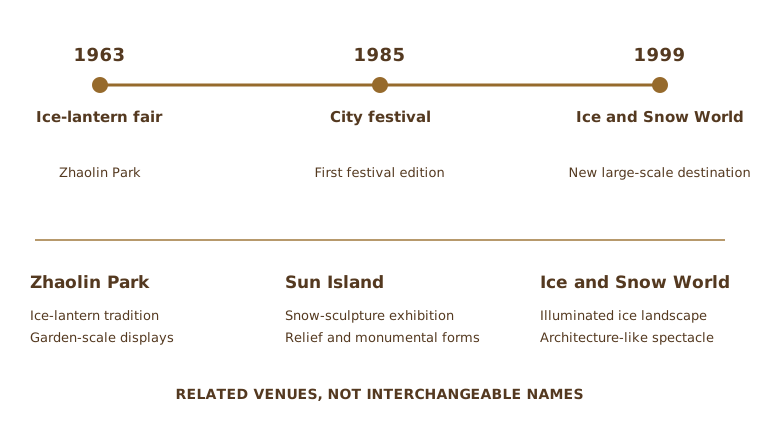
Chronology is not drawn to time scale. Venue descriptions are broad historical distinctions, not a current event map.
From lantern fair to city festival. Heilongjiang’s cultural authority dates the first Ice Lantern Garden Fair at Zhaolin Park to 7 February 1963. The first Harbin Ice and Snow Festival followed on 5 January 1985. Distinguishing these milestones explains why histories sometimes give different “beginning” dates. [H1]
A later expansion of the winter city. Ice and Snow World began in 1999. Alongside Sun Island’s snow-sculpture exhibitions and the older lantern tradition, it helped expand the range and scale of Harbin’s winter displays. The seasonal installations change, so photographs need their own year and venue rather than one timeless festival caption. [H1, H2]
Historical note: The exact original name and “1963 · China” record are preserved separately. This timeline adds context without overwriting them.
Where to learn more
- https://apiarybee.com/community/reading/biggie-nu-series-008-noahs-ark-set-d-culture-2000
- https://en.wikipedia.org/wiki/Harbin_International_Ice_and_Snow_Sculpture_Festival
Sources and rights
- H1 · Heilongjiang Culture and Tourism: ice history — 1963 ice-lantern garden fair, 1985 festival, 1999 Ice and Snow World; distinct venues.
- H2 · State Council Information Office: Harbin winter — Ice-lantern origins and Ice and Snow World development; seasonal spectacle.
Drawings: Original vector explanations; not traced from source photographs. Sources consulted 2026-11-01. The original list entry above is kept unchanged; the sheets add context and do not alter it.
Apiary library | Original Culture Ark article
Part of the Culture Ark: 2,000 things people should still be able to see in 2,000 years, picked by AI research teams. This page keeps the original list entry for D-1654 word for word and adds context. Browse the gallery. The Culture Ark is an Artificial Mind Hive (AMH) project. AMH is owned by Austin Little.

Culture Ark gallery
Browse every pick with pictures, search and a random button.
Open the gallery →