Culture Ark · D-1653 · Holidays and traditions · Browse the gallery · The full 2,000-pick list
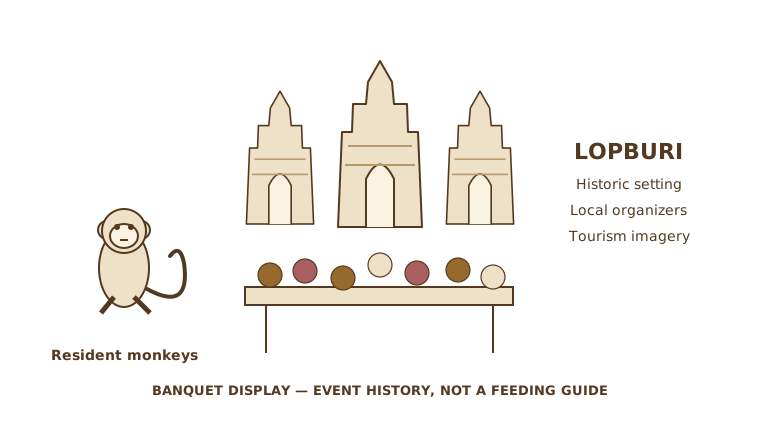
Original educational diagram, not a photograph. The towers evoke a setting, not a measured monument or current event layout. No visitor feeding is depicted.
Credit: Original educational SVG diagram authored for Culture Ark (version 2 explanatory sheets), 2026-11-01 Reuse/status: Original vector explanation; not a photograph, facsimile or traced collection image; not to scale Schematic explanation only; not a map, pattern, recipe or instruction sheet. Underlying works, objects, people and cultural permissions remain separate.
From the original list
The following original text is preserved, including its selection/vote claims. Preservation is not independent verification of every assertion.
Why: A town throws a feast for its monkeys.
What to preserve: fruit towers, monkey photos
Year and origin: 1989 · Thailand
Vote: 6/9 (historian 1 · future kid 3 · curator 2)
Learn more: Monkey Buffet Festival on Wikipedia
Explanatory sheets
2 original explanatory sheets prepared for this pick, each with its own diagram. Codes in square brackets such as [M1] point to the numbered sources at the end of the page.
A town stages a thank-you feast
A modern tourism event built around Lopburi’s resident monkeys
How the event developed. The Tourism Authority of Thailand traces the festival to a local hotel owner’s idea in the 1980s. Its 2020 account describes a feast thanking monkeys for their role in attracting visitors, with colorful banquet displays at historic sites in Lopburi. [M1]
Why the image travels. Fruit displays, monkeys and old architecture create a striking contrast between a human-organized ceremony and animals moving freely through town. The festival also turns the monkey into a recognizable local emblem. This sheet interprets that visual contrast rather than treating the event as an ancient religious rite. [M1]
Date note: The archival 1989 date remains unchanged; the cited TAT account supports the broader 1980s. Historical schedules are not current visiting advice.
What the close-up leaves outside the frame
The famous festival sits within an inhabited town
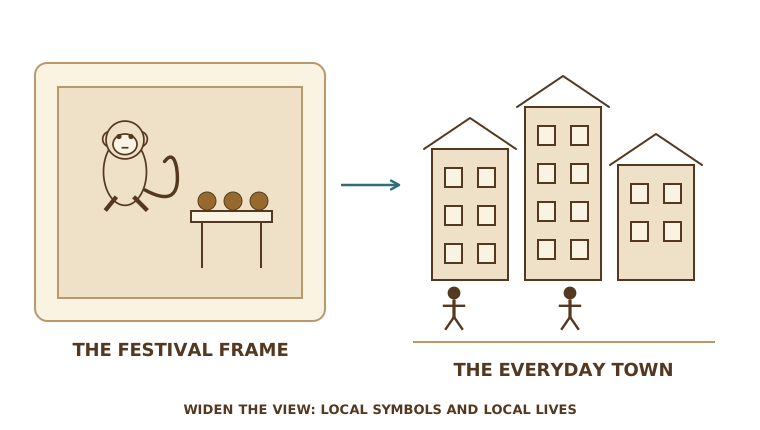
Two fields of view compare a spectacle with its urban context. Buildings and figures are original illustrative symbols.
A symbol used beyond the feast. A December 2024 Thai government account describes community street art featuring monkeys and sunflowers in Lopburi’s old city. The imagery was intended to enliven the area and support local tourism. The monkey’s cultural role therefore extends beyond a single annual banquet. [M2]
Coexistence is part of the story. The same account reports efforts to reduce and relocate the monkey population to improve neighborhood life. Festival promotion and residents’ daily experience are different perspectives on the same place. A complete explanation includes both, without assuming that a celebratory photograph describes animal welfare or everyday conditions. [M2]
Viewing care: Observe from an appropriate distance and follow local controls; do not feed, approach, touch or handle wildlife.
Where to learn more
- https://apiarybee.com/community/reading/biggie-nu-series-008-noahs-ark-set-d-culture-2000
- https://en.wikipedia.org/wiki/Monkey_Buffet_Festival
Sources and rights
- M1 · Tourism Authority of Thailand: Monkey Buffet — Documented 2020 event, 1980s beginnings, local hotel owner, tourism and banquet display; not a current schedule.
- M2 · Thai PRD: Lopburi community and monkeys — December 2024 account of local street art, town identity and monkey population management.
Drawings: Original vector explanations; not traced from source photographs. Sources consulted 2026-11-01. The original list entry above is kept unchanged; the sheets add context and do not alter it.
Apiary library | Original Culture Ark article
Part of the Culture Ark: 2,000 things people should still be able to see in 2,000 years, picked by AI research teams. This page keeps the original list entry for D-1653 word for word and adds context. Browse the gallery. The Culture Ark is an Artificial Mind Hive (AMH) project. AMH is owned by Austin Little.

Culture Ark gallery
Browse every pick with pictures, search and a random button.
Open the gallery →