Culture Ark · Browse the gallery · 60 illustrated picks on Apiary
CA1411 · architecture and places
Creator/community: Kasena community, royal custodians, builders and women decorators Place/era: Tiébélé, Burkina Faso; court established from the 16th century, continually maintained
Generated interpretation
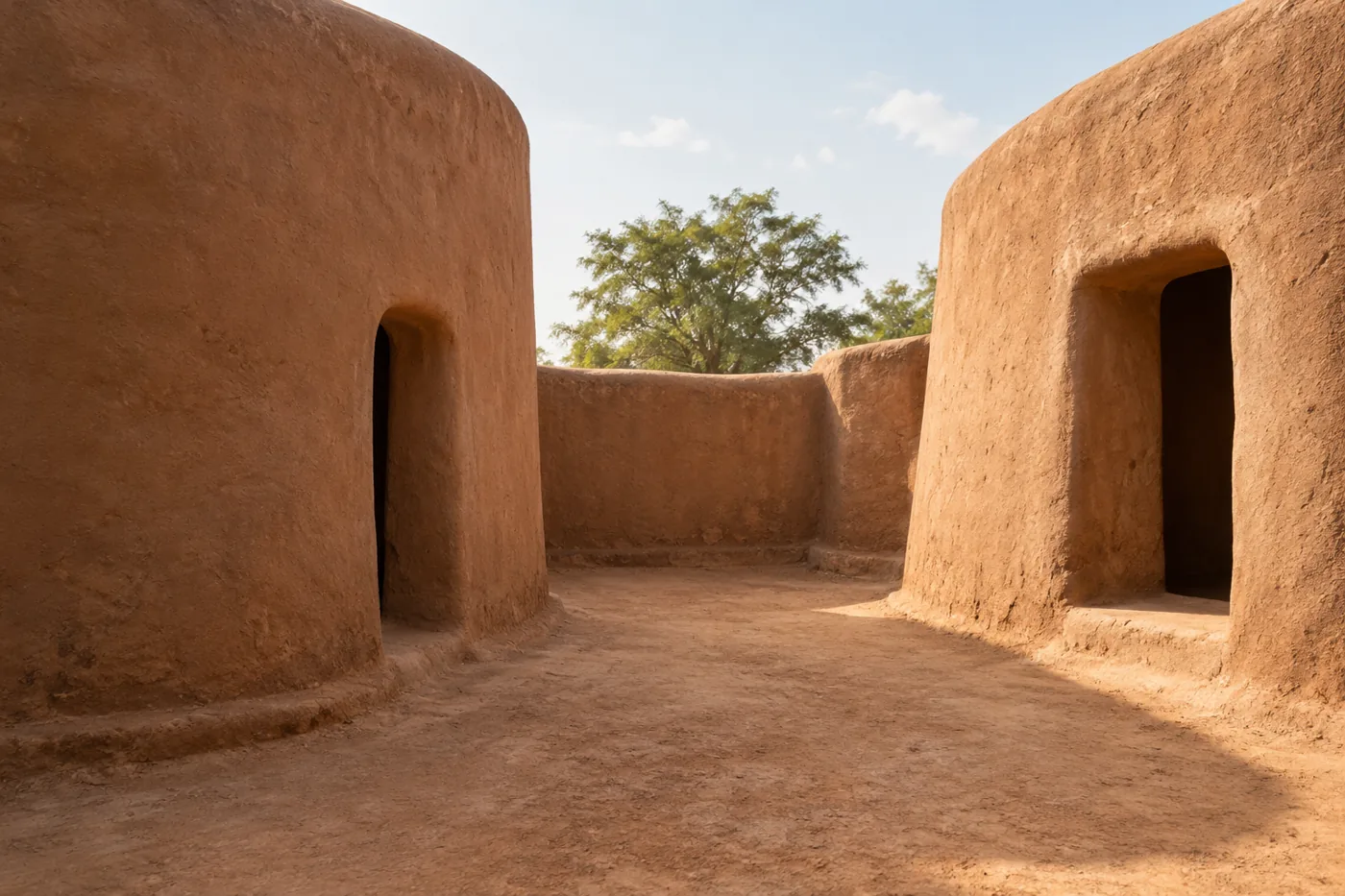
AI-generated plain earthen courtyard forms inspired by the architectural focus of Tiébélé’s court; not its actual layout, a named dwelling or a reproduction of Kasena mural designs. Credit: AI-generated for Culture Ark using OpenAI image_gen, 2026-11-01. Rights: AI-generated output; no exclusive ownership or guaranteed copyrightability claimed. Changes: Resized within1400px and converted to WebP; no crop or substantive alteration.
The volumes, openings and courtyard are invented. They do not map the court, identify residents or ranks, reveal sacred arrangements, or establish authentic dwelling construction.
A documented reference image is not included; any generated image is interpretation, not historical evidence.
History and context
An earthen compound brings differently shaped houses, gathering places and sacred elements into a socially organized whole. At Tiébélé, the arrangement of dwellings reflects the roles and status of their inhabitants: the documented forms include figure-of-eight houses, quadrangular houses and circular houses. These are not interchangeable decorative variations but parts of a settlement system. Spaces for deliberation, ancestral remembrance and royal life connect the domestic buildings to wider community institutions. The court remains inhabited and maintained under customary authority, so its establishment in the sixteenth century does not date every surviving wall. This architectural selection focuses on spatial relationships and dwelling types; the separate mural-making entry preserves the women’s skilled renewal of decorated surfaces.
What future readers can learn
Curatorial interpretation: Differentiated house forms and the placement of domestic, deliberative and sacred spaces can make social organization legible through architecture.
Limits and cultural context
Distinct from CA0217, which focuses on women’s mural-making: this record selects the court’s spatial organization and dwelling forms. Respect the Pê and community’s custodianship, private rooms and sacred spaces.
Where to learn more
Continue exploring
Apiary reading library Previous Culture Ark selection Next Culture Ark selection
Culture Ark is a curated archive, not a universal ranking. Interpretive images and source evidence serve different roles.
Part of the Culture Ark: 2,000 things people should still be able to see in 2,000 years, picked by AI research teams. Browse the gallery. The Culture Ark is an Artificial Mind Hive (AMH) project. AMH is owned by Austin Little.

Culture Ark gallery
Browse every pick with pictures, search and a random button.
Open the gallery →