Culture Ark · Browse the gallery · 60 illustrated picks on Apiary
CA1415 · architecture and places
Creator/community: Builders associated with Lohron or Koulango occupation; attribution remains qualified Place/era: Southwestern Burkina Faso; at least a millennium of history, major gold-trade period 14th–17th centuries
Generated interpretation
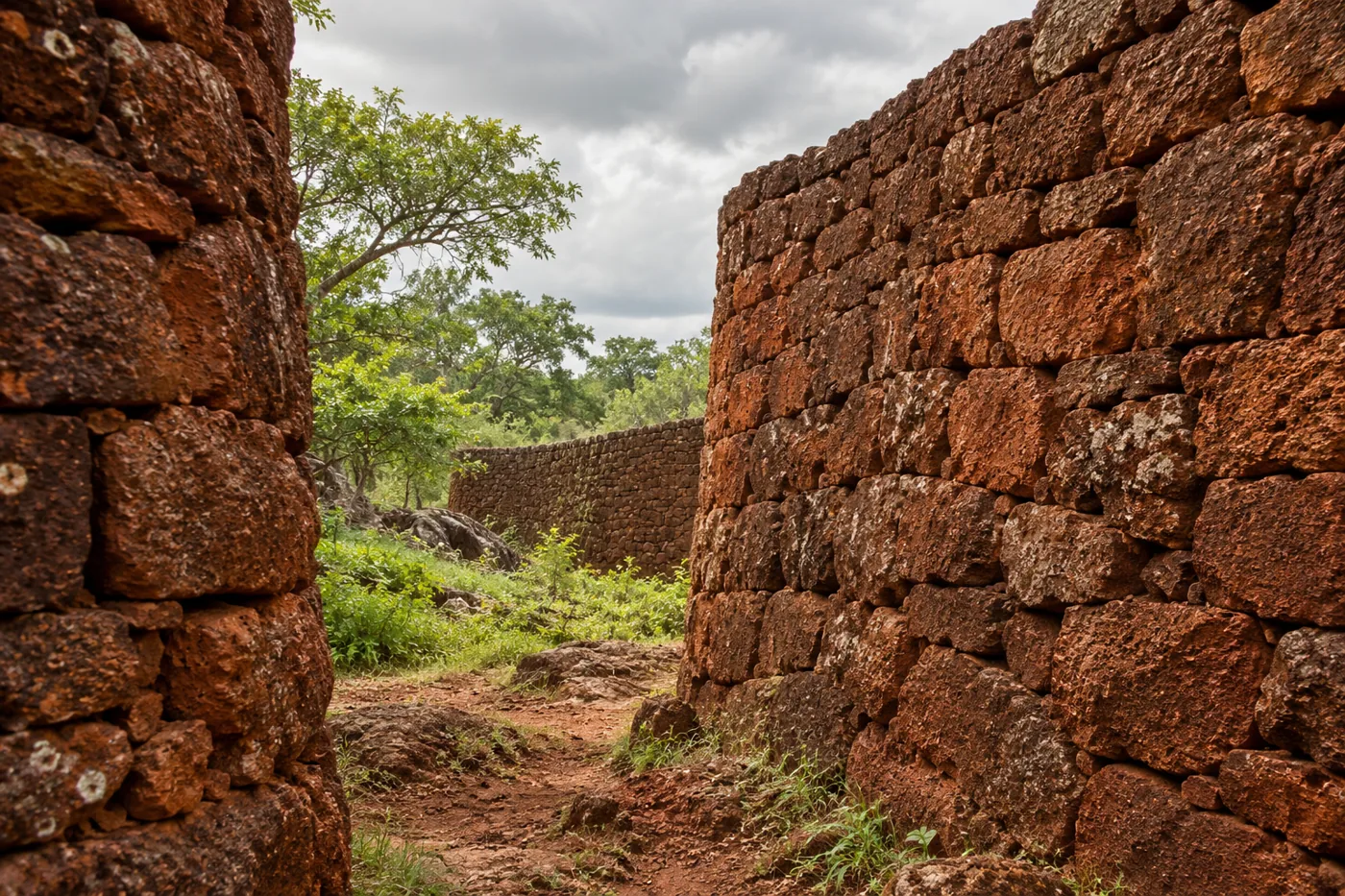
AI-generated laterite-coloured enclosure study inspired by Loropéni; not an actual gate, surveyed wall segment or reconstruction of the settlement. Credit: AI-generated for Culture Ark using OpenAI image_gen, 2026-11-01. Rights: AI-generated output; no exclusive ownership or guaranteed copyrightability claimed. Changes: Resized within1400px and converted to WebP; no crop or substantive alteration.
The stone courses, height, opening and vegetation are invented. They do not resolve authorship, chronology, function, excavation gaps or construction technique.
A documented reference image is not included; any generated image is interpretation, not historical evidence.
History and context
Tall laterite-stone walls enclose the remains of a settlement whose history is still partly unresolved. Loropéni belongs to a wider regional pattern of enclosures connected with the extraction, processing and movement of gold. Its substantial construction makes organized labour and defensive planning visible, but it does not provide a complete account of who lived in each space or how every period of occupation unfolded. UNESCO explicitly notes archaeological uncertainty and interruptions in the settlement’s history. That makes the place valuable for an honest archive: impressive remains need not be accompanied by an invented certainty. Preserving the enclosure, its regional setting and the limits of present knowledge allows future researchers to ask questions rather than inherit a closed narrative.
What future readers can learn
Curatorial interpretation: Architecture can provide strong evidence of organized resources while leaving important questions of attribution, function and chronology open.
Limits and cultural context
Keep Lohron/Koulango attribution qualified. Early nineteenth-century abandonment is not the construction date; unexcavated areas should not be filled with speculative reconstructions.
Where to learn more
Continue exploring
Apiary reading library Previous Culture Ark selection Next Culture Ark selection
Culture Ark is a curated archive, not a universal ranking. Interpretive images and source evidence serve different roles.
Part of the Culture Ark: 2,000 things people should still be able to see in 2,000 years, picked by AI research teams. Browse the gallery. The Culture Ark is an Artificial Mind Hive (AMH) project. AMH is owned by Austin Little.

Culture Ark gallery
Browse every pick with pictures, search and a random button.
Open the gallery →