Culture Ark · Browse the gallery · 60 illustrated picks on Apiary
CA1418 · architecture and places
Creator/community: Ghadamès households, builders and oasis-water custodians Place/era: Ghadamès, Libya; long-lived Saharan oasis settlement with successive domestic building phases
Generated interpretation
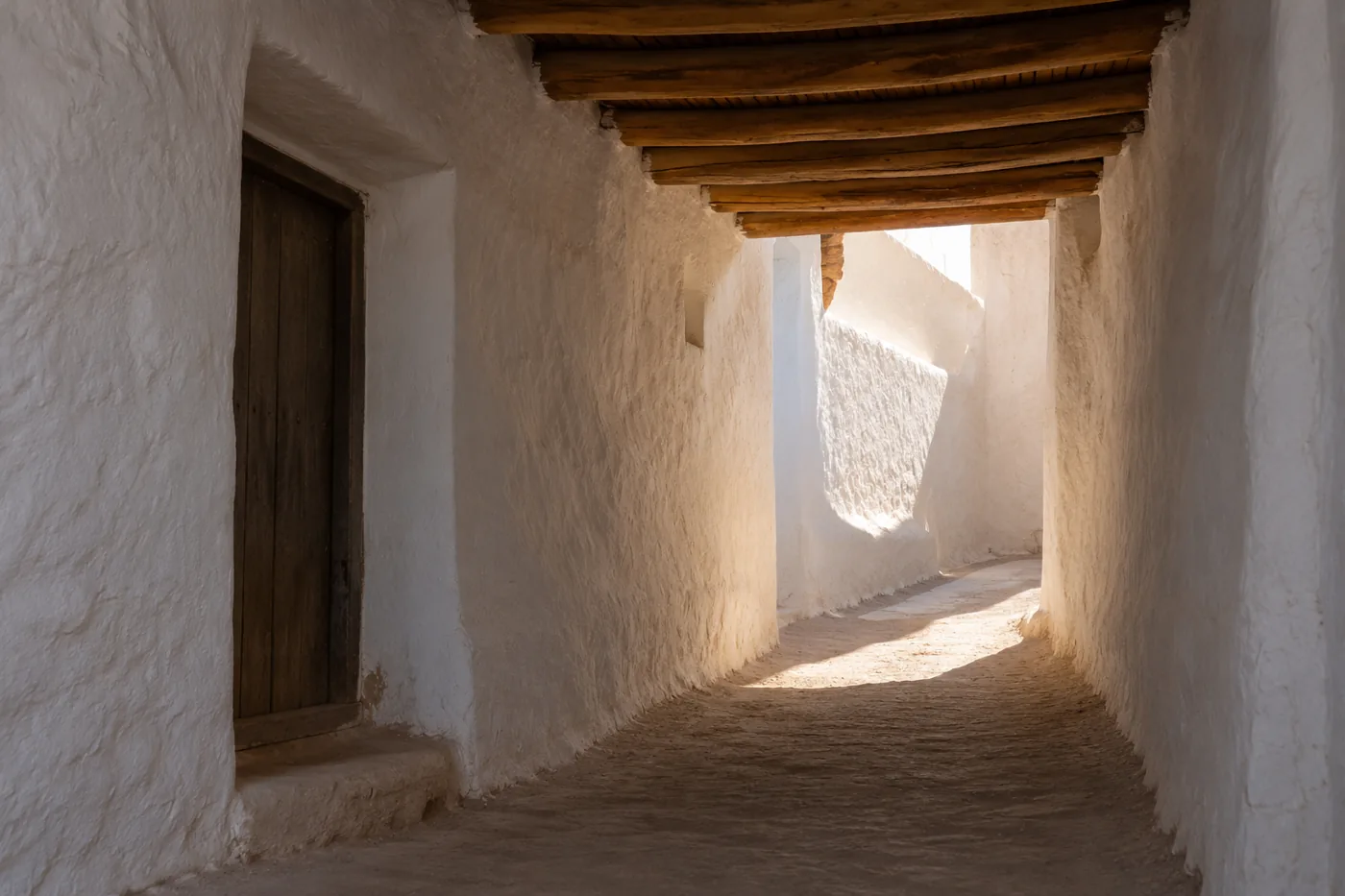
AI-generated covered passage inspired by Ghadamès’ shaded circulation; not a documented street, household plan or view of a private rooftop space. Credit: AI-generated for Culture Ark using OpenAI image_gen, 2026-11-01. Rights: AI-generated output; no exclusive ownership or guaranteed copyrightability claimed. Changes: Resized within1400px and converted to WebP; no crop or substantive alteration.
The passage, roof members, doorway and light are invented. They do not establish actual thermal performance, household practice, building geometry or access permission.
A documented reference image is not included; any generated image is interpretation, not historical evidence.
History and context
Covered passages, layered houses and roof terraces create a town adapted to strong heat, desert winds and the need for privacy. Ghadamès developed around a spring and within an oasis system that links buildings with water and palm cultivation. UNESCO describes a vertical organization of domestic functions, including storage below, family rooms above and terraces associated with women’s movement and social life. These arrangements show that climatic adaptation is also social design, not merely a technical response to temperature. The archive should retain the relationship between streets, interiors and the oasis rather than isolate one picturesque doorway. Its historical gendered spaces should be explained carefully, without assuming that every household or later generation uses them identically.
What future readers can learn
Curatorial interpretation: Environmental adaptation and social organization can be built into the same circulation system, from shaded passages to connected rooftops.
Limits and cultural context
The settlement’s long history is not a precise date for individual houses. Document gendered spatial traditions as contextual practices, not universal or unchanging rules.
Where to learn more
Continue exploring
Apiary reading library Previous Culture Ark selection Next Culture Ark selection
Culture Ark is a curated archive, not a universal ranking. Interpretive images and source evidence serve different roles.
Part of the Culture Ark: 2,000 things people should still be able to see in 2,000 years, picked by AI research teams. Browse the gallery. The Culture Ark is an Artificial Mind Hive (AMH) project. AMH is owned by Austin Little.

Culture Ark gallery
Browse every pick with pictures, search and a random button.
Open the gallery →