Culture Ark · Browse the gallery · 60 illustrated picks on Apiary
CA1412 · architecture and places
Creator/community: Batammariba builders, households and custodians Place/era: Northeastern Togo and northwestern Benin; living settlement landscape with successive construction and renewal
Generated interpretation
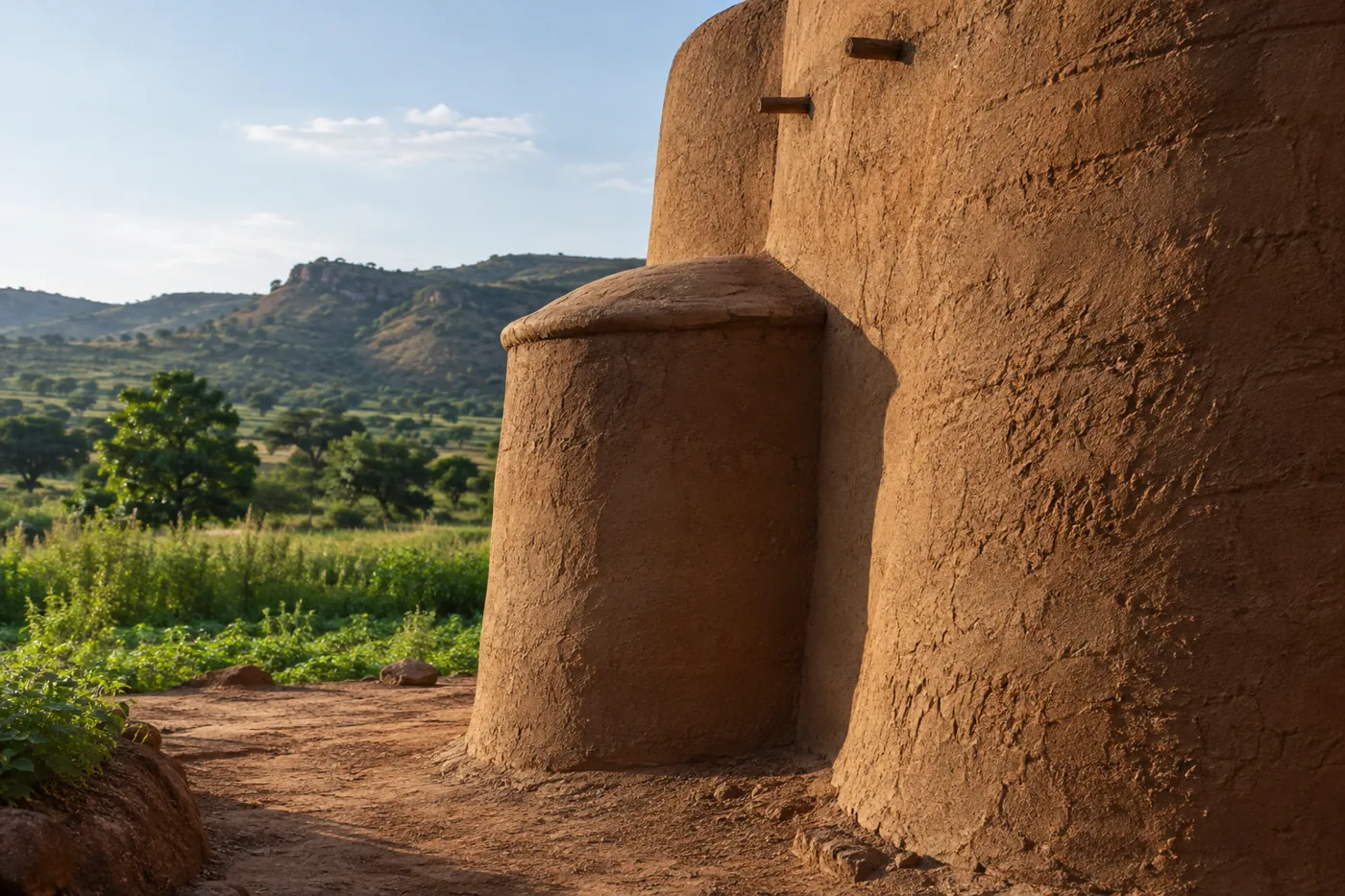
AI-generated earthen wall and rounded-volume study inspired by Koutammakou; not a verified takienta profile, household plan, ritual site or construction detail. Credit: AI-generated for Culture Ark using OpenAI image_gen, 2026-11-01. Rights: AI-generated output; no exclusive ownership or guaranteed copyrightability claimed. Changes: Resized within1400px and converted to WebP; no crop or substantive alteration.
The earth texture, projecting volume, wood elements and landscape are invented. They do not establish structural accuracy, an actual household, ceremonial function, age or customary permission.
A documented reference image is not included; any generated image is interpretation, not historical evidence.
History and context
Earthen tower-houses stand within villages, fields, wooded areas and places of ceremony. Known as takienta in the singular and sikien in the plural, these dwellings join practical organization with symbolic meaning. Their circular and elliptical forms belong to a wider landscape in which springs, sacred rocks and initiation places also matter. Selecting Koutammakou therefore means preserving relationships among building, cultivation and belief, rather than treating a striking house as a self-contained sculpture. It also requires recognition of the landscape’s continuity across today’s boundary between Togo and Benin. A future viewer should understand that the buildings remain part of community life and that renewal of earthen fabric can sustain, rather than negate, architectural knowledge.
What future readers can learn
Curatorial interpretation: A dwelling can organize technical needs, family life and symbolic relationships within a landscape that does not fit neatly inside modern borders.
Limits and cultural context
Do not assign one ancient construction date to all houses. Document only knowledge and spaces communities permit; heritage recognition does not transfer customary authority.
Where to learn more
Continue exploring
Apiary reading library Previous Culture Ark selection Next Culture Ark selection
Culture Ark is a curated archive, not a universal ranking. Interpretive images and source evidence serve different roles.
Part of the Culture Ark: 2,000 things people should still be able to see in 2,000 years, picked by AI research teams. Browse the gallery. The Culture Ark is an Artificial Mind Hive (AMH) project. AMH is owned by Austin Little.

Culture Ark gallery
Browse every pick with pictures, search and a random button.
Open the gallery →