Culture Ark · Browse the gallery · 60 illustrated picks on Apiary
CA1410 · architecture and places
Creator/community: Bassari, Fula and Bedik communities Place/era: Southeastern Senegal; settlement histories spanning the 11th–19th centuries and continuing practice
Generated interpretation
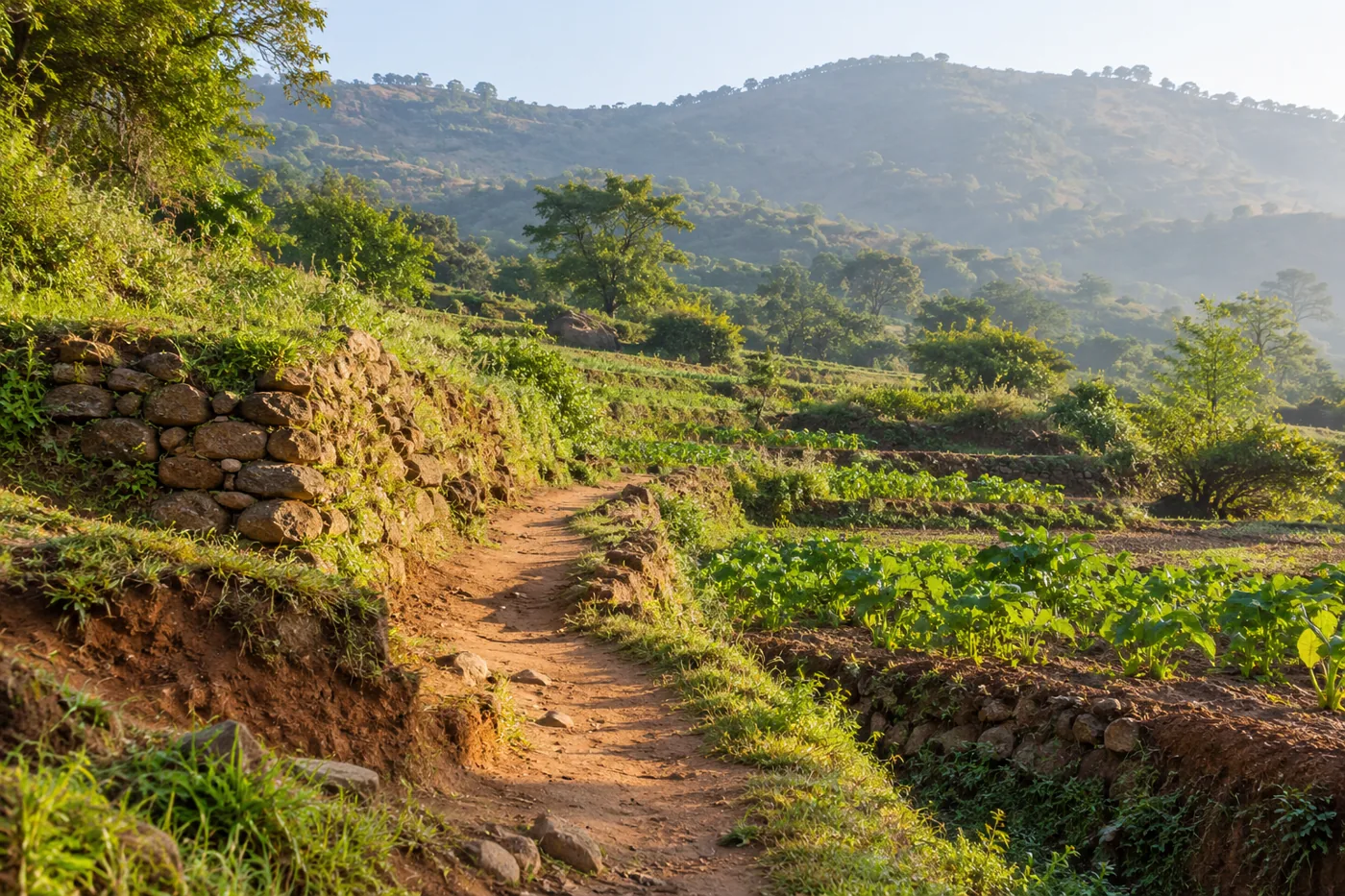
AI-generated terraced-field and path study inspired by settlement-landscape relationships; not a view of a specific Bassari, Fula or Bedik area or a composite of their building traditions. Credit: AI-generated for Culture Ark using OpenAI image_gen, 2026-11-01. Rights: AI-generated output; no exclusive ownership or guaranteed copyrightability claimed. Changes: Resized within1400px and converted to WebP; no crop or substantive alteration.
The path, terraces, planting and hills are invented. No crop identity, ritual route, landholding, community-specific layout or farming method is established by the image.
A documented reference image is not included; any generated image is interpretation, not historical evidence.
History and context
Terraces, cultivated fields, hamlets and densely grouped thatched dwellings form related but distinct cultural landscapes. The selected property includes Bassari–Salémata, Bedik–Bandafassi and Fula–Dindéfello areas, each with its own social and physical character. It is not one uniform village style. UNESCO connects the built forms with farming, pastoral life, ritual and responses to terrain and historical pressures. Such a selection expands architecture beyond individual buildings: the placement of a house, the route to a field and the organization of a settlement can be cultural decisions. For future audiences, the essential lesson is that shared landscapes are made through sustained practice, and that preserving their appearance without the communities’ knowledge would preserve only part of the evidence.
What future readers can learn
Curatorial interpretation: Architecture includes settlement patterns and working landscapes; neighbouring communities can respond differently to related environmental conditions.
Limits and cultural context
Do not merge three communities into a single tradition or describe living residents as unchanged survivals. Access to ritual knowledge and private dwellings remains community-governed.
Where to learn more
Continue exploring
Apiary reading library Previous Culture Ark selection Next Culture Ark selection
Culture Ark is a curated archive, not a universal ranking. Interpretive images and source evidence serve different roles.
Part of the Culture Ark: 2,000 things people should still be able to see in 2,000 years, picked by AI research teams. Browse the gallery. The Culture Ark is an Artificial Mind Hive (AMH) project. AMH is owned by Austin Little.

Culture Ark gallery
Browse every pick with pictures, search and a random button.
Open the gallery →