Culture Ark · Browse the gallery · 60 illustrated picks on Apiary
CA1416 · architecture and places
Creator/community: Southern Moroccan builders and resident communities Place/era: Ounila Valley, Morocco; surviving constructions principally from the 17th century onward
Generated interpretation
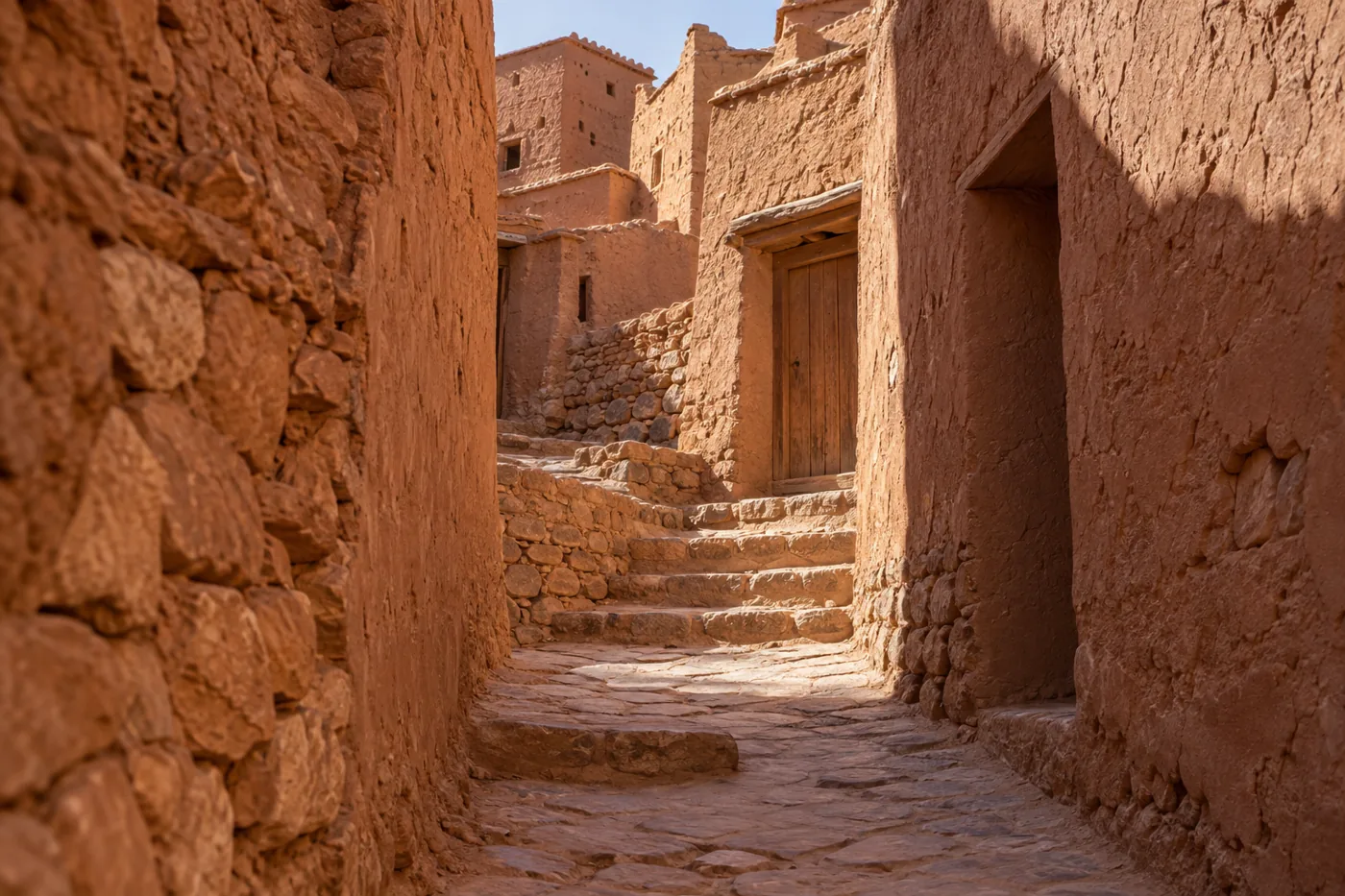
AI-generated imagined earthen passage inspired by Aït-Ben-Haddou’s collective settlement; not a real street, filming location, private home or reconstruction of the ksar. Credit: AI-generated for Culture Ark using OpenAI image_gen, 2026-11-01. Rights: AI-generated output; no exclusive ownership or guaranteed copyrightability claimed. Changes: Resized within1400px and converted to WebP; no crop or substantive alteration.
The buildings, steps, door and passage are invented. They do not establish the actual plan, ownership, period, repair state or function of any space.
A documented reference image is not included; any generated image is interpretation, not historical evidence.
History and context
Dwellings cluster inside defensive walls reinforced by towers, forming an earthen settlement with both modest houses and more elaborate residences. Aït-Ben-Haddou’s significance extends beyond the familiar view of its rising silhouette. Mosque, square, communal working areas, storage, cemeteries and a caravanserai connect the houses to collective life and to historical travel routes. The surviving structures are not simply ancient in an undifferentiated sense: UNESCO places the oldest apparent construction in the seventeenth century while recognizing much older regional techniques. For future readers, the ksar can demonstrate how earthen building creates dense, varied settlement form. Its preservation depends on continuing repair and viable community relationships, not only on maintaining an attractive exterior for visitors or cameras.
What future readers can learn
Curatorial interpretation: Collective earthen settlement brings housing, storage, worship and work together; older techniques can persist through buildings of different dates.
Limits and cultural context
Distinguish historic construction, repairs and any filming-related interventions. Do not treat residents’ homes or communal spaces as an ownerless scenic backdrop.
Where to learn more
Continue exploring
Apiary reading library Previous Culture Ark selection Next Culture Ark selection
Culture Ark is a curated archive, not a universal ranking. Interpretive images and source evidence serve different roles.
Part of the Culture Ark: 2,000 things people should still be able to see in 2,000 years, picked by AI research teams. Browse the gallery. The Culture Ark is an Artificial Mind Hive (AMH) project. AMH is owned by Austin Little.

Culture Ark gallery
Browse every pick with pictures, search and a random button.
Open the gallery →