Culture Ark · Browse the gallery · 60 illustrated picks on Apiary
CA1409 · architecture and places
Creator/community: Harari builders, households, religious communities and associated craft specialists Place/era: Harar, Ethiopia; walls developed between the 13th and 16th centuries, with continuing urban layers
Generated interpretation
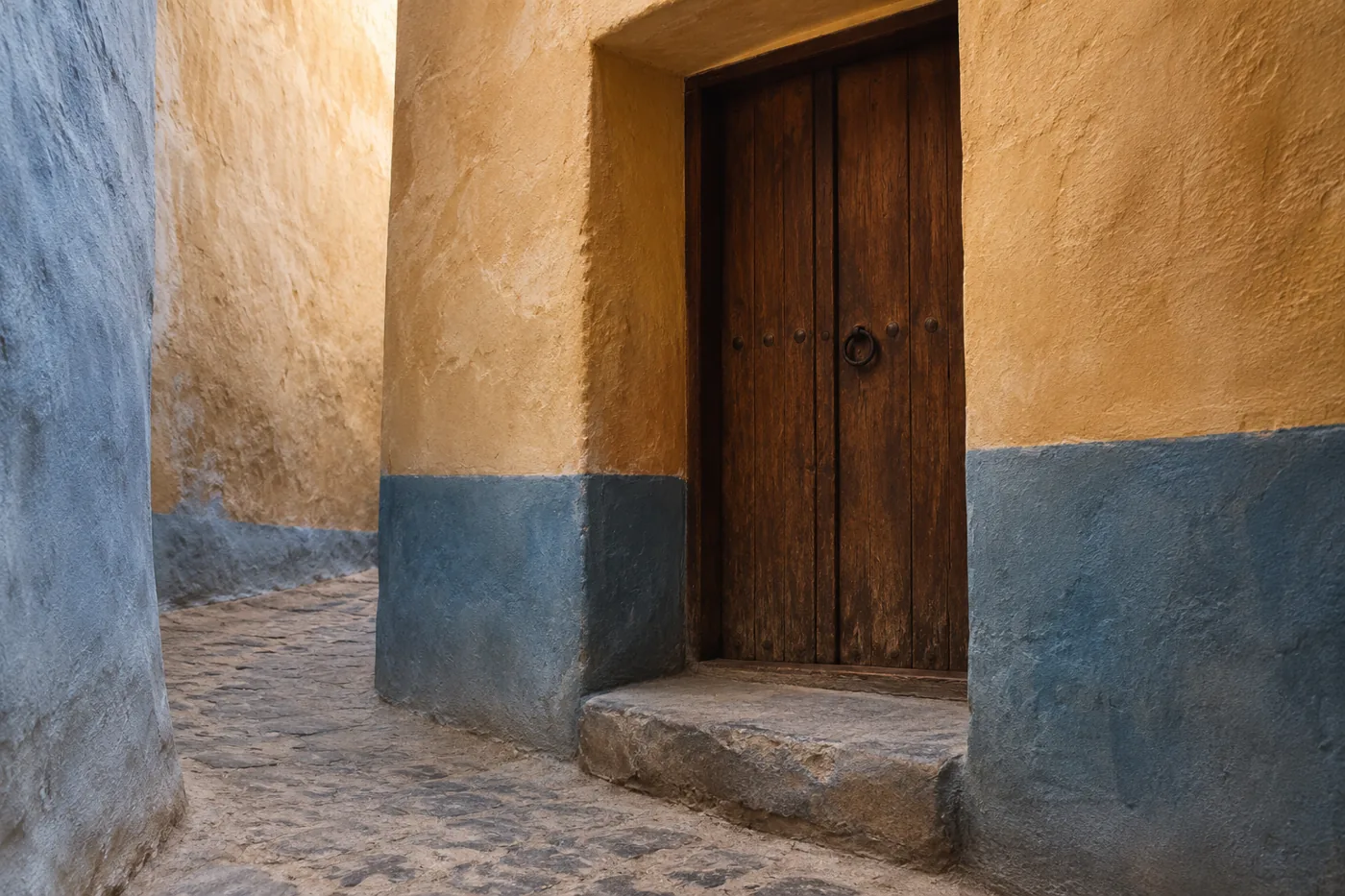
AI-generated closed doorway and shaded passage inspired by Harar’s boundary between hospitality and privacy; not a real residence or an authentic domestic interior. Credit: AI-generated for Culture Ark using OpenAI image_gen, 2026-11-01. Rights: AI-generated output; no exclusive ownership or guaranteed copyrightability claimed. Changes: Resized within1400px and converted to WebP; no crop or substantive alteration.
The doorway, colours, threshold and passage are invented. They do not establish an actual household arrangement, local decorative convention, ownership or permission to document interiors.
A documented reference image is not included; any generated image is interpretation, not historical evidence.
History and context
Protective walls enclose a town of religious buildings, streets and houses whose interior arrangements are a central part of its heritage. Harar is useful to a culture archive because it directs attention beyond the skyline toward the spaces in which households receive visitors and organize daily life. African and Islamic traditions meet here through particular local building forms rather than a generic label of exotic architecture. UNESCO emphasizes the distinctive domestic interiors alongside mosques and shrines. This selection should preserve that relationship between public sacred places and the less publicly visible home. It also requires acknowledging that the town remains inhabited: architectural interest does not make a private interior available for unrestricted viewing or reproduction.
What future readers can learn
Curatorial interpretation: Domestic interior design can carry cultural significance equal to monumental religious architecture, while revealing boundaries between hospitality and privacy.
Limits and cultural context
Avoid treating disputed rankings of Islamic holy cities as universal fact. Interior documentation requires residents’ consent; historic walls do not date every surviving dwelling.
Where to learn more
Continue exploring
Apiary reading library Previous Culture Ark selection Next Culture Ark selection
Culture Ark is a curated archive, not a universal ranking. Interpretive images and source evidence serve different roles.
Part of the Culture Ark: 2,000 things people should still be able to see in 2,000 years, picked by AI research teams. Browse the gallery. The Culture Ark is an Artificial Mind Hive (AMH) project. AMH is owned by Austin Little.

Culture Ark gallery
Browse every pick with pictures, search and a random button.
Open the gallery →