Culture Ark · Browse the gallery · 60 illustrated picks on Apiary
CA1407 · architecture and places
Creator/community: Swahili builders, merchants and religious communities Place/era: Coastal Tanzania; Kilwa occupied 9th–19th centuries, with major prosperity in the 13th–16th centuries
Generated interpretation
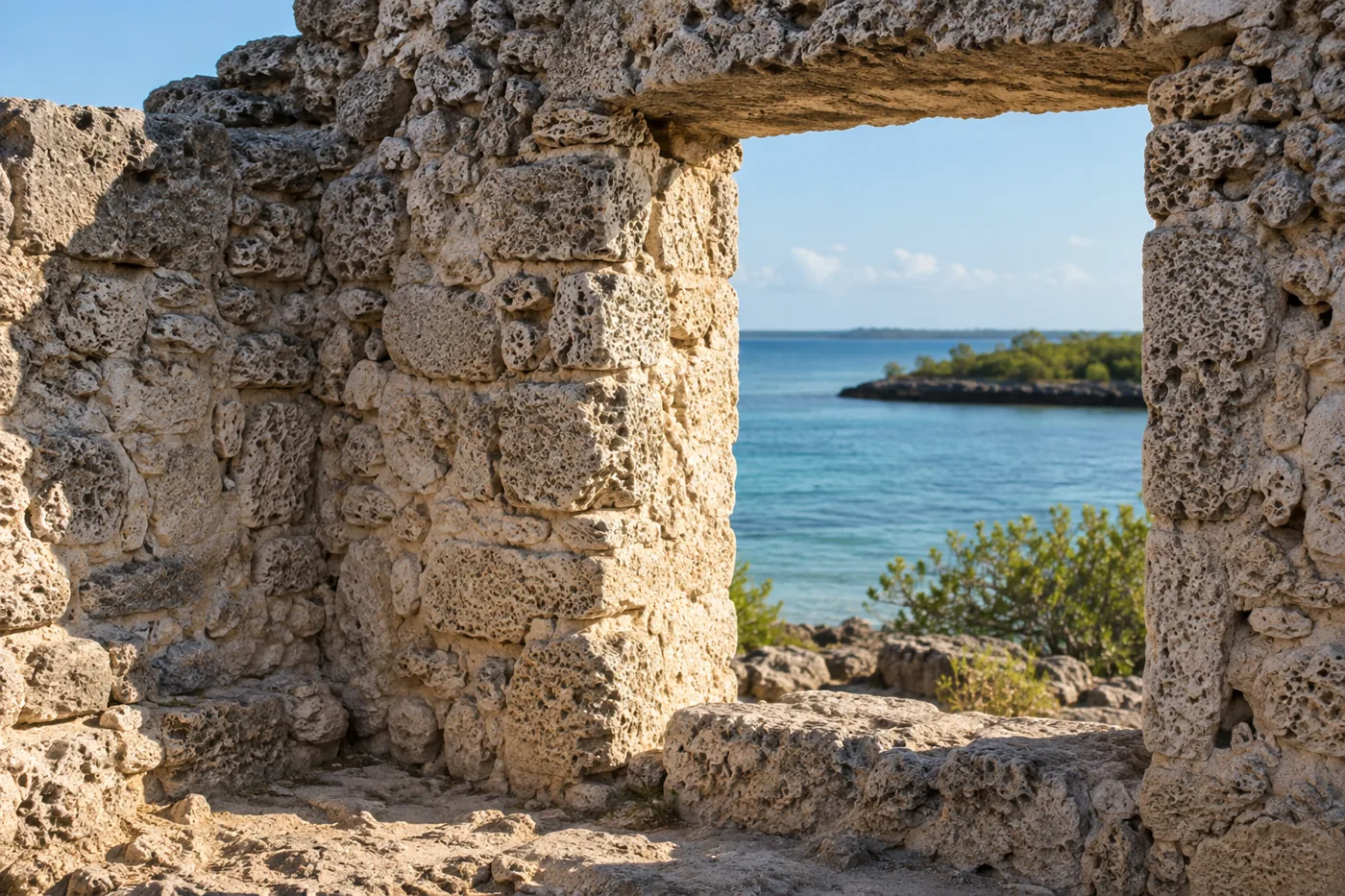
AI-generated porous stone wall and coastal opening inspired by the paired island settlements; not an identified mosque, palace, wall or composite island view. Credit: AI-generated for Culture Ark using OpenAI image_gen, 2026-11-01. Rights: AI-generated output; no exclusive ownership or guaranteed copyrightability claimed. Changes: Resized within1400px and converted to WebP; no crop or substantive alteration.
The masonry, opening and shoreline are invented. They do not establish a named structure, original function, repair state, stone source or exact construction method.
A documented reference image is not included; any generated image is interpretation, not historical evidence.
History and context
Two island settlements preserve traces of mosques, substantial residences and the spaces of maritime commerce. Kilwa Kisiwani and Songo Mnara belong to the history of Swahili urban life and extensive Indian Ocean connections, including exchanges with Arabia, India and China. Coral-stone and wooden construction linked local resources with ambitions that reached beyond the coastline. The pairing matters: this selection is an interconnected archaeological ensemble, not a claim that both islands developed identically or that every surviving building has the same date. It can help future readers imagine ports as homes, religious communities and political centres as well as trading points. Their ruined condition should not be mistaken for evidence that the cultures associated with them disappeared.
What future readers can learn
Curatorial interpretation: Ports are inhabited cultural environments, and archaeological architecture can connect local building practice with long-distance economic relationships.
Limits and cultural context
Treat the two settlements and their building phases distinctly. Date condition photographs; coastal exposure and conservation alter what later viewers see.
Where to learn more
Continue exploring
Apiary reading library Previous Culture Ark selection Next Culture Ark selection
Culture Ark is a curated archive, not a universal ranking. Interpretive images and source evidence serve different roles.
Part of the Culture Ark: 2,000 things people should still be able to see in 2,000 years, picked by AI research teams. Browse the gallery. The Culture Ark is an Artificial Mind Hive (AMH) project. AMH is owned by Austin Little.

Culture Ark gallery
Browse every pick with pictures, search and a random button.
Open the gallery →