Culture Ark · Browse the gallery · 60 illustrated picks on Apiary
CA1406 · architecture and places
Creator/community: Swahili residents and builders with African, Arab, Indian and European trading communities Place/era: Unguja, Tanzania; historic urban layers, with many major buildings from the 18th–19th centuries
Generated interpretation
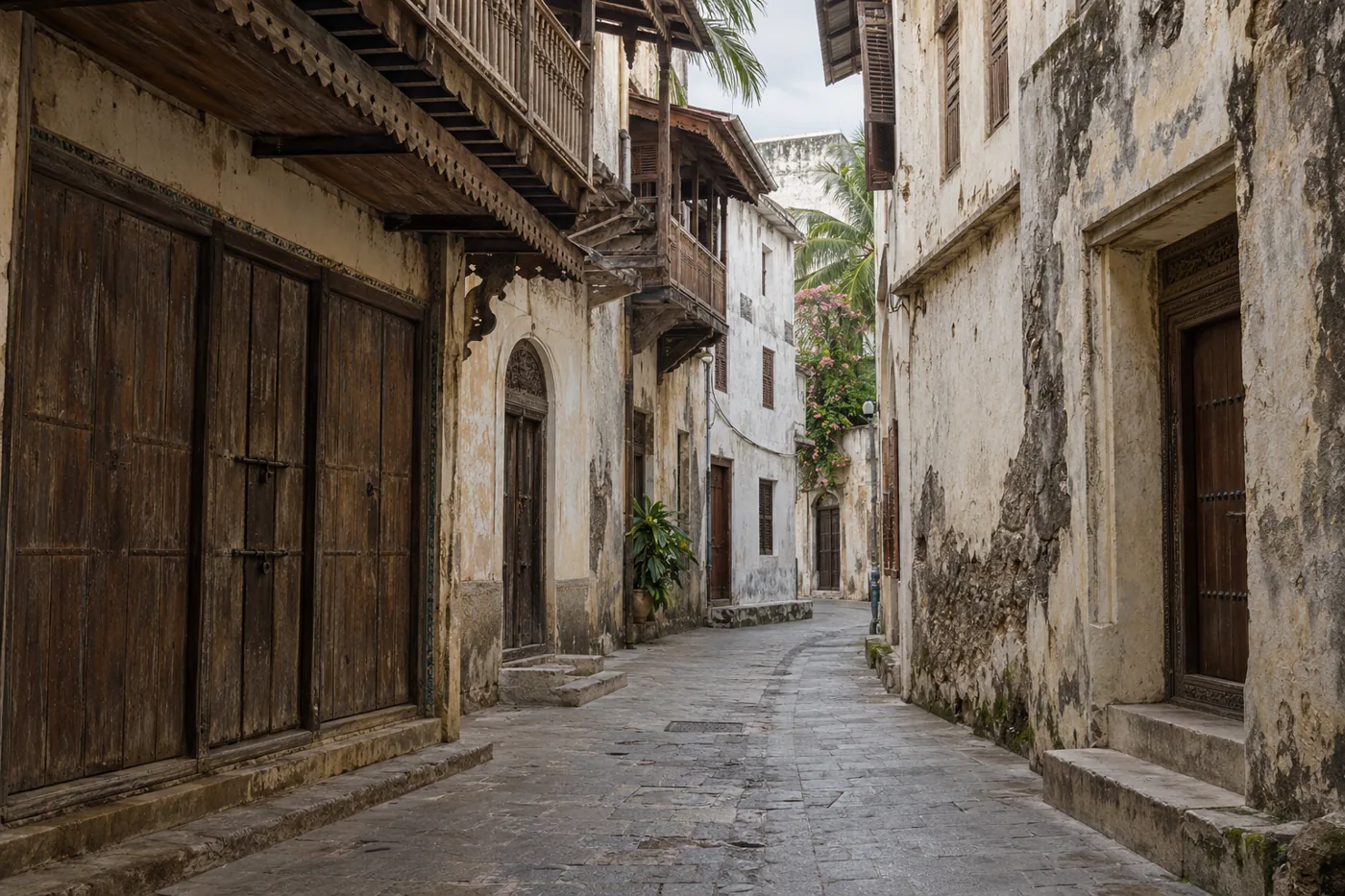
AI-generated imagined lane, shopfront and timber verandas inspired by Stone Town; not a documented street, private business or historical reconstruction. Credit: AI-generated for Culture Ark using OpenAI image_gen, 2026-11-01. Rights: AI-generated output; no exclusive ownership or guaranteed copyrightability claimed. Changes: Resized within1400px and converted to WebP; no crop or substantive alteration.
All buildings, surfaces, shops and routes are invented. The scene cannot identify actual owners, condition, trade activity or events associated with enslavement and resistance.
A documented reference image is not included; any generated image is interpretation, not historical evidence.
History and context
Winding streets, shops, courtyard houses and waterfront buildings form a dense urban environment shaped by trade. Coral ragstone, lime-based construction and mangrove timber helped create a town in which carved doors and verandas distinguish individual buildings without separating them from the surrounding streets. Stone Town also records unequal power: its commercial history includes enslavement and the institutions and memorials associated with opposition to that trade. The archive should preserve this difficult history beside the pleasure of architectural detail. Selecting an urban ensemble rather than one palace makes shops, ordinary dwellings and shared routes visible, while acknowledging that its present residents inhabit a changing place rather than a completed historical tableau.
What future readers can learn
Curatorial interpretation: An attractive trading-town streetscape can hold histories of cultural exchange, coercion and resistance that must be interpreted together.
Limits and cultural context
Do not romanticize maritime commerce or omit slavery. This record covers the historic town, not every settlement on Zanzibar; photographs require their own dates and permissions.
Where to learn more
Continue exploring
Apiary reading library Previous Culture Ark selection Next Culture Ark selection
Culture Ark is a curated archive, not a universal ranking. Interpretive images and source evidence serve different roles.
Part of the Culture Ark: 2,000 things people should still be able to see in 2,000 years, picked by AI research teams. Browse the gallery. The Culture Ark is an Artificial Mind Hive (AMH) project. AMH is owned by Austin Little.

Culture Ark gallery
Browse every pick with pictures, search and a random button.
Open the gallery →