Culture Ark · Browse the gallery · 60 illustrated picks on Apiary
CA1405 · architecture and places
Creator/community: Swahili builders, households, merchants and religious communities Place/era: Lamu Island, Kenya; continuously inhabited for more than seven centuries, with successive building phases
Generated interpretation
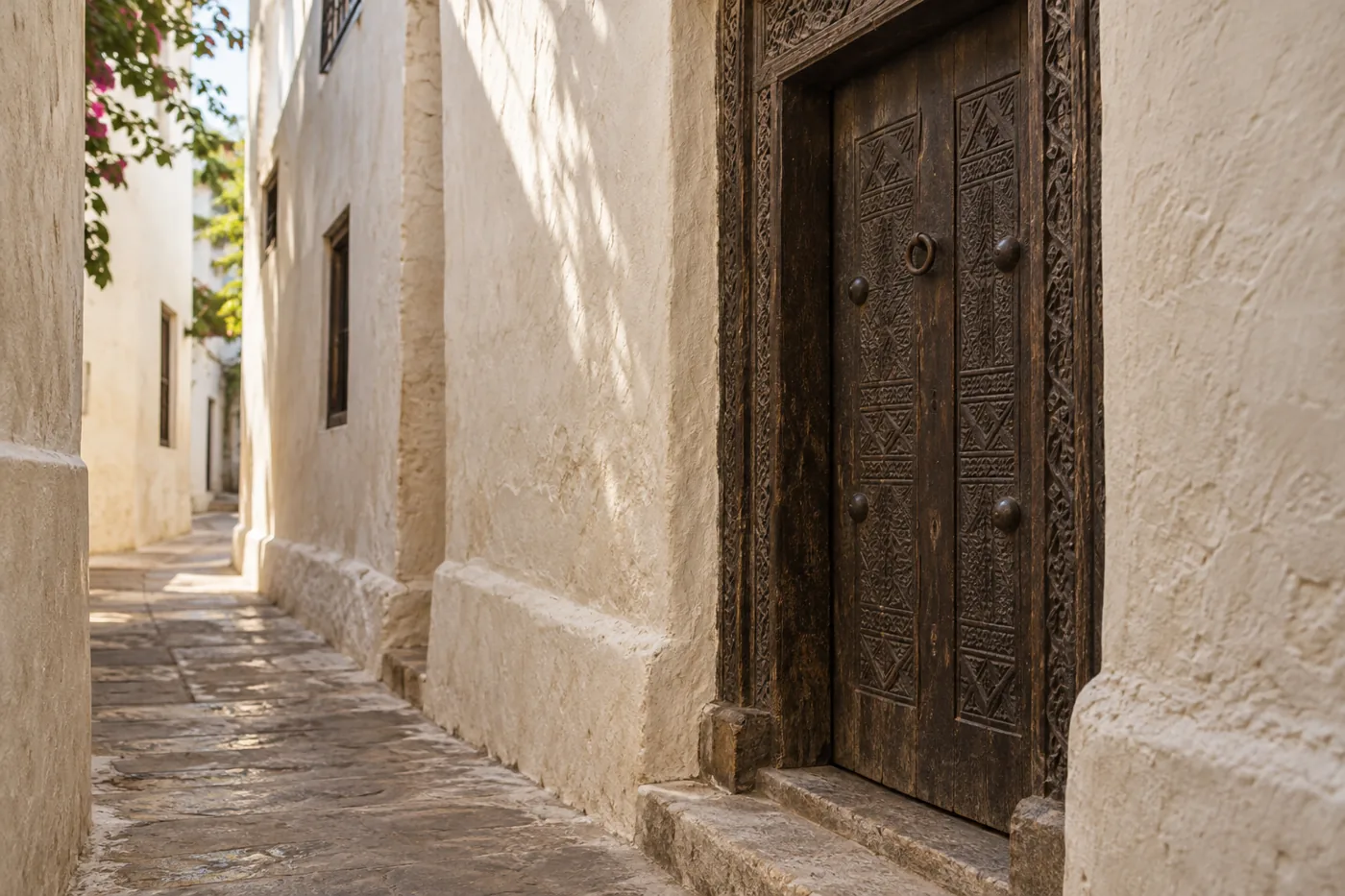
AI-generated closed timber doorway and lane inspired by Lamu’s thresholds; not an actual household entrance, authentic carving pattern or documentary street view. Credit: AI-generated for Culture Ark using OpenAI image_gen, 2026-11-01. Rights: AI-generated output; no exclusive ownership or guaranteed copyrightability claimed. Changes: Resized within1400px and converted to WebP; no crop or substantive alteration.
The door, carving, walls and lane are invented. They are not evidence of a particular household, historic date, local craft pattern, ownership or resident consent.
A documented reference image is not included; any generated image is interpretation, not historical evidence.
History and context
Narrow streets connect coral-stone houses, inner courtyards, verandas and carved wooden entrances. Lamu’s architecture makes privacy and encounter part of the same urban fabric: a restrained exterior can open toward a carefully organized domestic interior, while seafront buildings address maritime movement. The town’s continuing residential, religious and educational functions distinguish it from an archaeological ruin. Its forms developed through Swahili knowledge and exchanges around the Indian Ocean, not through a single imported style. Preserving Lamu as culture therefore means attending to the people using its rooms and streets, as well as to construction techniques. A future archive should resist turning a living town into a timeless visual setting emptied of maintenance, trade and household needs.
What future readers can learn
Curatorial interpretation: A town’s cultural value includes ongoing habitation and the negotiation between domestic privacy, public exchange and religious learning.
Limits and cultural context
Date individual buildings separately; a long settlement history does not date every house. Residents’ privacy and local access rules remain relevant to documentation.
Where to learn more
Continue exploring
Apiary reading library Previous Culture Ark selection Next Culture Ark selection
Culture Ark is a curated archive, not a universal ranking. Interpretive images and source evidence serve different roles.
Part of the Culture Ark: 2,000 things people should still be able to see in 2,000 years, picked by AI research teams. Browse the gallery. The Culture Ark is an Artificial Mind Hive (AMH) project. AMH is owned by Austin Little.

Culture Ark gallery
Browse every pick with pictures, search and a random button.
Open the gallery →