Culture Ark · Browse the gallery · 60 illustrated picks on Apiary
CA1403 · architecture and places
Creator/community: Baganda royal builders, custodians and craft specialists; Buganda Kingdom Place/era: Kampala, Uganda; palace built 1882, burial use from 1884; reconstruction completed 2023
Generated interpretation
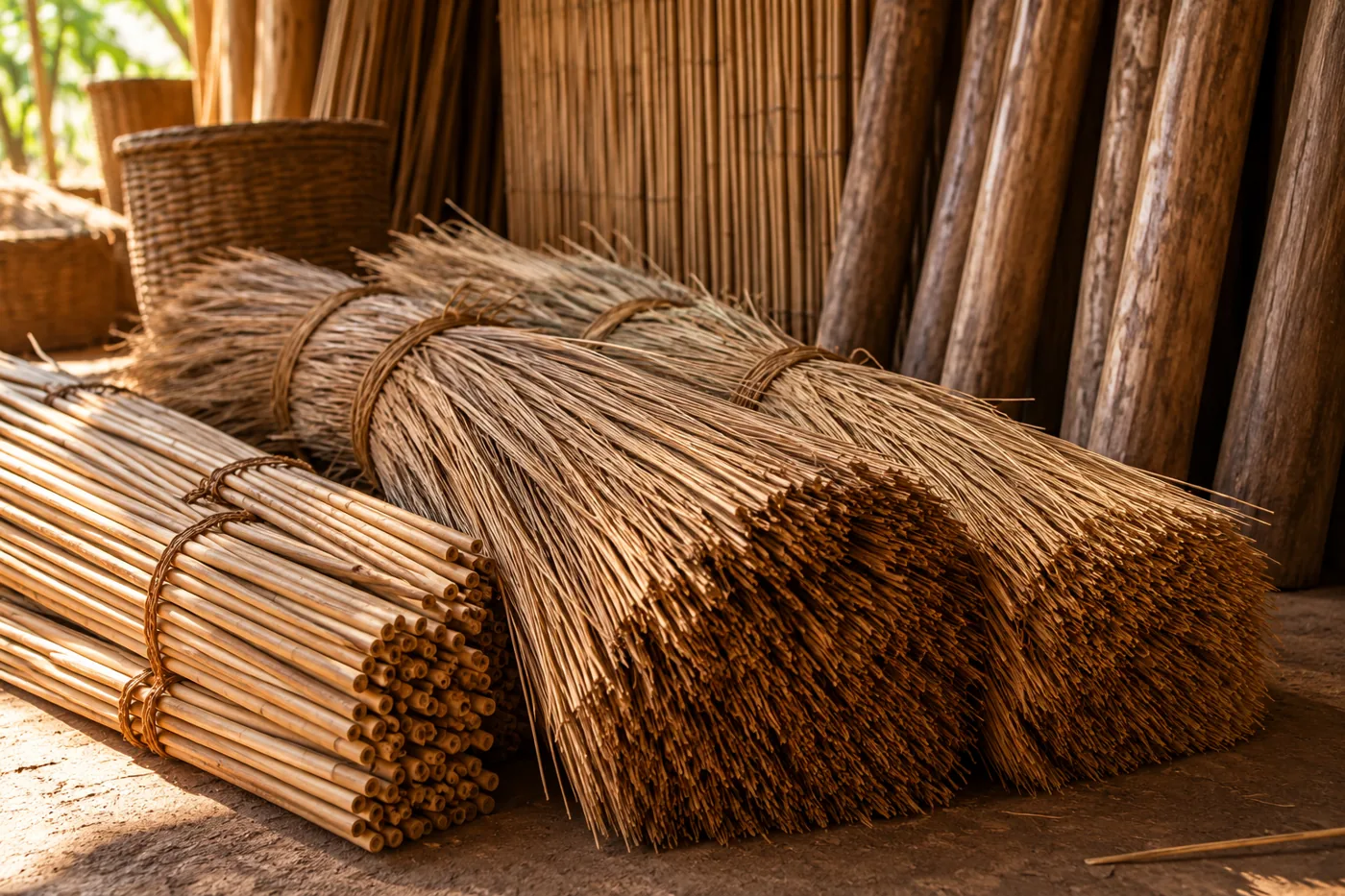
AI-generated still life of imagined reeds, thatch and wood, inspired by Kasubi’s craft and renewal; not materials from the tombs, an authentic workshop or a roof-construction diagram. Credit: AI-generated for Culture Ark using OpenAI image_gen, 2026-11-01. Rights: AI-generated output; no exclusive ownership or guaranteed copyrightability claimed. Changes: Resized within1400px and converted to WebP; no crop or substantive alteration.
The bundles, wood, workspace and plant appearance are invented. They do not identify actual species, craft procedures, structural assemblies or heritage fragments from Kasubi.
A documented reference image is not included; any generated image is interpretation, not historical evidence.
History and context
A sequence of boundary trees, gatehouse and courtyard leads toward a large thatched royal tomb building. At Kasubi, architecture organizes an encounter with Buganda kingship and ancestral presence rather than simply sheltering historical remains. Wooden poles, reeds, wattle and grass support a monumental form grounded in specialist craft knowledge. The former palace became a burial place in the nineteenth century, while its wider cultural significance continues through custodianship and ritual. A destructive fire in 2010 and the reconstruction completed in 2023 make this a record of renewal as well as survival. An archive should distinguish photographs of different building states and preserve the knowledge and community relationships that allowed rebuilding, not merely its outward silhouette.
What future readers can learn
Curatorial interpretation: Architectural continuity can depend on living craft transmission and custodianship even when much physical material must be renewed.
Limits and cultural context
This remains a royal and spiritual place under Buganda custodianship. Observe access restrictions; do not label reconstructed fabric as untouched nineteenth-century material.
Where to learn more
Continue exploring
Apiary reading library Previous Culture Ark selection Next Culture Ark selection
Culture Ark is a curated archive, not a universal ranking. Interpretive images and source evidence serve different roles.
Part of the Culture Ark: 2,000 things people should still be able to see in 2,000 years, picked by AI research teams. Browse the gallery. The Culture Ark is an Artificial Mind Hive (AMH) project. AMH is owned by Austin Little.

Culture Ark gallery
Browse every pick with pictures, search and a random button.
Open the gallery →