Culture Ark · Browse the gallery · 60 illustrated picks on Apiary
CA0226 · architecture and places
Creator/community: Japanese Buddhist communities and craftspeople drawing on continental architectural traditions Place/era: Nara Prefecture, Japan; surviving buildings include late seventh–early eighth-century examples
Generated interpretation
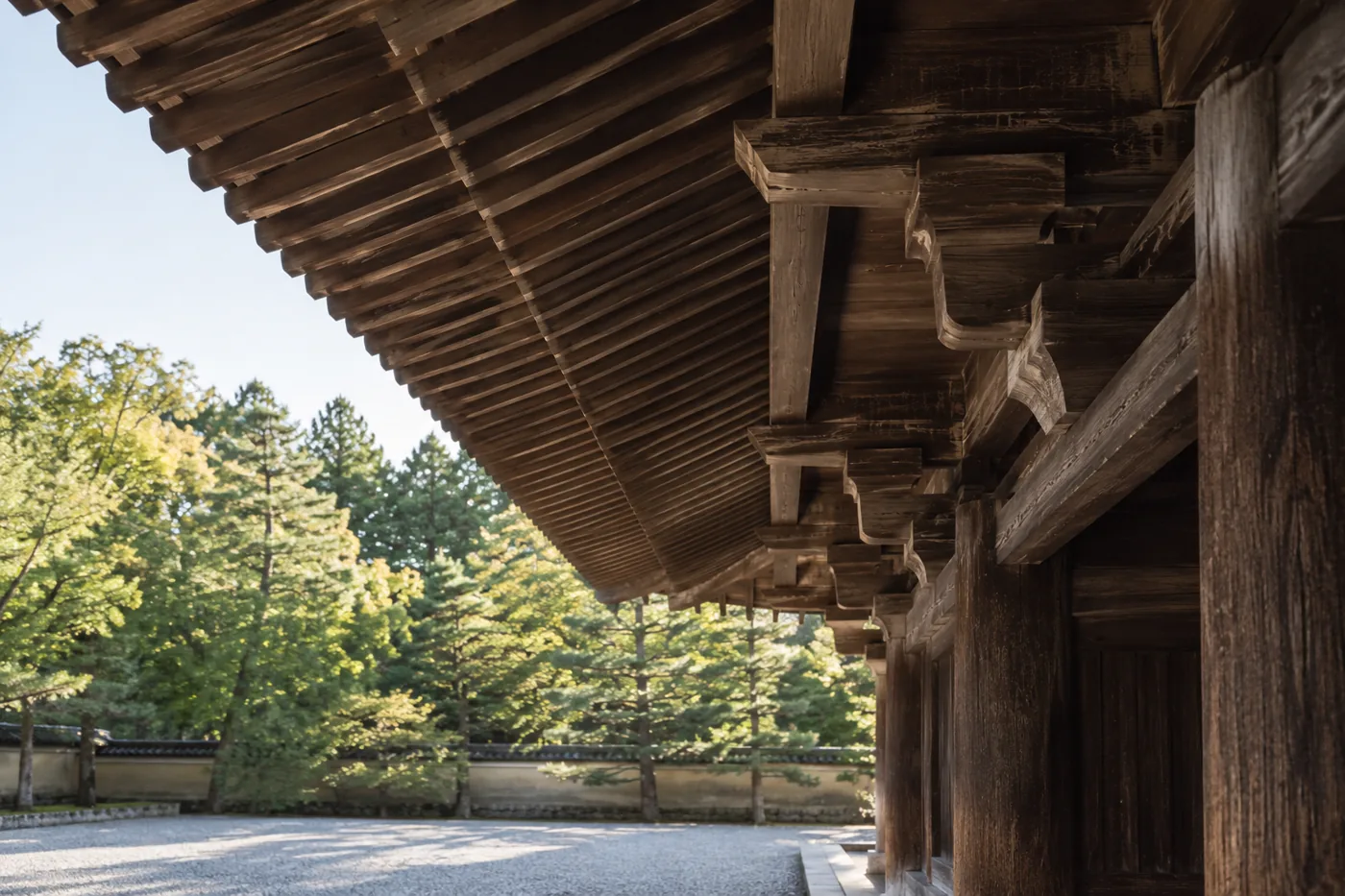
AI-generated timber-eave study inspired by the Horyu-ji entry; not an actual temple detail, original ancient timber or a measured joinery drawing. Credit: AI-generated for Culture Ark using OpenAI image_gen, 2026-11-01. Rights: AI-generated output; no exclusive ownership or guaranteed copyrightability claimed. Changes: Resized within1400px and converted to WebP; no crop or substantive alteration.
All beam arrangements, joints, surface wear and courtyard details are invented. Do not use the image as repair guidance, structural evidence or a claim about surviving original fabric.
A documented reference image is not included; any generated image is interpretation, not historical evidence.
History and context
The Horyu-ji area preserves a group of Buddhist monuments that includes very early surviving wooden buildings. UNESCO connects their importance to the adaptation of Chinese Buddhist architectural forms in Japan and to cultural transmission through the Korean peninsula. This is a useful correction to the idea that a national tradition must be culturally isolated to be distinctive. Wood is equally important to the selection: the endurance of a building depends on care, repair and craft knowledge as well as its original material. Future readers should examine a specific structure and its repair history rather than assuming that every piece of timber is the same age as the monument’s founding.
What future readers can learn
How religious and architectural forms travel and become locally distinctive.
Limits and cultural context
A monument’s early date does not mean every surviving component is original. Avoid attributing every building in the area to one construction phase.
Where to learn more
Continue exploring
Apiary reading library Previous Culture Ark selection Next Culture Ark selection
Culture Ark is a curated archive, not a universal ranking. Interpretive images and source evidence serve different roles.
Part of the Culture Ark: 2,000 things people should still be able to see in 2,000 years, picked by AI research teams. Browse the gallery. The Culture Ark is an Artificial Mind Hive (AMH) project. AMH is owned by Austin Little.

Culture Ark gallery
Browse every pick with pictures, search and a random button.
Open the gallery →