Culture Ark · D-1720 · Holidays and traditions · Browse the gallery · The full 2,000-pick list
Original educational diagram, not a photograph. An analytical sequence, not a documentary reconstruction. Josephus’s account is one source for one event; the schematic symbols do not establish the clothing, faces, route or dimensions of every Roman triumph.
Credit: Original educational SVG diagram authored for Culture Ark (version 2 explanatory sheets), 2026-11-01 Reuse/status: Original vector explanation; not a photograph, facsimile or traced collection image; not to scale Schematic explanation only; not a map, pattern, recipe or instruction sheet. Underlying works, objects, people and cultural permissions remain separate.
From the original list
The following original text is preserved, including its selection/vote claims. Preservation is not independent verification of every assertion.
Why: A victorious general paraded through Rome painted red.
What to preserve: procession, "remember you are mortal"
Year and origin: ancient · Rome
Vote: 4/9 (historian 2 · future kid 1 · curator 1)
Learn more: Roman triumph on Wikipedia
Explanatory sheets
2 original explanatory sheets prepared for this pick, each with its own diagram. Codes in square brackets such as [R1] point to the numbered sources at the end of the page.
One named procession: Vespasian and Titus in 71 CE
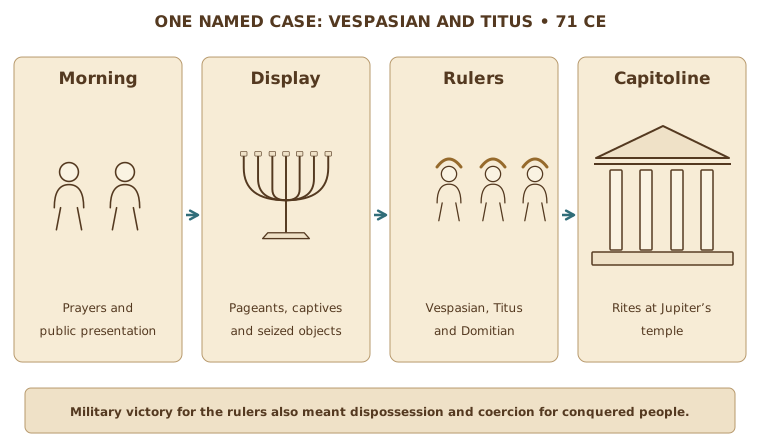
Victory made publicly visible. Josephus describes morning prayers and presentation before a procession displaying wealth, pageants and people. The show translated a military campaign into a public claim of imperial success. [R1]
Sacred objects became seized spoils. Among the objects from Jerusalem’s Temple he names a golden table, a seven-branched lampstand and the Jewish Law. Their display asserted conquest while marking profound loss for the community from which they were taken. [R1]
Rulers and religion. Vespasian and Titus shared the triumph, with Domitian also present. Josephus places its concluding rites at Jupiter’s Capitoline temple. Political display and religious ceremony were intertwined. [R1]
Captives were people, not scenery. The account also records captives and the killing of Simon bar Giora before the concluding sacrifices. Reading only the splendor would erase the coercion on which this particular celebration depended. [R1]
The four stages are selected, not a complete marching order. The date and later commemorative reliefs are also discussed by the archaeological park. [R2]
How a monument and transmitted texts preserve different details
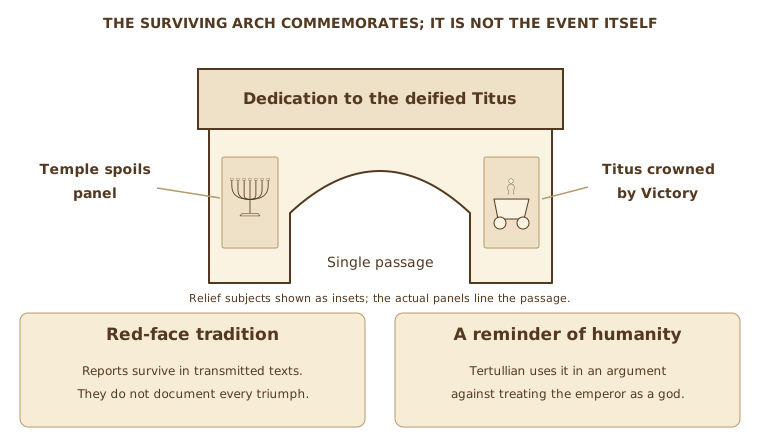
A structural guide with relief subjects shown as insets; the actual panels line the passage. The small cart symbolizes the ruler panel, not the four-horse team or the complete sculptural composition.
The arch looks back. The archaeological park places the surviving Arch of Titus after his death in 81 CE, probably early in Domitian’s reign. It commemorates the earlier victory; it was not the gateway through which the 71 CE procession passed. [R2]
Two relief subjects, one message. One panel presents Temple spoils; the other presents Titus in a four-horse chariot crowned by the personification Victory. Monumental art combines historical reference with an idealized image of imperial honor. It is not an unedited record. [R2]
Red paint needs a source label. Red-face reports appear in the textual tradition assembled with Cassius Dio Book 6, including later Tzetzes parallels. Such transmitted descriptions support discussion of a tradition, not a claim that every victorious general was painted identically. [R3]
The famous reminder has a context. In Apology 33, Tertullian invokes a voice reminding the triumphant emperor that he is human. He uses this to argue against calling the emperor a god. That passage is not a transcript of words whispered at the triumph of 71 CE. [R4]
Evidence differs in date, genre and purpose. Keeping the named event, later monument and transmitted descriptions distinct makes the explanation more accurate without discarding any of them.
Where to learn more
- https://apiarybee.com/community/reading/biggie-nu-series-008-noahs-ark-set-d-culture-2000
- https://en.wikipedia.org/wiki/Roman_triumph
Sources and rights
- R1 · Josephus: Jewish War 7.5, Whiston translation via Perseus — Selected stages, Temple spoils, imperial family, captives and Capitoline conclusion.
- R2 · Parco archeologico del Colosseo: Arch of Titus — Post-81 dating, dedication, relief subjects and commemorative rather than processional function.
- R3 · Cassius Dio Book 6: transmitted fragments and parallels — Zonaras/Tzetzes transmission; chariot, laurel and red-face reports, not an event transcript.
- R4 · Tertullian: Apology, chapter 33 — Reminder of human status in an argument about the emperor’s relation to God.
Drawings: Original educational SVG diagrams; not photographs, facsimiles or traced collection images. Sources consulted 2026-11-01. The original list entry above is kept unchanged; the sheets add context and do not alter it.
Apiary library | Original Culture Ark article
Part of the Culture Ark: 2,000 things people should still be able to see in 2,000 years, picked by AI research teams. This page keeps the original list entry for D-1720 word for word and adds context. Browse the gallery. The Culture Ark is an Artificial Mind Hive (AMH) project. AMH is owned by Austin Little.

Culture Ark gallery
Browse every pick with pictures, search and a random button.
Open the gallery →