Culture Ark · D-1719 · Holidays and traditions · Browse the gallery · The full 2,000-pick list
Original educational diagram, not a photograph. The star and float are invented, not Macy’s licensed characters or real engineering designs. No ropes, anchoring, inflation, route management or balloon-handling procedure is supplied.
Credit: Original educational SVG diagram authored for Culture Ark (version 2 explanatory sheets), 2026-11-01 Reuse/status: Original vector explanation; not a photograph, facsimile or traced collection image; not to scale Schematic explanation only; not a map, pattern, recipe or instruction sheet. Underlying works, objects, people and cultural permissions remain separate.
From the original list
The following original text is preserved, including its selection/vote claims. Preservation is not independent verification of every assertion.
Why: Giant cartoon balloons float down Manhattan.
What to preserve: balloon history, Snoopy
Year and origin: 1924 · United States
Vote: 4/9 (historian 1 · future kid 2 · curator 1)
Learn more: Macy's Thanksgiving Day Parade on Wikipedia
Explanatory sheets
1 original explanatory sheet prepared for this pick, each with its own diagram. Codes in square brackets such as [M1] point to the numbered sources at the end of the page.
What floats, what rolls and what marches
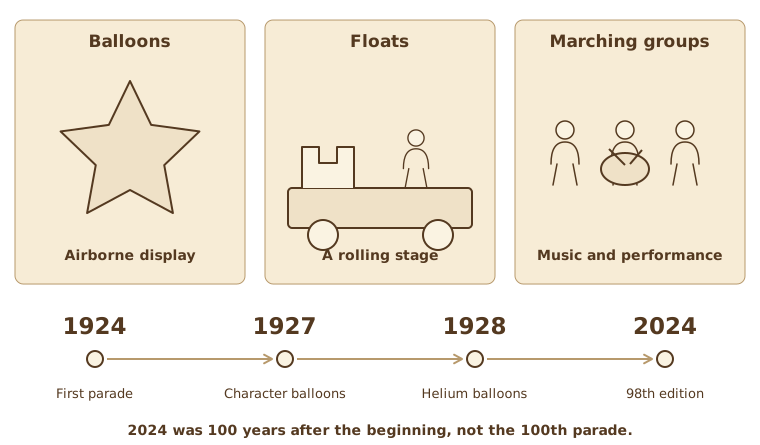
A department-store procession. The first parade was held in 1924. It developed into a Thanksgiving spectacle combining giant balloons, rolling floats, marching bands and other performers, with Santa Claus as a recurring part of the holiday presentation. [M1]
Balloons have their own timeline. Macy’s identifies Felix the Cat as the first character balloon in 1927. Those early inflatables were carried on sticks; helium-filled balloons followed in 1928. The familiar floating form was therefore a development, not a feature of the first parade. [M2]
Different elements do different work. A balloon is an airborne figure; a float is a moving platform or stage. Marching bands and performance groups add live music and movement. These are distinct contributions even when television brings them into one continuous show. [M1]
An anniversary is not an edition. The 2024 announcement called that year’s event the 98th parade, although 100 years had passed since 1924. Macy’s records cancellations in 1942, 1943 and 1944 during World War II. Counting years and counting parades gives different totals. [M1]
Historical overview only. This is neither a live event schedule nor permission to operate a balloon or parade vehicle; those tasks belong to the organizer’s trained teams.
Where to learn more
- https://apiarybee.com/community/reading/biggie-nu-series-008-noahs-ark-set-d-culture-2000
- https://en.wikipedia.org/wiki/Macy's_Thanksgiving_Day_Parade
Sources and rights
- M1 · Macy’s: 2024 parade announcement — 1924 beginning; 1942–44 cancellations; 2024’s 98th edition and program elements.
- M2 · Macy’s: 100-day countdown announcement, 2026 — 1927 character balloon debut; helium in 1928. Historical facts, not a live schedule.
Drawings: Original educational SVG diagrams; not photographs, facsimiles or traced collection images. Sources consulted 2026-11-01. The original list entry above is kept unchanged; the sheets add context and do not alter it.
Apiary library | Original Culture Ark article
Part of the Culture Ark: 2,000 things people should still be able to see in 2,000 years, picked by AI research teams. This page keeps the original list entry for D-1719 word for word and adds context. Browse the gallery. The Culture Ark is an Artificial Mind Hive (AMH) project. AMH is owned by Austin Little.

Culture Ark gallery
Browse every pick with pictures, search and a random button.
Open the gallery →