Culture Ark · D-1619 · Holidays and traditions · Browse the gallery · The full 2,000-pick list
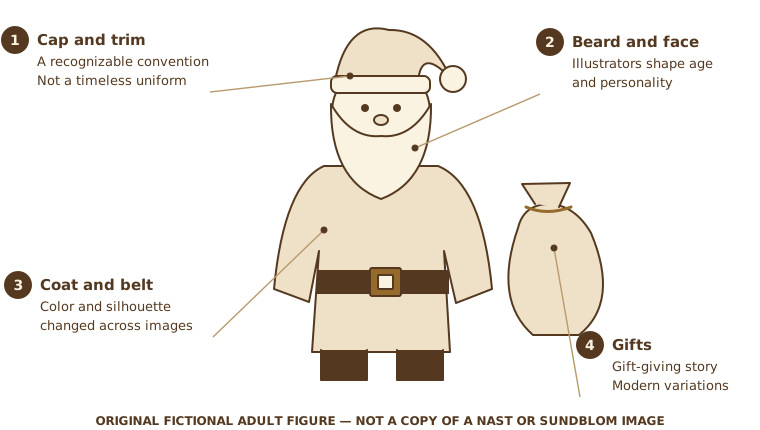
Original educational diagram, not a photograph. This newly drawn adult fictional figure is not traced from a company advertisement, historical print or documentary portrait.
Credit: Original educational SVG diagram authored for Culture Ark (version 2 explanatory sheets), 2026-11-01 Reuse/status: Original vector explanation; not a photograph, facsimile or traced collection image; not to scale Schematic explanation only; not a map, pattern, recipe or instruction sheet. Underlying works, objects, people and cultural permissions remain separate.
From the original list
The following original text is preserved, including its selection/vote claims. Preservation is not independent verification of every assertion.
Why: A jolly gift-giver who supposedly visits every child in one night.
What to preserve: Coca-Cola-era image, NORAD tracker, letters to Santa
Year and origin: 19th century · United States
Vote: 9/9 (historian 3 · future kid 3 · curator 3)
Learn more: Santa Claus on Wikipedia
Explanatory sheets
2 original explanatory sheets prepared for this pick, each with its own diagram. Codes in square brackets such as [S1] point to the numbered sources at the end of the page.
A familiar figure assembled by media
Recognizable traits grew through many retellings
No single inventor. American writers and illustrators reworked earlier Saint Nicholas traditions. The Library of Congress links the name to Dutch Sinter Klaas and describes a changing figure: the small, fur-clad visitor in an 1823 poem is not identical to the grandfatherly Santa familiar from later pictures. Thomas Nast’s 1881 print became an especially influential image. [S1]
Red did not begin with Coca-Cola. Coca-Cola’s own history says Santa wore red before Haddon Sundblom’s campaign. His advertising images began in 1931 and helped circulate a particular warm, human-looking version. Advertising shaped the figure but did not create every part of the tradition. [S2]
Source note: The original nineteenth-century United States label is retained. It does not erase older and non-American gift-giver traditions.
From a printed image to participation
Print advertising and a seasonal participation tradition
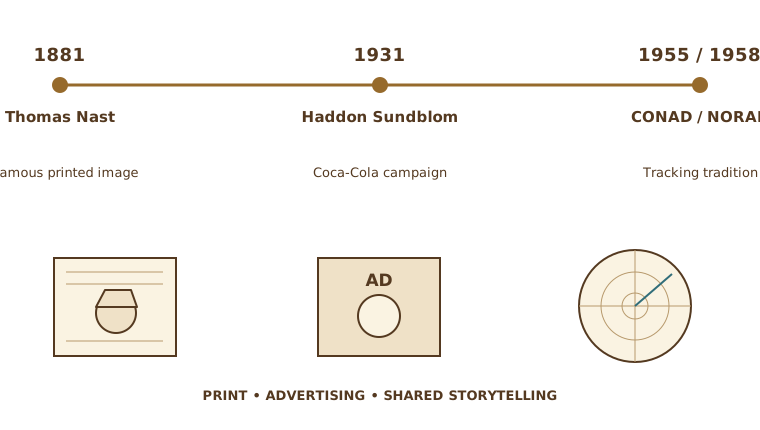
Chronology is not to time scale. Symbols distinguish media forms; the tracker represents a holiday storytelling activity.
Stories kept changing. The 1823 poem A Visit from St. Nicholas appeared anonymously; Clement Clarke Moore later claimed authorship, which remains disputed. It helped circulate the visiting gift-giver. Later writers still reinvented him: L. Frank Baum’s 1902 story supplied a different mythical origin and home. Santa’s history is a family of retellings, not one fixed biography. [S1]
The tracking tradition. NORAD’s official history traces the custom to a child’s 1955 call to CONAD while trying to reach Santa. Colonel Harry Shoup answered in the spirit of the story. NORAD continued the tradition from 1958. Reports on Christmas Eve turn a familiar character into a shared activity for families, rather than merely an image to look at. [S3]
Privacy view: If saving letters to Santa, obtain consent and remove home addresses, contact details and other private information from public copies.
Where to learn more
- https://apiarybee.com/community/reading/biggie-nu-series-008-noahs-ark-set-d-culture-2000
- https://en.wikipedia.org/wiki/Santa_Claus
Sources and rights
- S1 · Library of Congress A visit from Santa — Changing literary and visual figure; 1881 Nast depiction.
- S2 · Coca-Cola Haddon Sundblom and the Santas — 1931 campaign; red coat predates the company’s imagery.
- S3 · NORAD Tracks Santa official history — 1955 CONAD tradition and 1958 NORAD succession.
Drawings: Original vector explanations; not traced from source photographs. Sources consulted 2026-11-01. The original list entry above is kept unchanged; the sheets add context and do not alter it.
Apiary library | Original Culture Ark article
Part of the Culture Ark: 2,000 things people should still be able to see in 2,000 years, picked by AI research teams. This page keeps the original list entry for D-1619 word for word and adds context. Browse the gallery. The Culture Ark is an Artificial Mind Hive (AMH) project. AMH is owned by Austin Little.

Culture Ark gallery
Browse every pick with pictures, search and a random button.
Open the gallery →