Culture Ark · D-1616 · Holidays and traditions · Browse the gallery · The full 2,000-pick list
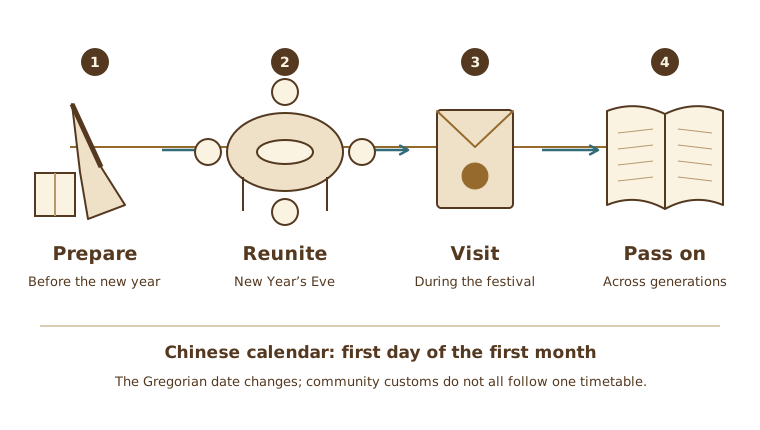
Original educational diagram, not a photograph. A schematic cycle based on UNESCO’s description of Spring Festival. It is not a universal daily ritual schedule.
Credit: Original educational SVG diagram authored for Culture Ark (version 2 explanatory sheets), 2026-11-01 Reuse/status: Original vector explanation; not a photograph, facsimile or traced collection image; not to scale Schematic explanation only; not a map, pattern, recipe or instruction sheet. Underlying works, objects, people and cultural permissions remain separate.
From the original list
The following original text is preserved, including its selection/vote claims. Preservation is not independent verification of every assertion.
Why: The largest annual human migration on Earth happens so families can eat one dinner together.
What to preserve: reunion dinner menus, red envelopes, Chunyun travel numbers by year (billions of trips), CCTV Gala clips
Year and origin: ancient · China
Vote: 9/9 (historian 3 · future kid 3 · curator 3)
Learn more: Chinese New Year on Wikipedia
Explanatory sheets
2 original explanatory sheets prepared for this pick, each with its own diagram. Codes in square brackets such as [N1] point to the numbered sources at the end of the page.
Crossing into a new year
Preparation reunion and continuity
More than one dinner. UNESCO describes preparations before the festival, a family meal and late-night welcome on New Year’s Eve, followed by greetings and community festivities. Knowledge passes through families, communities, education and apprenticeships. The tradition was inscribed on UNESCO’s Representative List in 2024. [N1]
Keep the calendar explicit. The festival begins on the first day of the first month of the Chinese calendar. Preserve the local calendar date as well as its Gregorian equivalent. “Chinese New Year” names this selection; it should not erase distinct Korean, Vietnamese or other new-year traditions. [N1]
Data caveat: The original Chunyun description is preserved. Trips are not unique people; any travel statistic needs a year, reporting window, mode and source.
A reunion table can speak
Food shape language and memory
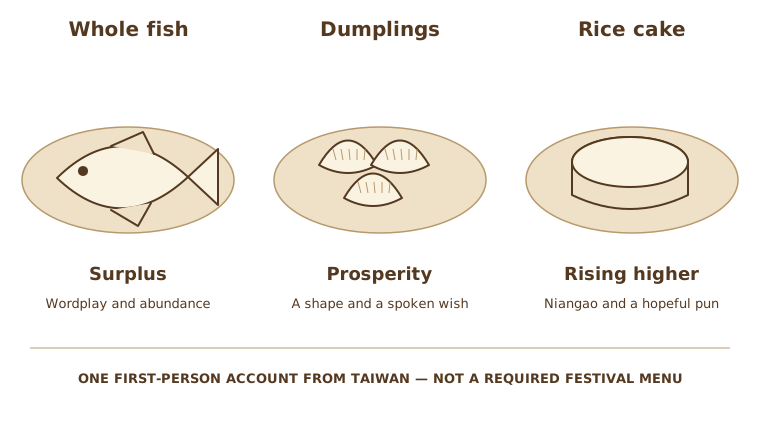
These are explanatory drawings, not copied dishes or recipes. Meanings below belong to a documented account and wider wordplay traditions.
A named witness. In a Smithsonian account, curator Jan Stuart recalls celebrating with a friend’s family in Taiwan. Fish carried a wish for surplus; ingot-shaped dumplings and the name niangao conveyed hopes for prosperity and rising achievement. The testimony links food, language and family memory. [N2]
What a menu cannot capture. Record the local spoken name, language, recipe version and the family’s explanation with consent. A translated dish name may lose its pun. Do not replace a household’s account with a single national list of “correct” foods, or assume every family eats these three dishes.
Media care: Keep broadcast titles, dates and authorized source links. No CCTV footage, lyrics or video frames are reproduced in this package.
Where to learn more
- https://apiarybee.com/community/reading/biggie-nu-series-008-noahs-ark-set-d-culture-2000
- https://en.wikipedia.org/wiki/Chinese_New_Year
Sources and rights
- N1 · UNESCO Spring festival social practices — Chinese calendar, reunion, preparations, visits, transmission, 2024 inscription.
- N2 · Smithsonian Memories of a Lunar New Year Past — Curator Jan Stuart’s first-person Taiwan account of reunion foods, wordplay and decorations.
Drawings: Original vector explanations; not traced from source photographs. Sources consulted 2026-11-01. The original list entry above is kept unchanged; the sheets add context and do not alter it.
Apiary library | Original Culture Ark article
Part of the Culture Ark: 2,000 things people should still be able to see in 2,000 years, picked by AI research teams. This page keeps the original list entry for D-1616 word for word and adds context. Browse the gallery. The Culture Ark is an Artificial Mind Hive (AMH) project. AMH is owned by Austin Little.

Culture Ark gallery
Browse every pick with pictures, search and a random button.
Open the gallery →