Culture Ark · D-1620 · Holidays and traditions · Browse the gallery · The full 2,000-pick list
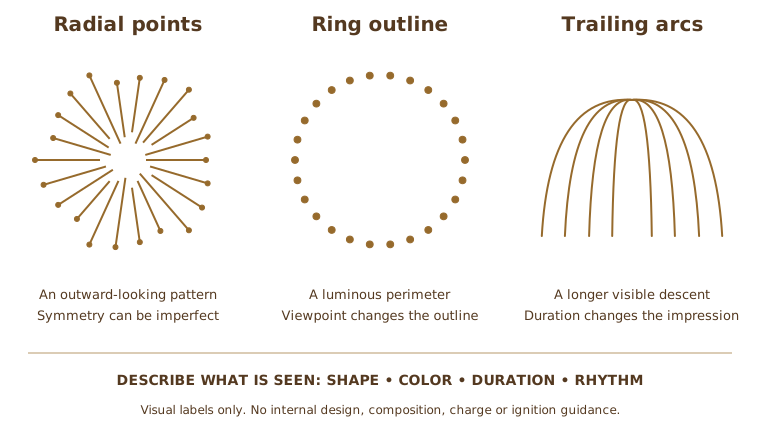
Original educational diagram, not a photograph. Original appearance diagrams, not firework device designs. Labels describe visible effects rather than standardized product categories.
Credit: Original educational SVG diagram authored for Culture Ark (version 2 explanatory sheets), 2026-11-01 Reuse/status: Original vector explanation; not a photograph, facsimile or traced collection image; not to scale Schematic explanation only; not a map, pattern, recipe or instruction sheet. Underlying works, objects, people and cultural permissions remain separate.
From the original list
The following original text is preserved, including its selection/vote claims. Preservation is not independent verification of every assertion.
Why: Gunpowder turned into art for every celebration.
What to preserve: firework types, record displays
Year and origin: 7th century · China
Vote: 9/9 (historian 3 · future kid 3 · curator 3)
Learn more: Fireworks on Wikipedia
Explanatory sheets
2 original explanatory sheets prepared for this pick, each with its own diagram. Codes in square brackets such as [F1] point to the numbered sources at the end of the page.
Reading light in the sky
Appearance and pacing without pyrotechnic construction
A long changing history. Smithsonian’s educational history places early fireworks development in China and traces later court spectacles and increasingly colored displays in the nineteenth century. The original “seventh century” label is preserved as archival wording, not presented here as a settled invention date. [F1]
Why light has different colors. The American Chemical Society distinguishes two broad processes. Incandescence is the glow of hot material. Luminescence involves excited particles releasing energy as light; the emitted wavelengths help determine the color we see. Shape and duration add another layer: a brief outline and a lingering trail can produce very different impressions. [F3]
Safe scope: Visual and historical explanation only. No construction, formulations, charges, fuses or assembly guidance.
From the public viewing area
Light sound and professional display boundaries
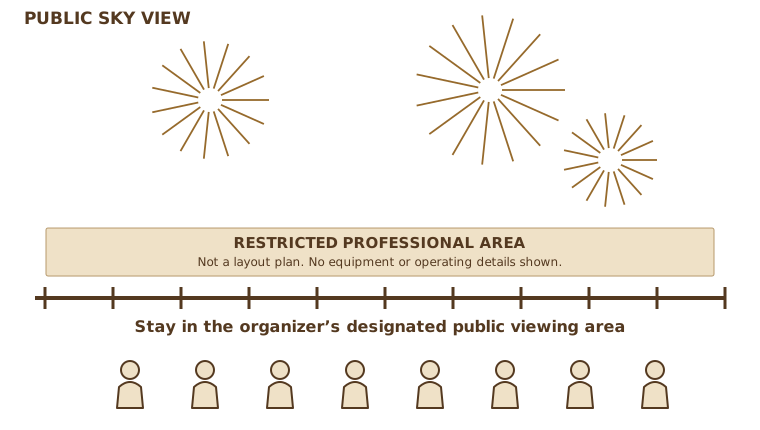
The spatial separation is conceptual and not to scale. This is not a display-site design, exclusion-zone calculation or operating plan.
Choose professional public displays. The U.S. Consumer Product Safety Commission advises leaving fireworks to professionals and attending public displays. Fireworks can cause serious injuries, and sparklers are not harmless toys. This guide does not tell readers how to handle, light or construct any device. [F2]
Why the flash comes first. Light travels much faster than sound. From a distance, the flash reaches an observer before the pressure wave is heard as a boom. That delay is a feature of transmission, not necessarily a badly timed show. A video’s viewpoint and sound recording therefore affect how the performance is experienced. [F3]
Stopping rule: If a display is canceled or an area is closed, respect that decision. Seek the organizer’s information rather than approaching equipment or debris.
Where to learn more
- https://apiarybee.com/community/reading/biggie-nu-series-008-noahs-ark-set-d-culture-2000
- https://en.wikipedia.org/wiki/Fireworks
Sources and rights
- F1 · Smithsonian The evolution of fireworks — Broad Chinese origins; historic spectacle; nineteenth-century colored displays. No construction details reused.
- F2 · CPSC Fireworks safety guidance — Professional public displays preferred; fireworks hazards.
- F3 · American Chemical Society Light and sound in fireworks — Only high-level light emission and light-versus-sound travel explanation used; no formulations, devices or experiments reproduced.
Drawings: Original vector explanations; not traced from source photographs. Sources consulted 2026-11-01. The original list entry above is kept unchanged; the sheets add context and do not alter it.
Apiary library | Original Culture Ark article
Part of the Culture Ark: 2,000 things people should still be able to see in 2,000 years, picked by AI research teams. This page keeps the original list entry for D-1620 word for word and adds context. Browse the gallery. The Culture Ark is an Artificial Mind Hive (AMH) project. AMH is owned by Austin Little.

Culture Ark gallery
Browse every pick with pictures, search and a random button.
Open the gallery →