Culture Ark · D-1618 · Holidays and traditions · Browse the gallery · The full 2,000-pick list
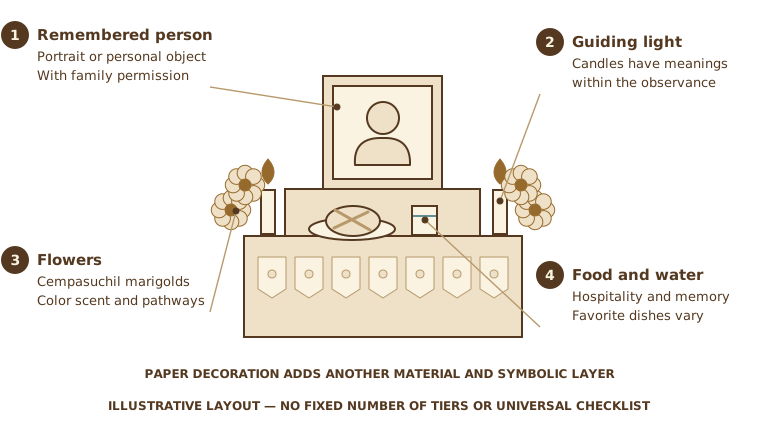
Original educational diagram, not a photograph. An original explanatory ofrenda. The portrait is a generic silhouette, not a real deceased person; this is not a prescribed ritual layout.
Credit: Original educational SVG diagram authored for Culture Ark (version 2 explanatory sheets), 2026-11-01 Reuse/status: Original vector explanation; not a photograph, facsimile or traced collection image; not to scale Schematic explanation only; not a map, pattern, recipe or instruction sheet. Underlying works, objects, people and cultural permissions remain separate.
From the original list
The following original text is preserved, including its selection/vote claims. Preservation is not independent verification of every assertion.
Why: Families picnic with their dead and build altars full of marigolds and sugar skulls.
What to preserve: ofrenda layouts, calaveras, pan de muerto, cempasuchil flowers
Year and origin: pre-Columbian · Mexico
Vote: 9/9 (historian 3 · future kid 3 · curator 3)
Learn more: Day of the Dead on Wikipedia
Explanatory sheets
2 original explanatory sheets prepared for this pick, each with its own diagram. Codes in square brackets such as [O1] point to the numbered sources at the end of the page.
An ofrenda holds relationships
Objects connect a remembered person with family and community
Objects and their meanings. Mexico’s INAH describes regional variation alongside common elements: portraits, candles, food, water, marigolds and paper decoration. Personal belongings may recall the person being honored. The meaning of an object belongs with the family’s account, not just its appearance. [O2]
Hospitality for remembered people. Favorite dishes and possessions make an ofrenda personal. INAH describes food and water as hospitality for returning souls, candles as guidance, and marigolds as markers of a pathway. Papel picado is associated with wind. These are meanings within the observance, not claims about physical events. [O2]
Care note: Document with permission. An intimate household altar or grave is not automatically a public photographic subject.
A path between places and histories
A wider view beyond the tabletop
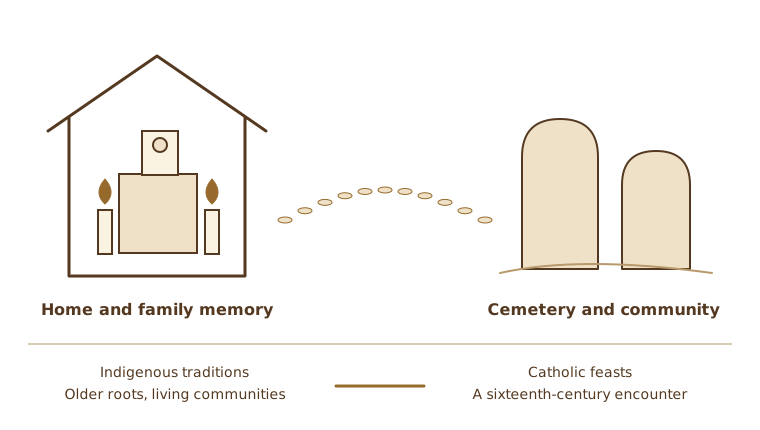
The petal line is symbolic, not a map or a required route. The two settings illustrate relationships described by UNESCO.
Place and season. UNESCO locates the festivities around late October and early November and relates them to the completion of the maize-growing cycle. Its account describes flowers, candles and offerings connecting home shrines and graves. The broader observance cannot be captured by one staged altar photograph. [O1]
A layered history. The source label “pre-Columbian” is preserved verbatim. UNESCO describes a meeting of pre-Hispanic religious rites and Catholic feasts introduced in the sixteenth century. Today’s practices are not an unchanged survival from one date; identify the particular community and period being documented. [O1]
Living tradition: The home, the cemetery, food preparation and shared stories are connected parts of remembrance, not interchangeable decorations.
Where to learn more
- https://apiarybee.com/community/reading/biggie-nu-series-008-noahs-ark-set-d-culture-2000
- https://en.wikipedia.org/wiki/Day_of_the_Dead
Sources and rights
- O1 · UNESCO Indigenous festivity dedicated to the dead — Mexican Indigenous communities, offerings, seasonal timing and layered histories.
- O2 · INAH Ofrendas para los muertos — 2024 institutional account of common altar elements and regional variation.
Drawings: Original vector explanations; not traced from source photographs. Sources consulted 2026-11-01. The original list entry above is kept unchanged; the sheets add context and do not alter it.
Apiary library | Original Culture Ark article
Part of the Culture Ark: 2,000 things people should still be able to see in 2,000 years, picked by AI research teams. This page keeps the original list entry for D-1618 word for word and adds context. Browse the gallery. The Culture Ark is an Artificial Mind Hive (AMH) project. AMH is owned by Austin Little.

Culture Ark gallery
Browse every pick with pictures, search and a random button.
Open the gallery →