Culture Ark · D-1617 · Holidays and traditions · Browse the gallery · The full 2,000-pick list
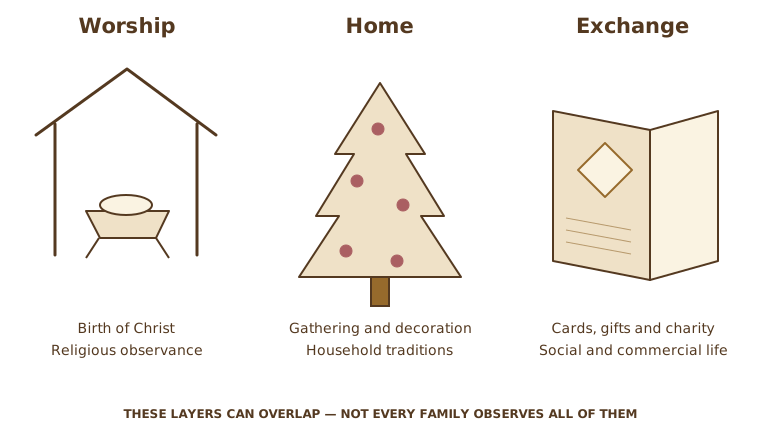
Original educational diagram, not a photograph. Original symbolic drawings. The nativity setting and tree are schematic, not copies of a particular community’s display.
Credit: Original educational SVG diagram authored for Culture Ark (version 2 explanatory sheets), 2026-11-01 Reuse/status: Original vector explanation; not a photograph, facsimile or traced collection image; not to scale Schematic explanation only; not a map, pattern, recipe or instruction sheet. Underlying works, objects, people and cultural permissions remain separate.
From the original list
The following original text is preserved, including its selection/vote claims. Preservation is not independent verification of every assertion.
Why: A birth story became a global season of lights, gifts and shopping.
What to preserve: nativity scenes, carols, retail sales totals by decade, Santa imagery evolution
Year and origin: 336 · Roman Empire
Vote: 9/9 (historian 3 · future kid 3 · curator 3)
Learn more: Christmas on Wikipedia
Explanatory sheets
2 original explanatory sheets prepared for this pick, each with its own diagram. Codes in square brackets such as [C1] point to the numbered sources at the end of the page.
A season with several histories
Religious observance household practice and public exchange
The meaning of 336. The Library of Congress notes that the Christian church in Rome observed the Nativity on December 25 by 336. That is evidence of observance, not proof that Christmas was invented in one moment or that Jesus’s birth date is historically known. The original Ark date is retained unchanged. [C1]
One name many practices. Christmas combines religious observance with varied domestic and secular traditions. Keep a nativity scene’s community and maker, a carol’s specific text and musical version, and a household’s own account. A retail sales series tells a different story and needs geography, currency and measurement method. [C1]
Variant caveat: Observance, dates and customs differ by church, region and family. These icons are examples, not a universal checklist.
How print carried a tradition
Dates distinguish observance from later popular forms
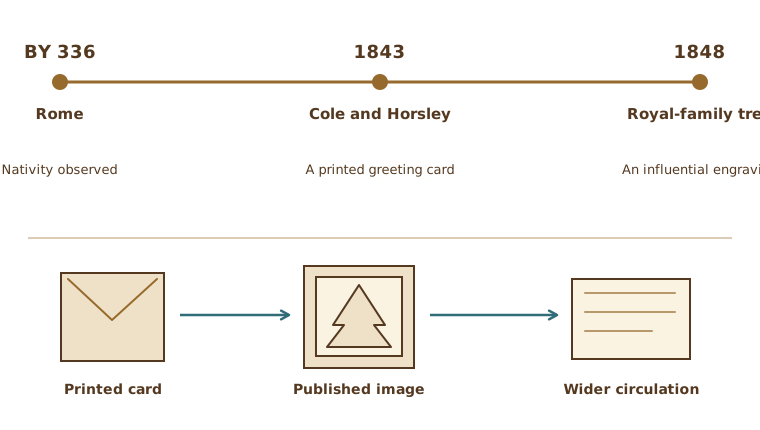
Chronology is not to time scale. The lower row explains circulation, not a claim that one card caused one engraving.
A card is an artifact. Henry Cole commissioned John Callcott Horsley’s Christmas card in 1843. The V&A’s account connects the design with changing postal and publishing practices. Preserve sender, recipient, date, printer and handwritten additions: the same printed design can become many different personal records. [C2]
An image can spread a custom. The V&A describes the 1848 engraving of the royal family around a tree as helping popularize a German tradition in Britain and beyond. The print did not invent decorated trees. Keep the image’s publication history separate from the older practices it depicts. [C3]
Rights note: No historical card, engraving or carol is reproduced. The drawings are new; the linked institutions supply the documentary examples.
Where to learn more
- https://apiarybee.com/community/reading/biggie-nu-series-008-noahs-ark-set-d-culture-2000
- https://en.wikipedia.org/wiki/Christmas
Sources and rights
- C1 · Library of Congress Today in History December 25 — Rome observation by 336; Christian and secular traditions.
- C2 · V&A The first Christmas card — Cole, Horsley and 1843 card production.
- C3 · V&A The magic of the tree — 1848 royal-family engraving and dissemination of German tree traditions.
Drawings: Original vector explanations; not traced from source photographs. Sources consulted 2026-11-01. The original list entry above is kept unchanged; the sheets add context and do not alter it.
Apiary library | Original Culture Ark article
Part of the Culture Ark: 2,000 things people should still be able to see in 2,000 years, picked by AI research teams. This page keeps the original list entry for D-1617 word for word and adds context. Browse the gallery. The Culture Ark is an Artificial Mind Hive (AMH) project. AMH is owned by Austin Little.

Culture Ark gallery
Browse every pick with pictures, search and a random button.
Open the gallery →