Culture Ark · D-1718 · Holidays and traditions · Browse the gallery · The full 2,000-pick list
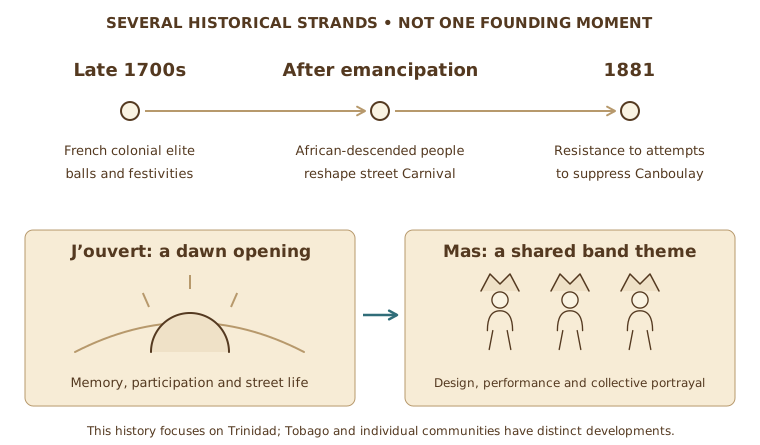
Original educational diagram, not a photograph. Selected historical strands, with emphasis on Trinidad. Anonymous figures and invented costume shapes explain collective portrayal; they do not copy a mas designer’s work or reconstruct an 1881 confrontation.
Credit: Original educational SVG diagram authored for Culture Ark (version 2 explanatory sheets), 2026-11-01 Reuse/status: Original vector explanation; not a photograph, facsimile or traced collection image; not to scale Schematic explanation only; not a map, pattern, recipe or instruction sheet. Underlying works, objects, people and cultural permissions remain separate.
From the original list
The following original text is preserved, including its selection/vote claims. Preservation is not independent verification of every assertion.
Why: The birthplace of soca and steelpan carnival.
What to preserve: mas bands, steelpan, J'ouvert
Year and origin: 18th century · Trinidad and Tobago
Vote: 4/9 (historian 1 · future kid 1 · curator 2)
Learn more: Trinidad and Tobago Carnival on Wikipedia
Explanatory sheets
2 original explanatory sheets prepared for this pick, each with its own diagram. Codes in square brackets such as [C1] point to the numbered sources at the end of the page.
Masquerade, freedom and the struggle for public celebration
More than an imported ball. French colonial elites held elaborate festivities, but enslaved and free people of African descent were excluded from much public celebration. A history limited to fashionable balls misses the unequal society in which Carnival developed. [C1]
Canboulay and emancipation. After emancipation, African-descended communities transformed street celebration and reworked memories of forced cane-field labor in Canboulay. These were expressions of freedom, satire and collective identity, not simply copies of elite entertainment. [C1]
Resistance shaped the festival. In 1881, masqueraders resisted police efforts to suppress Canboulay. NALIS connects later restrictions with the establishment of dawn J’ouvert. The festival’s development involved conflict over who could occupy public space. [C1]
Mas is organized portrayal. A mas band brings participants together through a shared theme and costume design. J’ouvert is a distinct dawn opening within the wider pre-Lenten season. Music, design, commentary and participation contribute different kinds of artistry. [C1, C2]
The title covers a two-island nation; this historical outline does not make every Trinidadian account the history of every Tobago community. No fire, combat or risky performance technique is taught.
Pan, calypso and soca: related arts with different roles
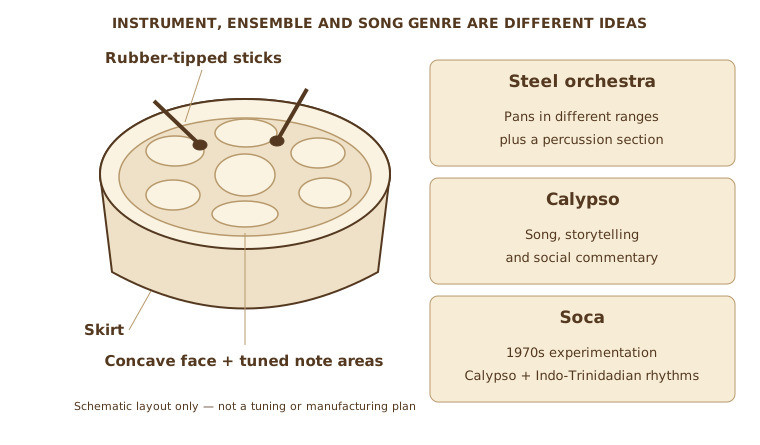
Original functional study of a pan, not a manufacturing or tuning plan. The seven drawn note areas are illustrative, not a prescribed count, pitch sequence or standard layout.
A pitched instrument, not only a drum. A pan has a shaped playing face with tuned areas sounded by tipped sticks. The skirt is the wall below the face. Different pan types occupy different musical ranges; the instrument can carry melody and harmony. [C4]
An orchestra is a family of roles. A steelband combines higher and lower pan ranges with a percussion section often called the engine room. NCC places key development in the 1930s and 1940s and acknowledges competing invention claims rather than one simple origin tale. [C4, C2]
Calypso carries words and argument. Calypso’s African-derived song traditions developed into an art of storytelling, humor and commentary on public affairs. Its importance is not exhausted by its usefulness as dance accompaniment during Carnival. [C2]
Soca adds a later musical history. NALIS associates soca’s emergence with Lord Shorty’s 1970s experiments combining calypso with East Indian rhythms and instruments. This Indo-Trinidadian contribution matters; soca is not just a new name for every older Carnival sound. [C3]
Mas, pan, calypso and soca interact but are not interchangeable labels. Instrument shapes and ensemble arrangements vary; this diagram is explanatory, not a score.
Where to learn more
- https://apiarybee.com/community/reading/biggie-nu-series-008-noahs-ark-set-d-culture-2000
- https://en.wikipedia.org/wiki/Trinidad_and_Tobago_Carnival
Sources and rights
- C1 · NALIS: Carnival — Colonial exclusion, emancipation, Canboulay, 1881 resistance, J’ouvert and themed mas bands.
- C2 · National Carnival Commission: history and elements — Pre-Lenten context; steelpan development; African roots and commentary in calypso.
- C3 · NALIS: Calypso and soca — Lord Shorty’s 1970s experimentation and the Indo-Trinidadian musical contribution.
- C4 · NALIS: Steelband — Concave playing surface, rubber-tipped sticks, pan ranges and percussion section.
Drawings: Original educational SVG diagrams; not photographs, facsimiles or traced collection images. Sources consulted 2026-11-01. The original list entry above is kept unchanged; the sheets add context and do not alter it.
Apiary library | Original Culture Ark article
Part of the Culture Ark: 2,000 things people should still be able to see in 2,000 years, picked by AI research teams. This page keeps the original list entry for D-1718 word for word and adds context. Browse the gallery. The Culture Ark is an Artificial Mind Hive (AMH) project. AMH is owned by Austin Little.

Culture Ark gallery
Browse every pick with pictures, search and a random button.
Open the gallery →