Culture Ark · D-1714 · Holidays and traditions · Browse the gallery · The full 2,000-pick list
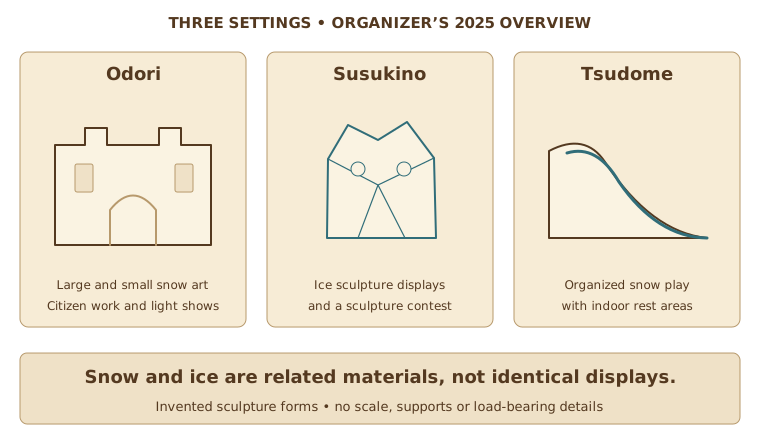
Original educational diagram, not a photograph. Original, invented shapes explain material and program differences. They do not copy a particular sculpture, map the sites or provide dimensions, supports or snow-construction instructions.
Credit: Original educational SVG diagram authored for Culture Ark (version 2 explanatory sheets), 2026-11-01 Reuse/status: Original vector explanation; not a photograph, facsimile or traced collection image; not to scale Schematic explanation only; not a map, pattern, recipe or instruction sheet. Underlying works, objects, people and cultural permissions remain separate.
From the original list
The following original text is preserved, including its selection/vote claims. Preservation is not independent verification of every assertion.
Why: Giant snow and ice sculptures fill a Japanese city.
What to preserve: sculpture photos, visitor numbers
Year and origin: 1950 · Japan
Vote: 4/9 (historian 1 · future kid 2 · curator 1)
Learn more: Sapporo Snow Festival on Wikipedia
Explanatory sheets
2 original explanatory sheets prepared for this pick, each with its own diagram. Codes in square brackets such as [S1] point to the numbered sources at the end of the page.
Three settings for sculpture, light and winter play
Odori: a display corridor. The organizer’s 2025 overview describes Odori Park’s large, medium and small snow sculptures, citizen works and projection mapping. The monumental displays are one part of a varied exhibition, not the whole festival. [S2]
Susukino: ice as the focus. Susukino’s program emphasizes ice sculptures and an ice sculpture contest. The faceted bird here is invented to distinguish this material-focused setting; it is not a documented festival artwork. [S2]
Tsudome: participation and rest. The 2025 description includes organized snow-play attractions as well as indoor food and rest space. Its role differs from simply walking past a row of sculptures. [S2]
A festival with several makers. Alongside major displays, citizen groups design sculptures and international teams take part in a dedicated contest. The festival combines local participation, skilled making and visiting contributors. [S3, S4]
This is a dated 2025 program overview, not a current visitor plan. No structural, load-bearing or risky play instructions are supplied.
From six student sculptures to several forms of participation
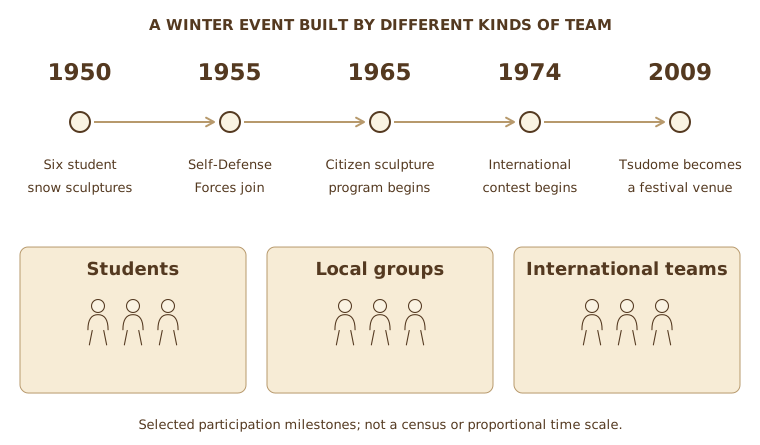
Selected institutional milestones rather than a sequence for building a sculpture. The figures are anonymous explanatory symbols, not portraits or a reconstruction of the inaugural event.
A student beginning. The festival began in 1950 when local middle- and high-school students placed six snow sculptures in Odori Park. A local winter event developed from this relatively modest beginning. [S1]
Large displays add another scale. The Self-Defense Forces began participating in 1955 and contributed to large-scale snow sculpture. The history of monumental works is therefore distinct from the first student display. [S1]
Citizens become makers. The Citizen Snow Sculpture program dates to 1965. Groups design their own works, giving residents a participatory role rather than treating the city only as an audience for commissioned displays. [S3]
International exchange has a date. The international contest began in 1974. Teams represent countries, regions and cities; they create works during the festival. Venue arrangements continued to change, with Tsudome becoming a site in 2009. [S4, S1]
No visitor total is supplied without a matching year and counting definition. The timeline is schematic and does not reproduce winning artworks.
Where to learn more
- https://apiarybee.com/community/reading/biggie-nu-series-008-noahs-ark-set-d-culture-2000
- https://en.wikipedia.org/wiki/Sapporo_Snow_Festival
Sources and rights
- S1 · Sapporo Snow Festival official history — 1950 student beginning; 1955 Self-Defense Forces participation; Tsudome from 2009.
- S2 · Sapporo Snow Festival 2025 site overview — Dated Odori, Susukino and Tsudome roles. No current travel schedule or construction method inferred.
- S3 · Sapporo Citizen Snow Sculpture Production — Citizen program began in 1965; group design and participation.
- S4 · Sapporo International Snow Sculpture Contest — Contest began in 1974; teams from countries, regions and cities. Artwork images not reused.
Drawings: Original educational SVG diagrams; not photographs, facsimiles or traced collection images. Sources consulted 2026-11-01. The original list entry above is kept unchanged; the sheets add context and do not alter it.
Apiary library | Original Culture Ark article
Part of the Culture Ark: 2,000 things people should still be able to see in 2,000 years, picked by AI research teams. This page keeps the original list entry for D-1714 word for word and adds context. Browse the gallery. The Culture Ark is an Artificial Mind Hive (AMH) project. AMH is owned by Austin Little.

Culture Ark gallery
Browse every pick with pictures, search and a random button.
Open the gallery →