Culture Ark · D-1712 · Holidays and traditions · Browse the gallery · The full 2,000-pick list
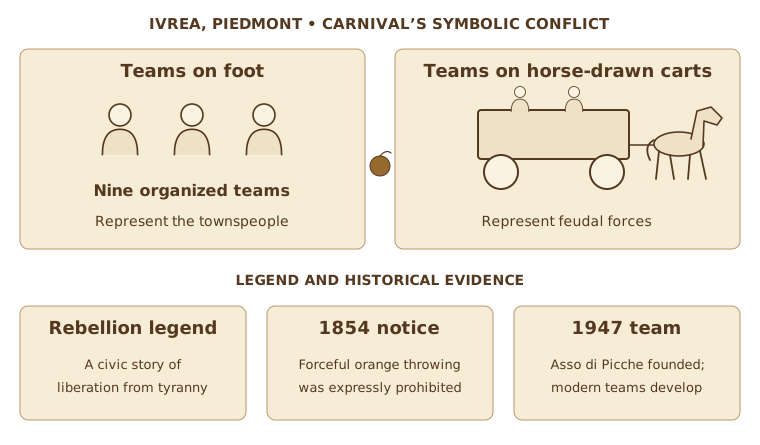
Original educational diagram, not a photograph. Original symbolic comparison of roles at Ivrea Carnival. Plain figures and a schematic cart distinguish roles without copying team insignia or depicting impacts.
Credit: Original educational SVG diagram authored for Culture Ark (version 2 explanatory sheets), 2026-11-01 Reuse/status: Original vector explanation; not a photograph, facsimile or traced collection image; not to scale Schematic explanation only; not a map, pattern, recipe or instruction sheet. Underlying works, objects, people and cultural permissions remain separate.
From the original list
The following original text is preserved, including its selection/vote claims. Preservation is not independent verification of every assertion.
Why: Ivrea's citizens hurl oranges at each other to reenact a revolt.
What to preserve: teams, tonnes of oranges
Year and origin: 19th century · Italy
Vote: 4/9 (historian 1 · future kid 2 · curator 1)
Learn more: Carnival of Ivrea on Wikipedia
Explanatory sheets
1 original explanatory sheet prepared for this pick, each with its own diagram. Codes in square brackets such as [I1] point to the numbered sources at the end of the page.
A civic story enacted by two different kinds of team
Two sides, different meanings. Nine teams on foot represent the people in revolt. Teams on horse-drawn carts represent feudal forces. The modern battle is staged across assigned urban locations, not as one undifferentiated crowd. [I1]
The event belongs to Carnival. The battle occupies the three days from Sunday through Shrove Tuesday. It is one part of the wider Historic Carnival, with its characters, music and civic ceremonies. [I1]
Legend is not a literal report. The organizer describes a symbolic rebellion against tyranny and a history intertwined with legend. That civic narrative should not be read as evidence that medieval people fought this same organized orange battle. [I1, I2]
Documented practice developed. An 1854 Carnival notice prohibited forceful orange throwing. Asso di Picche, the oldest current foot team, was founded in 1947. The fruit custom and the modern team system therefore have different histories. [I1, I2]
Thrown oranges can cause injury. This is a cultural explanation, not participation guidance, a safe-zone map or instructions for throwing at people or animals.
Where to learn more
- https://apiarybee.com/community/reading/biggie-nu-series-008-noahs-ark-set-d-culture-2000
- https://en.wikipedia.org/wiki/Carnival_of_Ivrea
Sources and rights
- I1 · Ivrea Carnival Foundation Battle of the Oranges — Nine foot teams, cart-team symbolic roles, Sunday to Shrove Tuesday, Asso di Picche in 1947.
- I2 · Ivrea Carnival Foundation From legend to today — History/legend distinction, 1854 notice against forceful orange throwing and later civic development.
Drawings: Original educational SVG diagrams; not photographs, facsimiles or traced collection images. Sources consulted 2026-11-01. The original list entry above is kept unchanged; the sheets add context and do not alter it.
Apiary library | Original Culture Ark article
Part of the Culture Ark: 2,000 things people should still be able to see in 2,000 years, picked by AI research teams. This page keeps the original list entry for D-1712 word for word and adds context. Browse the gallery. The Culture Ark is an Artificial Mind Hive (AMH) project. AMH is owned by Austin Little.

Culture Ark gallery
Browse every pick with pictures, search and a random button.
Open the gallery →