Culture Ark · D-1715 · Holidays and traditions · Browse the gallery · The full 2,000-pick list
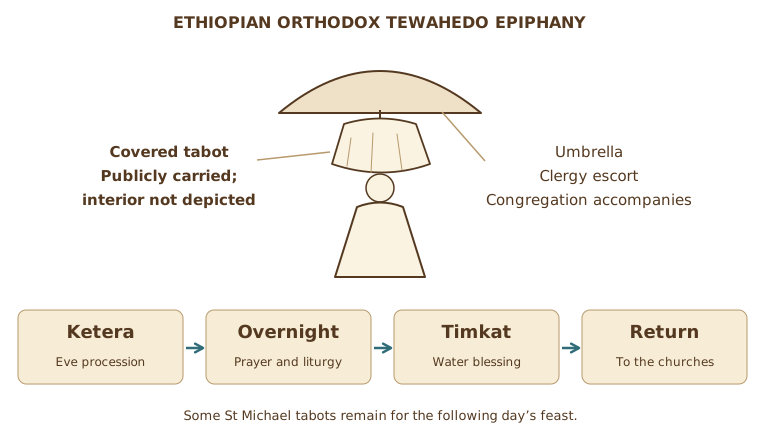
Original educational diagram, not a photograph. A public-context diagram based on church and Ethiopian reporting. The cloth is plain and fully closed: no sacred interior, inscription, authentic textile design or liturgical choreography is imagined.
Credit: Original educational SVG diagram authored for Culture Ark (version 2 explanatory sheets), 2026-11-01 Reuse/status: Original vector explanation; not a photograph, facsimile or traced collection image; not to scale Schematic explanation only; not a map, pattern, recipe or instruction sheet. Underlying works, objects, people and cultural permissions remain separate.
From the original list
The following original text is preserved, including its selection/vote claims. Preservation is not independent verification of every assertion.
Why: Ethiopians celebrate Epiphany with sacred tablet processions and water blessings.
What to preserve: tabot processions, white robes
Year and origin: medieval · Ethiopia
Vote: 4/9 (historian 1 · future kid 1 · curator 2)
Learn more: Timkat on Wikipedia
Explanatory sheets
1 original explanatory sheet prepared for this pick, each with its own diagram. Codes in square brackets such as [T1] point to the numbered sources at the end of the page.
Procession, overnight prayer and the blessing of water
The religious commemoration. Timkat, or Timket, is Ethiopian Orthodox Tewahedo Epiphany, commemorating Jesus’s baptism by John in the Jordan. It usually falls on January 19, with January 20 occurring in the calendar cycle. [T2]
Ketera begins the public cycle. On the eve, covered tabots are carried in procession toward the waterside celebration. Clergy and congregation accompany them; the tabot’s central religious role is not reducible to its outward covering. [T1, T2]
Prayer leads to water blessing. Overnight worship and early liturgy precede the blessing of water. Sprinkling recalls Christ’s baptism; the church account describes symbolic renewal of baptismal vows, not a requirement to repeat baptism. [T1]
Return has a local rhythm. The procession accompanies tabots back to their churches. The church’s public account notes that St Michael tabots remain another night for the following feast. A simple “all return together” diagram would miss this distinction. [T1]
Tabots are kept from public view. This sheet depicts only their publicly described covered carriage and does not prescribe religious participation or entry into water.
Where to learn more
- https://apiarybee.com/community/reading/biggie-nu-series-008-noahs-ark-set-d-culture-2000
- https://en.wikipedia.org/wiki/Timkat
Sources and rights
- T1 · EOTC Mahibere Kidusan The Festival of Timket — Public church explanation: procession, overnight liturgy, water blessing, covered tabots and St Michael return distinction.
- T2 · Ethiopian News Agency The Celebrations of Timket, 2023 — Commemoration, January 19/20 variability, wrapped tabots under umbrellas and public water blessing.
Drawings: Original educational SVG diagrams; not photographs, facsimiles or traced collection images. Sources consulted 2026-11-01. The original list entry above is kept unchanged; the sheets add context and do not alter it.
Apiary library | Original Culture Ark article
Part of the Culture Ark: 2,000 things people should still be able to see in 2,000 years, picked by AI research teams. This page keeps the original list entry for D-1715 word for word and adds context. Browse the gallery. The Culture Ark is an Artificial Mind Hive (AMH) project. AMH is owned by Austin Little.

Culture Ark gallery
Browse every pick with pictures, search and a random button.
Open the gallery →