Culture Ark · D-1716 · Holidays and traditions · Browse the gallery · The full 2,000-pick list
Original educational diagram, not a photograph. Original stylized prop study, not a copied troupe dragon or a dance routine. The shapes explain functional parts without specifying materials, assembly dimensions or acrobatic movement.
Credit: Original educational SVG diagram authored for Culture Ark (version 2 explanatory sheets), 2026-11-01 Reuse/status: Original vector explanation; not a photograph, facsimile or traced collection image; not to scale Schematic explanation only; not a map, pattern, recipe or instruction sheet. Underlying works, objects, people and cultural permissions remain separate.
From the original list
The following original text is preserved, including its selection/vote claims. Preservation is not independent verification of every assertion.
Why: A long dragon on poles snakes through New Year streets.
What to preserve: dragon construction, routines
Year and origin: ancient · China
Vote: 4/9 (historian 1 · future kid 2 · curator 1)
Learn more: Dragon dance on Wikipedia
Explanatory sheets
2 original explanatory sheets prepared for this pick, each with its own diagram. Codes in square brackets such as [D1] point to the numbered sources at the end of the page.
Separate bearers make one long creature appear to move
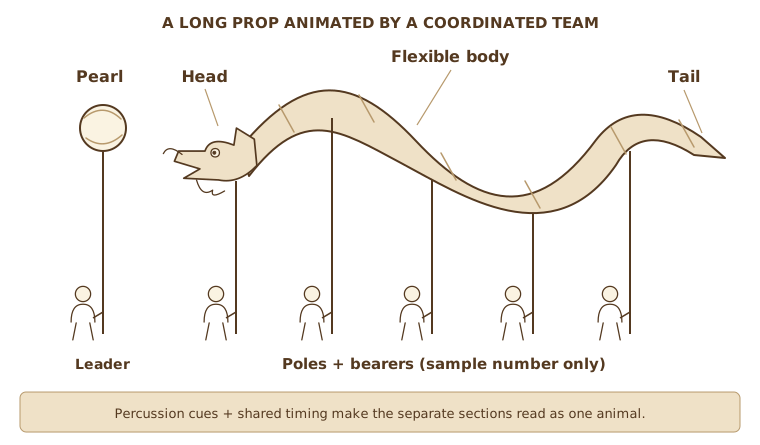
Three broad parts. A dragon prop has a head, a long flexible body and a tail. Bearers control different sections through poles. The number of people and sections varies with the form and length of the prop. [D1, D2]
The pearl supplies a focus. In a familiar performance form, a separate leader presents the dragon pearl ahead of the head. Its movement gives the encounter a visible focus. The drawing identifies the role without teaching a sequence of steps. [D1]
Music links the team. Drum and gong rhythms help coordinate movement. The illusion of one creature depends on the relationship among bearers and musicians, not on a single operator hidden inside the head. [D1]
Meaning and occasion vary. Dragon dances are associated with auspiciousness and community celebration. They occur at Lunar New Year and other festivals, including Singapore examples described by the National Library Board. Different local forms have distinct histories. [D1, D2]
A schematic count is not a rule for all dragons. No fire-dragon practice, stunt, pole construction or unsupervised performance instructions are included.
Dragon and lion: two forms, not interchangeable names
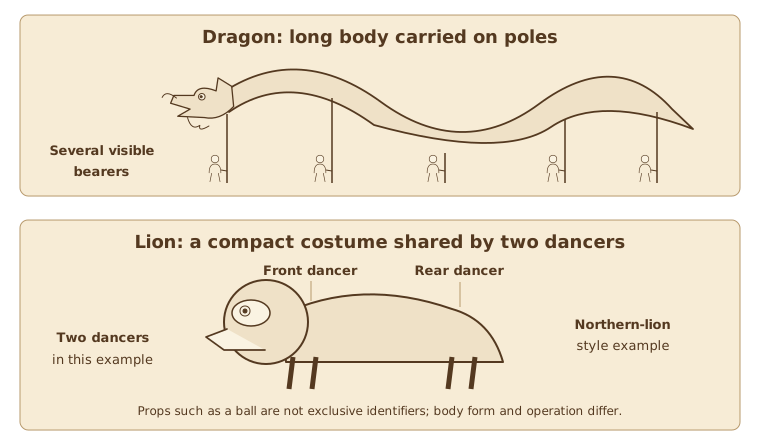
Two invented side views compare basic operation. The lion is a northern-style example, not a universal design; neither drawing copies a costume or presents a performance pose to imitate.
Read the whole body. The dragon’s elongated body extends over a line of pole bearers. Its distributed operation is the clearest contrast with the compact lion costume shown below. A decorative head alone can be misleading. [D2]
A named two-person example. NLB’s account of Singapore’s Chin Woo Northern Lions describes two dancers per lion. The front performer controls the head and front legs; the rear performer manages the back and hind legs. [D3]
Lion forms also differ. Northern and southern lion traditions have different appearances and costume arrangements. The comparison uses one northern-style example rather than claiming that all lions have identical shapes, capes or performance conventions. [D3]
A ball is not a perfect test. A dragon pearl is familiar, but Northern Lion performances can also involve a ball, the xiu qiu, and a separate performer. Body form, bearer arrangement and the named tradition are better clues than a ball alone. [D1, D3]
This page explains recognition and collaboration, not acrobatic technique. Troupe-specific meanings and performance protocols remain with practitioners.
Where to learn more
- https://apiarybee.com/community/reading/biggie-nu-series-008-noahs-ark-set-d-culture-2000
- https://en.wikipedia.org/wiki/Dragon_dance
Sources and rights
- D1 · National Library Board Singapore Dragon dance — Head/body/tail, pearl, musical coordination and regional variation; no photographs or construction instructions reused.
- D2 · National Museum of Singapore A dragon dance — Museum’s public interpretation of sectioned prop, pole bearers, coordination and auspicious symbolism.
- D3 · NLB BiblioAsia Chin Woo’s Northern Lions, 2026 — Named troupe account: two dancers, head/rear roles, northern/southern differences and xiu qiu.
Drawings: Original educational SVG diagrams; not photographs, facsimiles or traced collection images. Sources consulted 2026-11-01. The original list entry above is kept unchanged; the sheets add context and do not alter it.
Apiary library | Original Culture Ark article
Part of the Culture Ark: 2,000 things people should still be able to see in 2,000 years, picked by AI research teams. This page keeps the original list entry for D-1716 word for word and adds context. Browse the gallery. The Culture Ark is an Artificial Mind Hive (AMH) project. AMH is owned by Austin Little.

Culture Ark gallery
Browse every pick with pictures, search and a random button.
Open the gallery →