Culture Ark · D-1635 · Holidays and traditions · Browse the gallery · The full 2,000-pick list
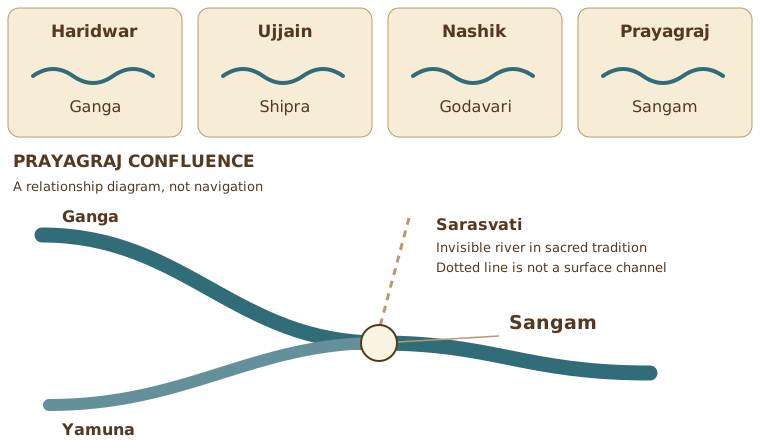
Original educational diagram, not a photograph. Original relation diagram, not a geographic map. Card order does not indicate distance, travel order or the festival’s chronological rotation.
Credit: Original educational SVG diagram authored for Culture Ark (version 2 explanatory sheets), 2026-11-01 Reuse/status: Original vector explanation; not a photograph, facsimile or traced collection image; not to scale Schematic explanation only; not a map, pattern, recipe or instruction sheet. Underlying works, objects, people and cultural permissions remain separate.
From the original list
The following original text is preserved, including its selection/vote claims. Preservation is not independent verification of every assertion.
Why: The largest peaceful gathering of humans ever recorded, bathing in sacred rivers.
What to preserve: crowd estimates by year (2019, 2025 records), sadhu processions, bathing dates
Year and origin: ancient · India
Vote: 7/9 (historian 3 · future kid 1 · curator 3)
Learn more: Kumbh Mela on Wikipedia
Explanatory sheets
2 original explanatory sheets prepared for this pick, each with its own diagram. Codes in square brackets such as [K1] point to the numbered sources at the end of the page.
Four places and a sacred confluence
Place is part of the practice. The named river setting matters. At Prayagraj, the Sangam joins the Ganga and Yamuna; an invisible Sarasvati is part of sacred tradition. The dotted line records that belief, not a surveyed surface watercourse. [K1]
Why people gather. For devotees, bathing has religious meaning associated with purification and liberation. Pilgrims and ascetic communities participate in a living tradition whose knowledge is passed between teachers and students. This sheet reports beliefs without treating them as physical measurements. [K2]
History is not one simple date. INTACH distinguishes older sacred narratives and pilgrimage references from the historical development of the named Kumbh fairs. The source record’s “ancient” label is kept, but it does not settle all questions about origin and continuity. [K3]
More than a river dip. Akhadas are communities of ascetics. Teaching, religious discussion, processions, music, crafts and markets also contribute to the gathering. This mixture of pilgrimage and fair helps explain why a count of bathers alone cannot describe the event. [K2, K3]
No sacred participant is depicted as a documentary portrait. Original drawings describe relationships rather than recreating a photographed ceremony.
The 2025 bathing calendar at Prayagraj
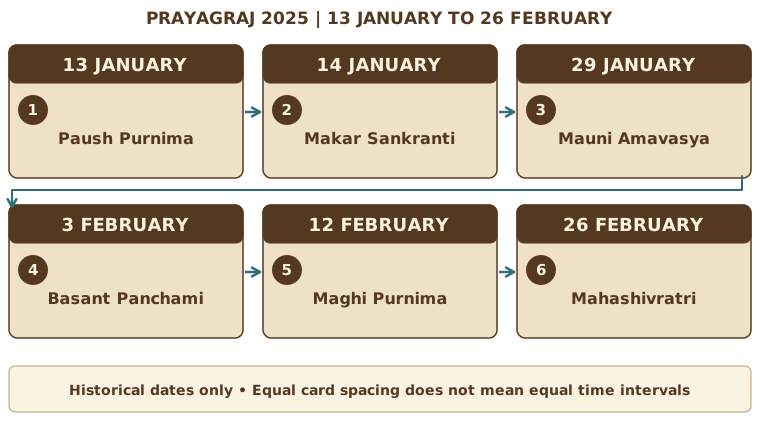
Officially listed dates for one past event. Names follow the district source; the common variant Vasant is also used for Basant Panchami. Cards are not crowd forecasts or current access instructions.
Read the year and site first. The district’s 2025 schedule ran from 13 January to 26 February. It describes a twelve-year framework involving four sites, with timing tied to traditional astrological criteria. A simple “every few years” sentence cannot specify all event dates. [K1]
Many days within one gathering. These six named dates sit within a longer festival, not six separate festivals. Their spacing varies: the first two are consecutive, while later intervals are longer. The ordered cards deliberately avoid implying a uniform interval. [K1]
Crowd totals need a denominator. The unchanged source asks for crowd estimates. An archive should state who estimated a figure, how, over what dates, and whether it counts visits or unique people. A season total cannot automatically be compared with a single-day count.
Why the timing matters. A calendar brings religious meaning and collective organization together. Traditional celestial criteria help identify auspicious occasions; the resulting dates shape when many people gather. This is a cultural calendar, not a measured astronomical mechanism that causes spiritual purification. [K1, K3]
This historical sheet is not travel, crowd-safety or bathing guidance. The diagrams add no attendance numbers or record-size claims.
Where to learn more
- https://apiarybee.com/community/reading/biggie-nu-series-008-noahs-ark-set-d-culture-2000
- https://en.wikipedia.org/wiki/Kumbh_Mela
Sources and rights
- K1 · District Prayagraj Maha Kumbh 2025 — Four named sites and rivers, sacred Sarasvati distinction, and the official January 13 to February 26 schedule with six bathing dates.
- K2 · UNESCO Kumbh Mela — Religious meaning and transmission through practitioners, teachers and students. Search-index text consulted; live page presented a JavaScript challenge. Its generalized rotation wording is not used as a date calculator.
- K3 · INTACH The Kumbh a confluence of river religion and people — Heritage documentation and the distinction between sacred narratives and debated historical development. No 144-year recurrence claim adopted.
Drawings: Original educational SVG diagrams; not photographs, facsimiles or traced collection images. Sources consulted 2026-11-01. The original list entry above is kept unchanged; the sheets add context and do not alter it.
Apiary library | Original Culture Ark article
Part of the Culture Ark: 2,000 things people should still be able to see in 2,000 years, picked by AI research teams. This page keeps the original list entry for D-1635 word for word and adds context. Browse the gallery. The Culture Ark is an Artificial Mind Hive (AMH) project. AMH is owned by Austin Little.

Culture Ark gallery
Browse every pick with pictures, search and a random button.
Open the gallery →