Culture Ark · D-1651 · Holidays and traditions · Browse the gallery · The full 2,000-pick list
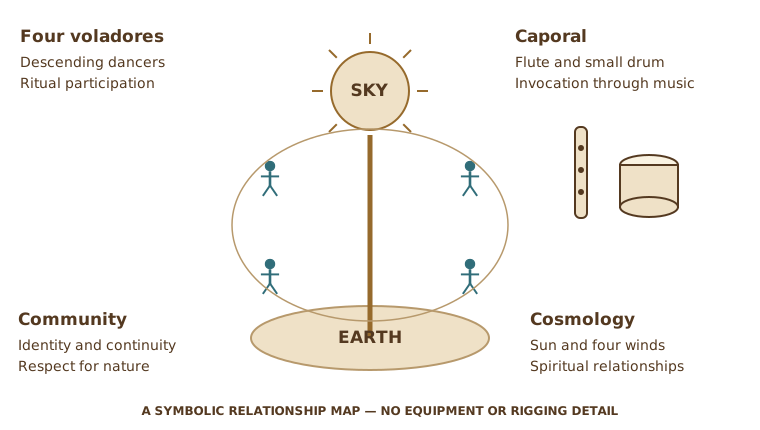
Original educational diagram, not a photograph. The four icons identify roles, not physical positions or a movement sequence. Instruments are emblematic, not measured drawings.
Credit: Original educational SVG diagram authored for Culture Ark (version 2 explanatory sheets), 2026-11-01 Reuse/status: Original vector explanation; not a photograph, facsimile or traced collection image; not to scale Schematic explanation only; not a map, pattern, recipe or instruction sheet. Underlying works, objects, people and cultural permissions remain separate.
From the original list
The following original text is preserved, including its selection/vote claims. Preservation is not independent verification of every assertion.
Why: Men spin down from a 30-metre pole on ropes.
What to preserve: the pole ritual, flute music
Year and origin: pre-Columbian · Mexico
Vote: 6/9 (historian 2 · future kid 2 · curator 2)
Learn more: Danza de los Voladores on Wikipedia
Explanatory sheets
2 original explanatory sheets prepared for this pick, each with its own diagram. Codes in square brackets such as [V1] point to the numbered sources at the end of the page.
A ceremony linking sky and earth
Ritual roles and music, rather than an acrobatic blueprint
What the flight expresses. UNESCO describes a fertility ritual connecting people with nature and the spiritual world. Four voladores participate in the descent while the caporal plays flute and drum in an invocation associated with the sun, winds and cardinal directions. Music belongs to the ceremony’s meaning; it is not merely accompaniment. [V1]
More than a public spectacle. The ceremony expresses a community’s worldview and hopes for prosperity. It is particularly emblematic among Totonac communities in Veracruz, but is practiced by several peoples in Mexico and Central America. A visitor sees a visible moment of a larger sacred tradition. [V1, V2]
Safety: Cultural explanation only. This sheet provides no rope, pole, anchoring or performance instructions.
A living tradition is not one fixed version
Place, language and community change how the ceremony is understood
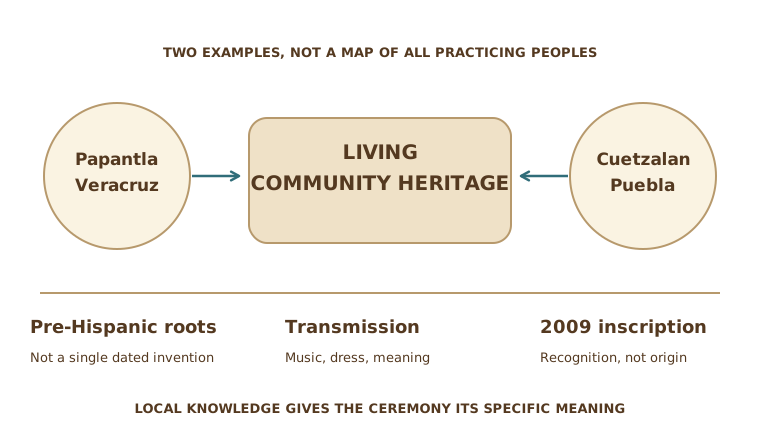
A relationship diagram, not a geographic map. The lower strip distinguishes historical roots from later international recognition.
Different communities, shared heritage. INAH names Papantla and Cuetzalan among places where the tradition continues, and also notes communities in Hidalgo and San Luis Potosí. Dress, local explanations and ritual nuances should be understood in their own setting. A famous tourist image cannot stand for every group. [V2]
Recognition and continuity. The 2009 UNESCO inscription recognized an existing living practice. It did not establish the ceremony or freeze its forms. The important continuity is people carrying music, knowledge and responsibility between generations, alongside the meanings communities give their own celebrations. [V1, V2]
Historical note: The archival “pre-Columbian · Mexico” label is retained; it is not a precise founding date.
Where to learn more
- https://apiarybee.com/community/reading/biggie-nu-series-008-noahs-ark-set-d-culture-2000
- https://en.wikipedia.org/wiki/Danza_de_los_Voladores
Sources and rights
- V1 · UNESCO Ritual ceremony of the Voladores — Communities, ritual meaning, music, participants and 2009 inscription. Technical performance details excluded.
- V2 · INAH Voladores: living heritage — Sacred meaning and variation across Papantla, Cuetzalan and other communities; 2025 institutional account.
Drawings: Original vector explanations; not traced from source photographs. Sources consulted 2026-11-01. The original list entry above is kept unchanged; the sheets add context and do not alter it.
Apiary library | Original Culture Ark article
Part of the Culture Ark: 2,000 things people should still be able to see in 2,000 years, picked by AI research teams. This page keeps the original list entry for D-1651 word for word and adds context. Browse the gallery. The Culture Ark is an Artificial Mind Hive (AMH) project. AMH is owned by Austin Little.

Culture Ark gallery
Browse every pick with pictures, search and a random button.
Open the gallery →