Culture Ark · D-1650 · Holidays and traditions · Browse the gallery · The full 2,000-pick list
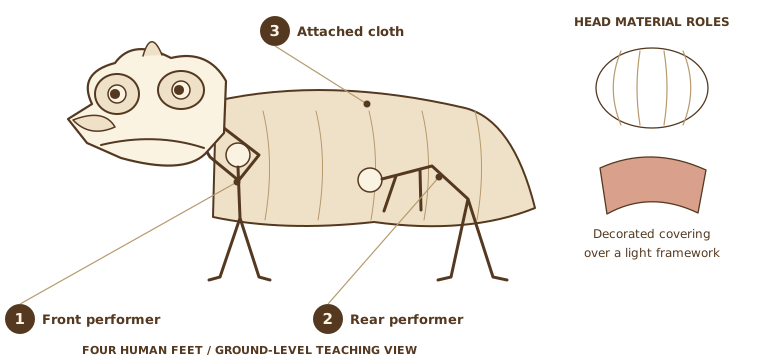
Original educational diagram, not a photograph. A representative Southern-lion arrangement. Costumes and controls vary; this is not an acrobatic or construction guide.
Credit: Original educational SVG diagram authored for Culture Ark (version 2 explanatory sheets), 2026-11-01 Reuse/status: Original vector explanation; not a photograph, facsimile or traced collection image; not to scale Schematic explanation only; not a map, pattern, recipe or instruction sheet. Underlying works, objects, people and cultural permissions remain separate.
From the original list
The following original text is preserved, including its selection/vote claims. Preservation is not independent verification of every assertion.
Why: Two dancers in one lion costume chase away bad luck.
What to preserve: costumes, drum rhythms
Year and origin: ancient · China
Vote: 6/9 (historian 2 · future kid 2 · curator 2)
Learn more: Lion dance on Wikipedia
Explanatory sheets
2 original explanatory sheets prepared for this pick, each with its own diagram. Codes in square brackets such as [A] point to the numbered sources at the end of the page.
Two performers make one apparent animal
A Southern tradition in diaspora. Southern Chinese lion dance is a living performance tradition carried through migration and community associations. A Powerhouse Museum costume was made in Guangdong around 1950 and used by Sydney’s Yiu Ming Society. Its documented journey offers a concrete history without pretending to identify the dance’s first invention. Auspicious and protective meanings belong to practitioners’ beliefs and ceremonial contexts. [R1]
Two people, one apparent body. In the Southern form shown here, one performer operates the head while a second animates the rear beneath an attached cloth body. Their coordinated steps create the apparent animal. Heads are lightweight structures with decorated surfaces, though materials and controls differ. The Powerhouse example has a bamboo framework, painted cardboard, movable wooden eyes and a detachable silk skirt. [R1, R2, R4]
Music makes movement legible. A large drum, cymbals and gong work with the dancers rather than serving as unrelated background sound. Rhythms help communicate the lion’s changing attention and emotion. In a picking-the-greens episode, a lion may investigate and approach vegetables, then perform eating and scattering gestures. The Central Victorian Lion Team describes the scattered leaves as a symbolic blessing; arrangements vary by occasion. [R3]
Percussion and movement communicate together
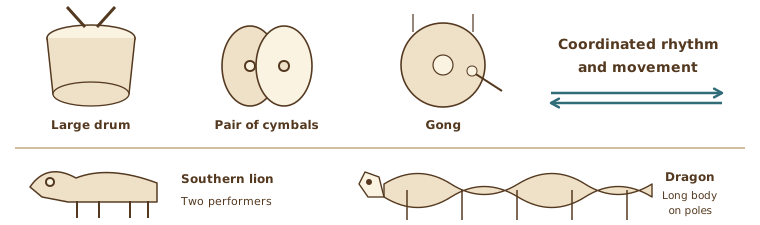
Percussion and movement communicate together. Lion dance and dragon dance are distinct forms, even when they appear at the same celebration.
Named styles and a different creature. Cambridge’s troupe identifies its practice as Hok-san or HeShan, a Southern school emphasizing expressive, catlike movement. Fut-san or FoShan is another named Southern school; Northern lions and other traditions should not be collapsed into this example. A dragon dance is distinct: a long segmented creature is supported on poles by a larger team, rather than formed by two people under one lion costume. [R2, R3]
Where to learn more
- https://apiarybee.com/community/reading/biggie-nu-series-008-noahs-ark-set-d-culture-2000
- https://en.wikipedia.org/wiki/Lion_dance
Sources and rights
- A · Existing Culture Ark record — Exact approved current-live refresh; original body retained.
- R1 · Powerhouse Museum — Lion dance costume, object 2003/114/1 — Object 2003/114/1: Guangdong c.1950, Sydney Yiu Ming Society, specific materials. Image unavailable; not reconstructed.
- R2 · Cambridge University Lion Dance Troupe — About Lion Dance — Practitioner account: two performers, Southern Hok-san/HeShan and dragon distinction.
- R3 · Central Victorian Lion Team — Lion Dance Team: Team Information — Community PDF: styles, drum/cymbals/gong and picking greens. Text read; illustrations not inspected.
- R4 · Musical Instrument Museum, Phoenix — The Lion Dance: Musical Instruments and Animal Art of Asia, p.4 — Official indexed text corroborates two dancers and percussion; direct PDF returned 404.
Drawings: Original educational SVG schematics; no copied historical/product artwork. Not to scale. Archive note: The original “ancient · China” wording is unchanged. This is a Southern example, not every lion tradition; auspicious effects are cultural meanings, not verified supernatural outcomes. No stunt or rigging instructions. Sources consulted 2026-11-01. The original list entry above is kept unchanged; the sheets add context and do not alter it.
Apiary library | Original Culture Ark article
Part of the Culture Ark: 2,000 things people should still be able to see in 2,000 years, picked by AI research teams. This page keeps the original list entry for D-1650 word for word and adds context. Browse the gallery. The Culture Ark is an Artificial Mind Hive (AMH) project. AMH is owned by Austin Little.

Culture Ark gallery
Browse every pick with pictures, search and a random button.
Open the gallery →