Culture Ark · D-1648 · Holidays and traditions · Browse the gallery · The full 2,000-pick list
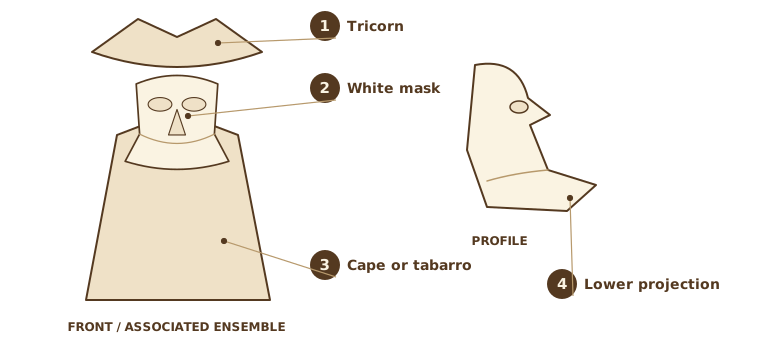
Original educational diagram, not a photograph. Original simplified bauta front and profile with the associated tricorn and cape. Not a tracing, authenticated historic object or measured mask pattern.
Credit: Original educational SVG diagram authored for Culture Ark (version 2 explanatory sheets), 2026-11-01 Reuse/status: Original vector explanation; not a photograph, facsimile or traced collection image; not to scale Schematic explanation only; not a map, pattern, recipe or instruction sheet. Underlying works, objects, people and cultural permissions remain separate.
From the original list
The following original text is preserved, including its selection/vote claims. Preservation is not independent verification of every assertion.
Why: Venetians hide behind elaborate masks for weeks of balls.
What to preserve: bauta and plague-doctor masks
Year and origin: 1162 · Italy
Vote: 6/9 (historian 2 · future kid 2 · curator 2)
Learn more: Carnival of Venice on Wikipedia
Explanatory sheets
2 original explanatory sheets prepared for this pick, each with its own diagram. Codes in square brackets such as [A] point to the numbered sources at the end of the page.
The mask and the whole costume work together
A documented carnival history. Venice’s municipal account identifies a reference to Carnival in 1094 and an official holiday declaration in 1296. It also records the renewal of a public, city-supported Carnival in 1979. These are different kinds of milestone: a written reference, a legal recognition and a modern revival. The original Ark’s 1162 date is retained separately, not treated as the only established beginning. [R1]
Bauta is more than a white face. The bauta is associated with a white mask, a tricorn hat and a long cape or tabarro. The official Carnival site describes its projecting lower shape as allowing speech and eating beneath it. The front view shows coverage, while the profile makes the projection legible. Ornamented modern versions exist, so plain white is an explanatory choice rather than an authenticity test. [R1, R2]
Anonymity and character are different effects. A mask can conceal a wearer’s identity, while a recognizable costume can also give that person a public role. Venetian masquerade included multiple types, not one interchangeable face. The city’s account describes professional mask makers as an acknowledged craft in 1436. The paired drawing therefore keeps mask, headwear and cloak distinct while showing how they form an ensemble. [R1]
Compare the bauta with a later beaked type
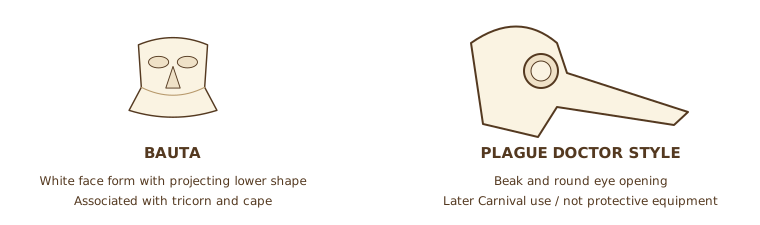
Original type comparison, not two objects of the same age. The beaked plague-doctor style has a distinct medical-costume history and is not protective equipment.
The beak belongs to another history. The plague-doctor type uses a long beak and round eye openings, often with a dark hat and coat. Museum accounts associate the historical medical costume with seventeenth-century European plague responses and obsolete ideas about foul air. Its later Carnival use is not evidence that it protected against infection, nor that it belonged to Carnival’s earliest period. This sheet shows visual distinction, not a medical reconstruction. [R2, R3]
Where to learn more
- https://apiarybee.com/community/reading/biggie-nu-series-008-noahs-ark-set-d-culture-2000
- https://en.wikipedia.org/wiki/Carnival_of_Venice
Sources and rights
- A · Existing Culture Ark record — Exact approved current-live refresh; original body retained.
- R1 · City of Venice — Storia del Carnevale — 1094, 1296, 1436 and 1979 milestones; mask-making, bauta and other forms.
- R2 · Official Venice Carnival — Inside Masks — Bauta ensemble and projecting lower form; modern variants and beaked type.
- R3 · Wiener Museum of Decorative Arts — The Plague Doctor — Seventeenth-century medical-costume context and later Carnival use; images reference-only.
Drawings: Original educational SVG schematics; no copied historical/product artwork. Not to scale. Archive note: The original “1162 · Italy” wording is preserved. Documentary milestones differ from origin legends; neither drawing is a surviving historical object or health-protection device. Sources consulted 2026-11-01. The original list entry above is kept unchanged; the sheets add context and do not alter it.
Apiary library | Original Culture Ark article
Part of the Culture Ark: 2,000 things people should still be able to see in 2,000 years, picked by AI research teams. This page keeps the original list entry for D-1648 word for word and adds context. Browse the gallery. The Culture Ark is an Artificial Mind Hive (AMH) project. AMH is owned by Austin Little.

Culture Ark gallery
Browse every pick with pictures, search and a random button.
Open the gallery →