Culture Ark · D-1647 · Holidays and traditions · Browse the gallery · The full 2,000-pick list
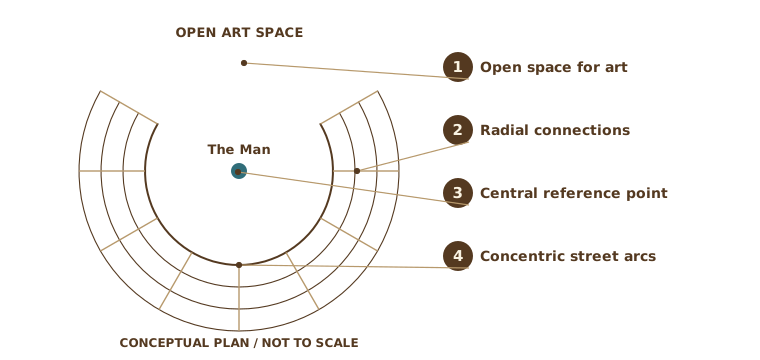
Original educational diagram, not a photograph. Original not-to-scale diagram of a familiar Black Rock City layout idea. It is not a current map, navigation aid, population estimate or site-engineering plan.
Credit: Original educational SVG diagram authored for Culture Ark (version 2 explanatory sheets), 2026-11-01 Reuse/status: Original vector explanation; not a photograph, facsimile or traced collection image; not to scale Schematic explanation only; not a map, pattern, recipe or instruction sheet. Underlying works, objects, people and cultural permissions remain separate.
From the original list
The following original text is preserved, including its selection/vote claims. Preservation is not independent verification of every assertion.
Why: A temporary city in the desert builds art and then burns it.
What to preserve: the Man effigy, Black Rock City population by year
Year and origin: 1986 · United States
Vote: 6/9 (historian 2 · future kid 2 · curator 2)
Learn more: Burning Man on Wikipedia
Explanatory sheets
2 original explanatory sheets prepared for this pick, each with its own diagram. Codes in square brackets such as [A] point to the numbered sources at the end of the page.
A temporary city organized around an open centre
From a beach gathering to a city. The organizer’s archive places the first Burning Man gathering at Baker Beach in San Francisco in 1986, associated with Larry Harvey and Jerry James. The later Nevada event developed into Black Rock City. Its name refers both to the central figure and to a broader participatory culture; not every artwork is burned, and the event is not only a closing spectacle. [R1, R3]
Why the plan is recognizable. Planner Rod Garrett describes the 1998 redesign around the Man as a geographic centre. Concentric streets and radial connections make a large temporary settlement easier to understand while preserving open space for art. The schematic shows that relationship, not an exact annual count of roads or compass orientation. The real plan and facilities change from year to year. [R2]
Participants also make the experience. Larry Harvey formulated the Ten Principles in 2004 as a description of emerging community values. They include participation, communal effort, gifting, civic responsibility and leaving no trace. Gifting is described as unconditional rather than barter. Those ideas help explain why camps, shared activities and collective work matter alongside conspicuous sculptures. They are aspirations, not proof that every participant acts identically. [R3]
The event is more than the final burn
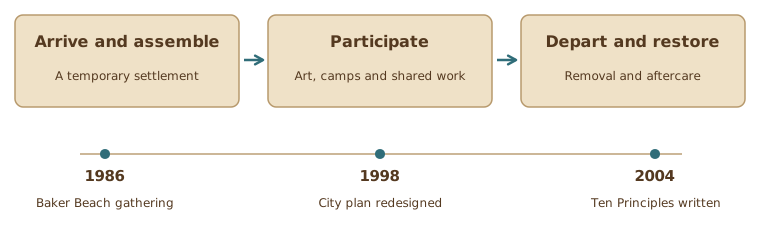
A conceptual lifecycle and three documented milestones. No effigy structure, ignition, fire perimeter or rigging procedure is shown.
A temporary city has an afterlife. Arrival and assembly are followed by occupation, art and interaction; departure requires removal and restoration work. The cycle diagram makes the often less-visible final stage as prominent as the gathering. It is an interpretation of the temporary-city concept and the stated leave-no-trace principle, not a claim that environmental effects vanish. Annual population figures require a named year and counting method; none are invented here. [R2, R3]
Where to learn more
- https://apiarybee.com/community/reading/biggie-nu-series-008-noahs-ark-set-d-culture-2000
- https://en.wikipedia.org/wiki/Burning_Man
Sources and rights
- A · Existing Culture Ark record — Exact approved current-live refresh; original body retained.
- R1 · Burning Man Project — Historical timeline — 1986 Baker Beach origin and named founders.
- R2 · Rod Garrett — Designing Black Rock City — Planner’s first-person account of 1998 layout; civic functions and open-space relationships. Earlier year claims in the essay are not used.
- R3 · Burning Man Project — The Ten Principles — 2004 formulation; gifting, participation, communal effort, civic responsibility and leaving no trace.
Drawings: Original educational SVG schematics; no copied historical/product artwork. Not to scale. Archive note: The 1986 archival label is preserved. The drawing omits annual operational details and is not an installation, navigation, burning or rigging guide. Sources consulted 2026-11-01. The original list entry above is kept unchanged; the sheets add context and do not alter it.
Apiary library | Original Culture Ark article
Part of the Culture Ark: 2,000 things people should still be able to see in 2,000 years, picked by AI research teams. This page keeps the original list entry for D-1647 word for word and adds context. Browse the gallery. The Culture Ark is an Artificial Mind Hive (AMH) project. AMH is owned by Austin Little.

Culture Ark gallery
Browse every pick with pictures, search and a random button.
Open the gallery →