Culture Ark · D-1646 · Holidays and traditions · Browse the gallery · The full 2,000-pick list
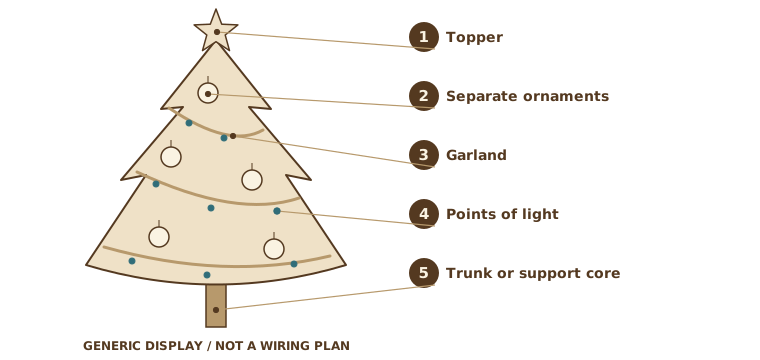
Original educational diagram, not a photograph. Original generic decorated-tree study. Decorations are illustrative choices, not a universal Christmas arrangement or a support/wiring plan.
Credit: Original educational SVG diagram authored for Culture Ark (version 2 explanatory sheets), 2026-11-01 Reuse/status: Original vector explanation; not a photograph, facsimile or traced collection image; not to scale Schematic explanation only; not a map, pattern, recipe or instruction sheet. Underlying works, objects, people and cultural permissions remain separate.
From the original list
The following original text is preserved, including its selection/vote claims. Preservation is not independent verification of every assertion.
Why: Families bring a tree indoors and cover it in lights.
What to preserve: decorations, Rockefeller tree, real vs artificial numbers
Year and origin: 16th century · Germany
Vote: 6/9 (historian 2 · future kid 2 · curator 2)
Learn more: Christmas tree on Wikipedia
Explanatory sheets
2 original explanatory sheets prepared for this pick, each with its own diagram. Codes in square brackets such as [A] point to the numbered sources at the end of the page.
A branching display brings several media together
An evergreen framework. Christmas trees may be natural or artificial. A natural example supplies a trunk and branching form; an artificial one recreates a reusable silhouette. Ornaments, a topper, garlands and lights add separate layers of colour and meaning. Not every tree uses all of them, and a household tree differs in scale and setting from a civic display. [R1, R2]
A tradition with more than one origin claim. The Natural History Museum places the recognizable Christmas-tree tradition in northern Europe in the fifteenth and sixteenth centuries, while noting competing claims about the first tree. German-speaking practice is important, but “16th century · Germany” should not be mistaken for a single documented invention event. Different evergreen species and local substitutes also show how the custom adapts. [R1]
Images helped the custom spread. In 1848 the Illustrated London News published the royal family around a decorated tree. The Royal Collection Trust explains Victoria and Albert’s role in popularising the custom in Britain, not inventing decorated trees. The V&A connects expanding popularity with the production and sale of ornaments in reflective materials, alongside homemade edible decorations. [R2, R3]
A history of changing materials and circulation
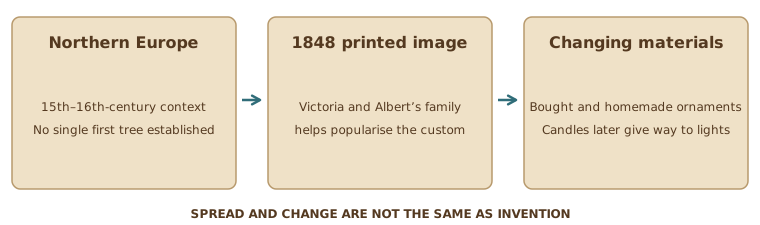
Selected developments explain how a custom travels and changes. These are not claims to one exact inventor or the first tree in every country.
Objects change while the arrangement persists. Glass ornaments, paper decorations, edible treats and electric lights have different material properties and histories. The V&A contrasts Victorian candles with later fairy lights. A cut natural tree and a reusable artificial tree also have different life cycles; this sheet does not invent market totals or declare one universally preferable. Historical candles are discussed as evidence, not recommended for present-day trees. [R1, R2]
Where to learn more
- https://apiarybee.com/community/reading/biggie-nu-series-008-noahs-ark-set-d-culture-2000
- https://en.wikipedia.org/wiki/Christmas_tree
Sources and rights
- A · Existing Culture Ark record — Exact approved current-live refresh; original body retained.
- R1 · Natural History Museum — Festive flora — Natural/artificial trees, contested earliest location and changing species.
- R2 · Victoria and Albert Museum — Victorian Christmas traditions — German connection; 1848 image; commercial, reflective and edible ornaments; later lighting.
- R3 · Royal Collection Trust — A Royal Christmas — 1848 royal-family illustration and British popularisation, supported by collection records and journals.
Drawings: Original educational SVG schematics; no copied historical/product artwork. Not to scale. Archive note: The archival date and origin remain unchanged. No electrical circuit, tree-rigging design, candle-use instructions or unsupported real-versus-artificial statistics are supplied. Sources consulted 2026-11-01. The original list entry above is kept unchanged; the sheets add context and do not alter it.
Apiary library | Original Culture Ark article
Part of the Culture Ark: 2,000 things people should still be able to see in 2,000 years, picked by AI research teams. This page keeps the original list entry for D-1646 word for word and adds context. Browse the gallery. The Culture Ark is an Artificial Mind Hive (AMH) project. AMH is owned by Austin Little.

Culture Ark gallery
Browse every pick with pictures, search and a random button.
Open the gallery →