Culture Ark · D-1644 · Holidays and traditions · Browse the gallery · The full 2,000-pick list
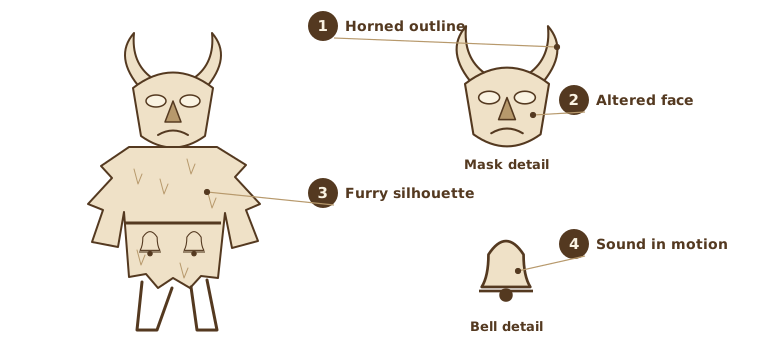
Original educational diagram, not a photograph. Generic original costume study informed by Grossarltal’s account. It does not copy a named troupe, historic mask or measured costume.
Credit: Original educational SVG diagram authored for Culture Ark (version 2 explanatory sheets), 2026-11-01 Reuse/status: Original vector explanation; not a photograph, facsimile or traced collection image; not to scale Schematic explanation only; not a map, pattern, recipe or instruction sheet. Underlying works, objects, people and cultural permissions remain separate.
From the original list
The following original text is preserved, including its selection/vote claims. Preservation is not independent verification of every assertion.
Why: A horned Christmas demon punishes naughty children in Alpine towns.
What to preserve: masks, Krampuslauf runs, postcards
Year and origin: medieval · Austria
Vote: 6/9 (historian 2 · future kid 2 · curator 2)
Learn more: Krampus on Wikipedia
Explanatory sheets
2 original explanatory sheets prepared for this pick, each with its own diagram. Codes in square brackets such as [A] point to the numbered sources at the end of the page.
Costume turns a performer into a character
A companion in the Advent story. In Austrian St Nicholas customs, Krampus is the frightening companion to the gift-bearing saint. Austrian and Grossarltal sources associate the pair especially with 5 and 6 December. The contrast between praise and warning is part of the performed story. A human participant wears the character; the horned figure is folklore, not a documented supernatural being. [R1, R2]
What the costume contributes. Grossarltal describes carved masks, fur, horns, bells and chains. The mask changes the face, the fur changes the body’s outline, and bells give movement a loud audible presence. Local groups have their own styles and may commission individually carved masks. The parts view explains those visible and audible roles without inventing a fastening system or a carving pattern. [R1, R2]
Krampus is not every Percht. The same regional account distinguishes Krampus’s connection with St Nicholas from Perchten customs around the year’s transition. It distinguishes auspicious Schönperchten from frightening Schiachperchten as well. A horned mask alone is therefore not enough to identify an event. The community, date and character’s role matter; the categories can overlap in contemporary public presentation. [R1]
Similar masks do not mean the same custom
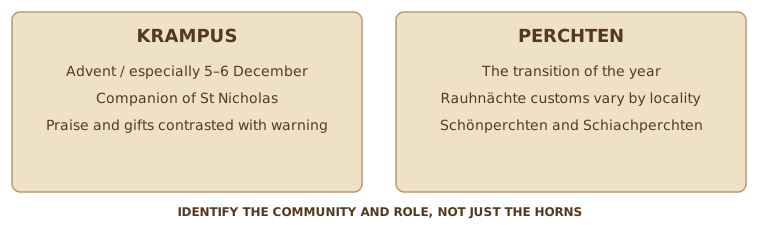
Comparison of ritual contexts, not a universal event timetable. Local groups and present-day parades can vary.
The transformation can be explained. A Salzburg museum-network report describes a children’s workshop with the Altgnigler Krampus- und Perchtenpass. Participants saw a familiar adult gradually put on the costume and mask. That example makes performance legible rather than presenting fear as unavoidable. These living practices include teaching, making and group identity as well as noisy processions. No single “medieval” date proves the origin of every modern form. [R3, A]
Where to learn more
- https://apiarybee.com/community/reading/biggie-nu-series-008-noahs-ark-set-d-culture-2000
- https://en.wikipedia.org/wiki/Krampus
Sources and rights
- A · Existing Culture Ark record — Exact approved current-live refresh; original body retained.
- R1 · Grossarltal tourism association — Krampus and Perchten — Named regional costume, group variation, St Nicholas relationship and Perchten distinctions.
- R2 · Austrian National Tourist Office — Christmas traditions — 5–6 December context; horned figure and contrast with St Nicholas.
- R3 · Salzburg museum network — Children’s Krampus workshop — 2025 report of Altgnigler troupe explaining the gradual human-to-costume transformation.
Drawings: Original educational SVG schematics; no copied historical/product artwork. Not to scale. Archive note: The original “medieval · Austria” wording is preserved as an archive label, not verified here as a precise beginning. Scaring or striking unwilling spectators is not necessary to understand the tradition. Sources consulted 2026-11-01. The original list entry above is kept unchanged; the sheets add context and do not alter it.
Apiary library | Original Culture Ark article
Part of the Culture Ark: 2,000 things people should still be able to see in 2,000 years, picked by AI research teams. This page keeps the original list entry for D-1644 word for word and adds context. Browse the gallery. The Culture Ark is an Artificial Mind Hive (AMH) project. AMH is owned by Austin Little.

Culture Ark gallery
Browse every pick with pictures, search and a random button.
Open the gallery →