Culture Ark · D-1643 · Holidays and traditions · Browse the gallery · The full 2,000-pick list
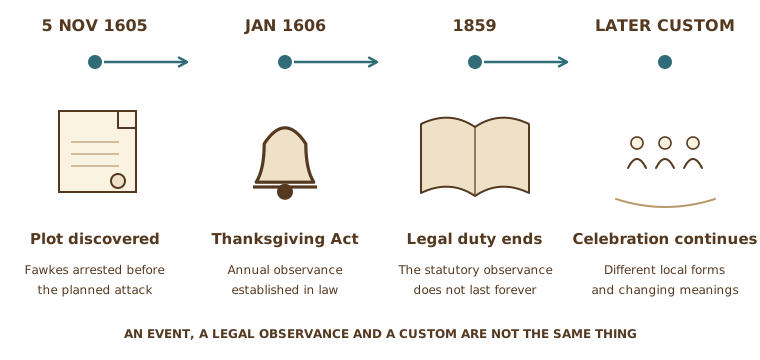
Original educational diagram, not a photograph. Selected historical milestones, not a reconstruction of the plot or its equipment. The 1605-named Act was passed in January 1606.
Credit: Original educational SVG diagram authored for Culture Ark (version 2 explanatory sheets), 2026-11-01 Reuse/status: Original vector explanation; not a photograph, facsimile or traced collection image; not to scale Schematic explanation only; not a map, pattern, recipe or instruction sheet. Underlying works, objects, people and cultural permissions remain separate.
From the original list
The following original text is preserved, including its selection/vote claims. Preservation is not independent verification of every assertion.
Why: Britons burn effigies of a failed bomber every 5 November.
What to preserve: bonfires, effigies, "Remember, remember" rhyme
Year and origin: 1605 · England
Vote: 6/9 (historian 2 · future kid 2 · curator 2)
Learn more: Guy Fawkes Night on Wikipedia
Explanatory sheets
2 original explanatory sheets prepared for this pick, each with its own diagram. Codes in square brackets such as [A] point to the numbered sources at the end of the page.
A failed plot becomes an annual observance
What happened in 1605. The Gunpowder Plot aimed to kill James I and members of Parliament. Guy Fawkes was discovered before the planned attack on 5 November 1605. He became its best-known face, but was not its mastermind. The event belongs to a period of religious persecution and political conflict, not a simple story about all Catholics or all Protestants. [R1, R2]
From event to calendar. In January 1606 a thanksgiving Act established an annual observance of 5 November. Prayer, church services and public celebration connected the date with the monarch’s survival. Its title refers to 1605, which can obscure the actual passage date. The legal observance remained in force until 1859; celebrations outlived that requirement. [R2]
Why an effigy is different. The Ark names bonfires, effigies and a commemorative rhyme. An effigy gives an absent person a symbolic body; a repeated phrase makes a date memorable; a gathering turns remembrance into a shared event. These are different media, not pieces of one mechanical device. The drawn dummy is a generic teaching symbol, not Guy Fawkes’s likeness. [A]
Objects give memory different forms
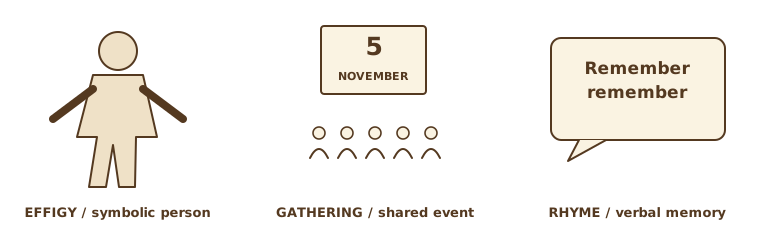
Original symbolic views of an effigy, communal spectacle and spoken remembrance. No bonfire layout, explosive mechanism or lighting procedure is depicted.
Continuity does not mean sameness. The occasion is also called Bonfire Night. Its meanings have shifted between official thanksgiving, religious and political hostility, local custom and public entertainment. Historic Royal Palaces also documents the separate ceremonial search before the State Opening of Parliament. That search is not a replay of a November street celebration. Today’s events should not be assumed to reproduce one unchanged ceremony from 1605. [R1, R2]
Where to learn more
- https://apiarybee.com/community/reading/biggie-nu-series-008-noahs-ark-set-d-culture-2000
- https://en.wikipedia.org/wiki/Guy_Fawkes_Night
Sources and rights
- A · Existing Culture Ark record — Exact approved current-live refresh; original body retained.
- R1 · UK Parliament — The Gunpowder Plot — Political and religious context; 5 November 1605 and parliamentary commemoration.
- R2 · Historic Royal Palaces — Guy Fawkes and the Gunpowder Plot — Fawkes not the mastermind; January 1606 Act, 1859 endpoint and ceremonial search.
Drawings: Original educational SVG schematics; no copied historical/product artwork. Not to scale. Archive note: The original “1605 · England” entry is unchanged. A modern celebration is not evidence that Fawkes was burned alive or that every community observes the date in the same way. Warning: Historical explanation only. No pyrotechnic, bonfire-building or ignition instructions are supplied. Sources consulted 2026-11-01. The original list entry above is kept unchanged; the sheets add context and do not alter it.
Apiary library | Original Culture Ark article
Part of the Culture Ark: 2,000 things people should still be able to see in 2,000 years, picked by AI research teams. This page keeps the original list entry for D-1643 word for word and adds context. Browse the gallery. The Culture Ark is an Artificial Mind Hive (AMH) project. AMH is owned by Austin Little.

Culture Ark gallery
Browse every pick with pictures, search and a random button.
Open the gallery →