Culture Ark · D-1642 · Holidays and traditions · Browse the gallery · The full 2,000-pick list
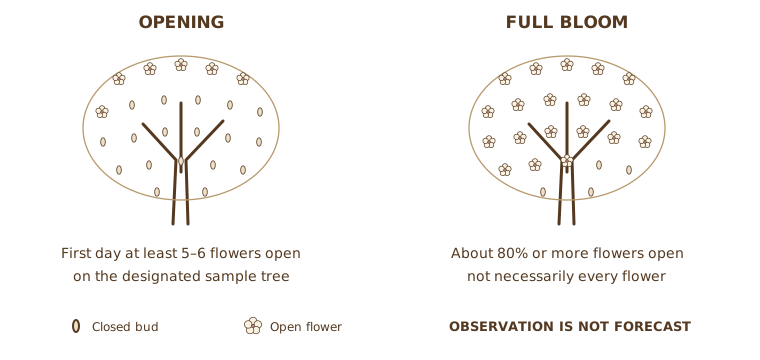
Original educational diagram, not a photograph. Observation thresholds apply to a designated tree. The schematic counts are illustrative, not a forecast or a survey of an entire park.
Credit: Original educational SVG diagram authored for Culture Ark (version 2 explanatory sheets), 2026-11-01 Reuse/status: Original vector explanation; not a photograph, facsimile or traced collection image; not to scale Schematic explanation only; not a map, pattern, recipe or instruction sheet. Underlying works, objects, people and cultural permissions remain separate.
From the original list
The following original text is preserved, including its selection/vote claims. Preservation is not independent verification of every assertion.
Why: A whole nation picnics under cherry blossoms, tracked by official bloom forecasts.
What to preserve: sakura forecast data by year, picnic customs, Kyoto bloom-date records back 1,200 years
Year and origin: 8th century · Japan
Vote: 6/9 (historian 2 · future kid 2 · curator 2)
Learn more: Hanami on Wikipedia
Explanatory sheets
2 original explanatory sheets prepared for this pick, each with its own diagram. Codes in square brackets such as [A] point to the numbered sources at the end of the page.
A sample tree makes bloom stages observable
A history of flower viewing. Hanami means flower viewing. Japan’s tourism organisation presents aristocratic poetry gatherings in the Nara period as one origin account, initially associated strongly with plum blossoms. Cherry viewing later became especially prominent. This is a history of changing preferences and social occasions, not evidence for a single inventor or an unchanged national ritual since the eighth century. [R1]
What people actually do. Friends, families or colleagues may gather beneath flowering trees with picnic sheets, food and drinks. Others simply enjoy the blossoms; illuminated night viewing is called yozakura. Species, cultivars and location affect the season, so there is no single day when the entire country celebrates together. A blossom-viewing gathering is a social practice, not a meteorological measurement. [R1]
Observation is not a forecast. The Japan Meteorological Agency defines opening as the first day at least five or six flowers are open on a designated sample tree. Full bloom means roughly eighty percent or more of its flowers are open. Those are observations, not predictions for every tree nearby. JMA stopped issuing flowering forecasts from spring 2010 while continuing observations; private weather providers publish forecasts. [R2, R3]
A gathering and a historical record are different evidence
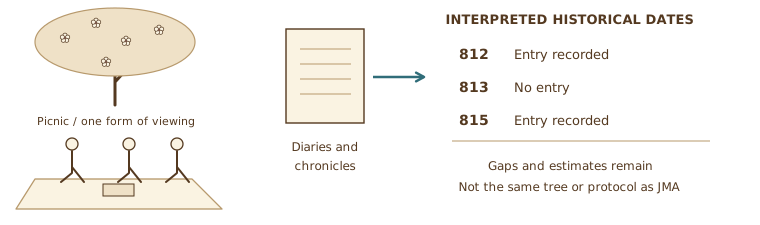
Hanami can generate historical descriptions, but reconstructing a date series requires interpretation; missing years are not filled with invented observations.
What the Kyoto series records. Researchers assembled Kyoto flowering dates for Japanese mountain cherry, Prunus jamasakura, from diaries and chronicles, with an entry reaching 812 CE. The series contains missing years and some estimated dates; it is not an uninterrupted instrument record or today’s Tokyo sample tree. Spring temperature influences flowering, allowing carefully calibrated historical dates to inform climate research as well as cultural history. [R4]
Where to learn more
- https://apiarybee.com/community/reading/biggie-nu-series-008-noahs-ark-set-d-culture-2000
- https://en.wikipedia.org/wiki/Hanami
Sources and rights
- A · Existing Culture Ark record — Exact approved current-live refresh; original body retained.
- R1 · Japan National Tourism Organization — Time for Japan’s Favourite Spring Activity! Hanami Manners and What to Bring — Qualified origin account; picnic customs, night viewing and regional variation.
- R2 · Japan Meteorological Agency, Tokyo Regional Headquarters — Tokyo cherry blossoms: observation definitions and statistics — Official sample-tree opening and roughly 80% full-bloom definitions.
- R3 · Japan Meteorological Agency — End of JMA cherry-blossom flowering forecasts, 25 December 2009 — Forecast announcements ended from spring 2010; observations continued.
- R4 · Aono, Saito and Kazui; NOAA NCEI World Data Service for Paleoclimatology — Kyoto, Japan 1,200 Year Cherry Tree Flowering Dates and March Temperature Reconstructions — Primary Kyoto documentary dataset, beginning with 812 entry; gaps and estimates; archived version through 2010.
Drawings: Original educational SVG schematics; no copied historical/product artwork. Not to scale. Archive note: The original whole-nation and official-forecast wording remains unchanged. JMA observation continues, but its flowering forecasts ended from 2010; the Kyoto series is not uninterrupted. Sources consulted 2026-11-01. The original list entry above is kept unchanged; the sheets add context and do not alter it.
Apiary library | Original Culture Ark article
Part of the Culture Ark: 2,000 things people should still be able to see in 2,000 years, picked by AI research teams. This page keeps the original list entry for D-1642 word for word and adds context. Browse the gallery. The Culture Ark is an Artificial Mind Hive (AMH) project. AMH is owned by Austin Little.

Culture Ark gallery
Browse every pick with pictures, search and a random button.
Open the gallery →