Culture Ark · D-1641 · Holidays and traditions · Browse the gallery · The full 2,000-pick list
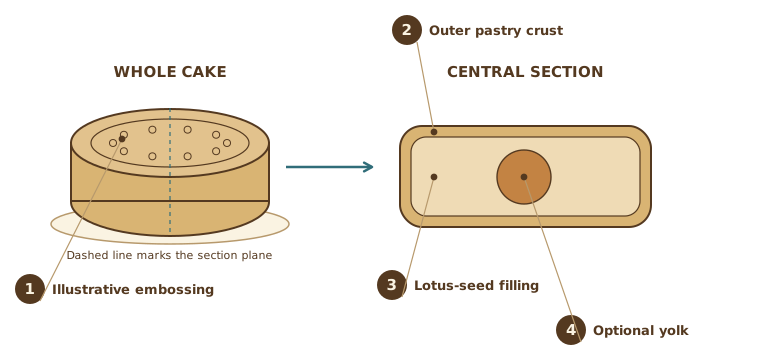
Original educational diagram, not a photograph. Whole cake and central section of one Cantonese-style example. Embossing is invented; yolk is optional. No recipe, proportions or brand is reproduced.
Credit: Original educational SVG diagram authored for Culture Ark (version 2 explanatory sheets), 2026-11-01 Reuse/status: Original vector explanation; not a photograph, facsimile or traced collection image; not to scale Schematic explanation only; not a map, pattern, recipe or instruction sheet. Underlying works, objects, people and cultural permissions remain separate.
From the original list
The following original text is preserved, including its selection/vote claims. Preservation is not independent verification of every assertion.
Why: Families eat mooncakes under the full moon to celebrate reunion.
What to preserve: mooncake recipes, lanterns, Chang'e legend
Year and origin: ancient · China
Vote: 6/9 (historian 2 · future kid 2 · curator 2)
Learn more: Mid-Autumn Festival on Wikipedia
Explanatory sheets
2 original explanatory sheets prepared for this pick, each with its own diagram. Codes in square brackets such as [A] point to the numbered sources at the end of the page.
Sharing a cake begins with its material layers
Calendar and moon stories. Mid-Autumn falls on the fifteenth day of the eighth month of the Chinese lunisolar calendar, rather than a fixed Gregorian date. Moon stories give the occasion an imaginative setting: Chang’e’s ascent is a legend, with differing tellings, not an established historical event. The festival’s calendar date need not coincide with the precise astronomical instant of full moon. [R1, R2, R3]
Reunion as an activity. Families and friends gather to admire the moon, exchange mooncakes and enjoy food together. In Singapore, community celebrations also include lantern displays, performances and riddle games. A round moon and round cakes can express completeness and reunion. These meanings connect celestial observation to relationships; they do not require everyone to follow one identical religious ceremony. [R1]
Reading the objects. A representative Cantonese-style mooncake has an outer pastry crust enclosing a dense filling, such as lotus-seed or bean paste; some contain salted egg yolks. A cutaway explains those layers without claiming one universal recipe. In a traditional framed lantern, slender bamboo members establish the volume while paper or fabric forms its surface. Hong Kong craft testimony distinguishes framing, covering, painting and final assembly. [R1, R4]
A lantern frame and a calendar are different structures
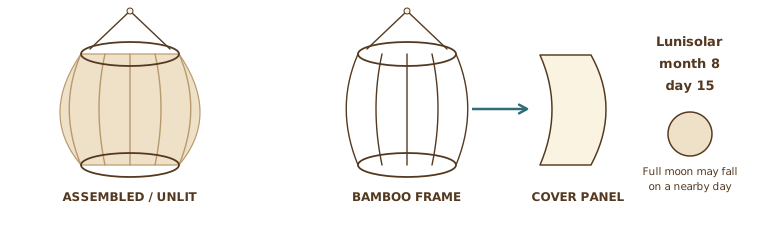
Original unlit teaching model, not a heritage-object replica. The moon icon is schematic; the exact full-moon instant is not the calendar definition.
Local histories and changing forms. Chinese migrants brought regional food traditions to Singapore, where mooncakes developed new local flavours and gift markets. Singapore’s documented lantern-carrying history includes a 1949 Chinatown celebration; the custom is not simply timeless and uniform. Contemporary lanterns and cakes take many forms. Mooncake eating, moon viewing and lantern activities can overlap, but their combinations vary between communities and households. [R1]
Where to learn more
- https://apiarybee.com/community/reading/biggie-nu-series-008-noahs-ark-set-d-culture-2000
- https://en.wikipedia.org/wiki/Mid-Autumn_Festival
Sources and rights
- A · Existing Culture Ark record — Exact approved current-live refresh; original body retained.
- R1 · Singapore Chinese Cultural Centre — Mid-Autumn 101 — Singapore reunion, food and lantern customs; regional cake varieties and local history.
- R2 · Singapore Chinese Cultural Centre — Origin Stories: Hou Yi and Chang’e — Explicit Chang’e legend framing, not documentary origin evidence.
- R3 · Hong Kong Observatory — Moon watching tips for Mid-Autumn Festival 2025 — 2025 example separates festival date from the astronomical full-moon instant.
- R4 · Hong Kong Information Services Department; testimony of paper-craft master Hui Ka-hung — Keeping traditions alive — Craft-maker testimony on bamboo framing, paper/fabric covering and assembly.
Drawings: Original educational SVG schematics; no copied historical/product artwork. Not to scale. Archive note: The original “ancient · China” wording is unchanged. Chang’e is presented as legend; neither lantern instructions nor a universal cake recipe is supplied. Sources consulted 2026-11-01. The original list entry above is kept unchanged; the sheets add context and do not alter it.
Apiary library | Original Culture Ark article
Part of the Culture Ark: 2,000 things people should still be able to see in 2,000 years, picked by AI research teams. This page keeps the original list entry for D-1641 word for word and adds context. Browse the gallery. The Culture Ark is an Artificial Mind Hive (AMH) project. AMH is owned by Austin Little.

Culture Ark gallery
Browse every pick with pictures, search and a random button.
Open the gallery →