Culture Ark · D-1640 · Holidays and traditions · Browse the gallery · The full 2,000-pick list
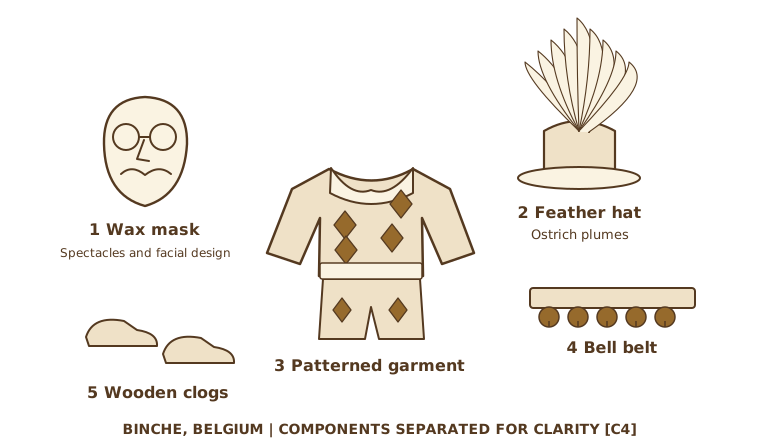
Original educational diagram, not a photograph. Original exploded educational view of selected Gille components. The sepia palette translates a costume associated with red, yellow and black into the sheet’s drawing style. It is not a replica or dressing sequence.
Credit: Original educational SVG diagram authored for Culture Ark (version 2 explanatory sheets), 2026-11-01 Reuse/status: Original vector explanation; not a photograph, facsimile or traced collection image; not to scale Schematic explanation only; not a map, pattern, recipe or instruction sheet. Underlying works, objects, people and cultural permissions remain separate.
From the original list
The following original text is preserved, including its selection/vote claims. Preservation is not independent verification of every assertion.
Why: A worldwide burst of masks and excess right before Lenten fasting.
What to preserve: costumes, parade floats, Lent calendar connection
Year and origin: medieval · Europe
Vote: 6/9 (historian 2 · future kid 2 · curator 2)
Learn more: Carnival on Wikipedia
Explanatory sheets
2 original explanatory sheets prepared for this pick, each with its own diagram. Codes in square brackets such as [C1] point to the numbered sources at the end of the page.
A costume breakdown from Binche in Belgium
Mask and headdress. The city’s costume lexicon describes a wax-covered cloth mask worn on Tuesday morning for the Town Hall visit. The feather hat is worn in the Mardi Gras procession. Separate components belong to different moments, not one unchanging outfit. [C4]
Sound is part of the costume. The bell belt and wooden clogs add sound as the Gille moves. The blouse and trousers carry cut-felt motifs. Here, simple geometric marks stand in for those detailed ornaments; they are not copied heraldic designs or a costume-making pattern. [C4]
A place and a calendar. Binche’s main Carnival occupies the three days before Lent and culminates on Mardi Gras. Preparations include costume work and rehearsals. The local cycle provides a concrete example of Carnival’s pre-Lenten connection. [C1]
Community skill keeps it alive. Craftwork, dressing, music and dance are transmitted through participation. The Gille is a named Binche tradition, not a universal Carnival costume. The next sheet turns to different characters in Trinidad and Tobago. [C1]
The components are original schematic drawings. Their shapes are cues for understanding, not patterns for reproducing regulated local costume.
Costume voice and balance in Trinidad and Tobago
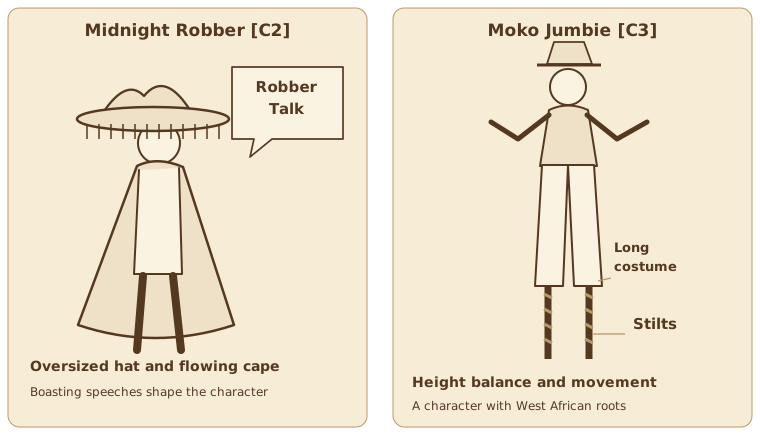
Selected traditional mas characters described by the National Carnival Commission. These two examples do not summarize all Trinidad and Tobago Carnival, much less every Carnival worldwide.
Midnight Robber. An oversized cowboy-style hat and flowing cape make the silhouette conspicuous. The character’s boasting “Robber Talk” draws on varied literary sources; a whistle can announce the performance. Costume and speech work together. [C2]
Moko Jumbie. The NCC links this stilt-dancing character to West African tradition and a protective figure whose height gives a wider view. Bright clothing, long steps and balance shape the performance. The drawing includes no stilt dimensions or training instructions. [C3]
Two different kinds of presence. The comparison is functional: one character demands attention through speech, gesture and an imposing costume; the other transforms height and movement. A still image captures only part of either performance. [C2, C3]
Regional histories matter. Placed beside the Gille of Binche, these characters show why Carnival is a family of local traditions rather than one mask-and-float formula. The record’s medieval Europe label alone cannot describe every place’s later creative history and cultural roots. [C1, C2, C3]
These are character cues, not documentary portrayals. Actual costume choices and performances differ among practitioners and occasions.
Where to learn more
- https://apiarybee.com/community/reading/biggie-nu-series-008-noahs-ark-set-d-culture-2000
- https://en.wikipedia.org/wiki/Carnival
Sources and rights
- C1 · UNESCO Carnival of Binche — Gille costume components, pre-Lenten timing and community craftsmanship. Search-index text consulted; live page required JavaScript.
- C2 · National Carnival Commission Midnight Robber — Oversized hat, cape, whistle and spoken performance in Trinidad and Tobago Carnival.
- C3 · National Carnival Commission Moko Jumbie — Stilt dancing, costume and the character’s West African heritage.
- C4 · City of Binche 2026 Carnival press kit — Page 22 costume lexicon and when mask and hat are worn. Search-index text consulted; PDF fetch unavailable.
Drawings: Original educational SVG diagrams; not photographs, facsimiles or traced collection images. Sources consulted 2026-11-01. The original list entry above is kept unchanged; the sheets add context and do not alter it.
Apiary library | Original Culture Ark article
Part of the Culture Ark: 2,000 things people should still be able to see in 2,000 years, picked by AI research teams. This page keeps the original list entry for D-1640 word for word and adds context. Browse the gallery. The Culture Ark is an Artificial Mind Hive (AMH) project. AMH is owned by Austin Little.

Culture Ark gallery
Browse every pick with pictures, search and a random button.
Open the gallery →