Culture Ark · D-1639 · Holidays and traditions · Browse the gallery · The full 2,000-pick list
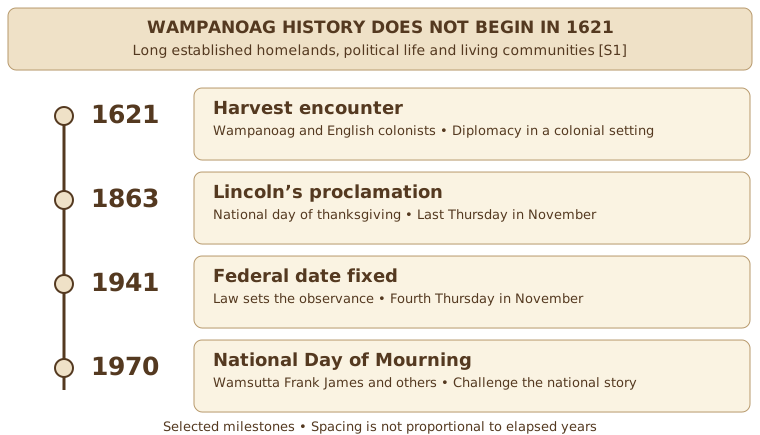
Original educational diagram, not a photograph. Original timeline of selected milestones, not a reconstructed feast scene. The entries describe different events and purposes rather than one unchanged tradition.
Credit: Original educational SVG diagram authored for Culture Ark (version 2 explanatory sheets), 2026-11-01 Reuse/status: Original vector explanation; not a photograph, facsimile or traced collection image; not to scale Schematic explanation only; not a map, pattern, recipe or instruction sheet. Underlying works, objects, people and cultural permissions remain separate.
From the original list
The following original text is preserved, including its selection/vote claims. Preservation is not independent verification of every assertion.
Why: A national feast built around one roast bird and family arguments.
What to preserve: turkey recipes, the 1621 Plymouth story, the presidential turkey pardon, travel numbers
Year and origin: 1863 · United States
Vote: 6/9 (historian 2 · future kid 2 · curator 2)
Learn more: Thanksgiving (United States) on Wikipedia
Explanatory sheets
2 original explanatory sheets prepared for this pick, each with its own diagram. Codes in square brackets such as [S1] point to the numbered sources at the end of the page.
The United States holiday developed over time
1621 was an encounter between societies. The Wampanoag had established homelands and political relationships. The Plymouth harvest gathering occurred within diplomacy with English colonists. Calling Native participants nameless helpers obscures their agency and the colonial context. [S1]
1863 and 1941 are different milestones. Lincoln’s 1863 proclamation called for a national thanksgiving on the last Thursday of November. In 1941, legislation fixed the holiday on the fourth Thursday. The source entry’s 1863 date therefore names a milestone, not the invention of giving thanks. [S2]
1970 brought a public challenge. Wamsutta Frank James, an Aquinnah Wampanoag leader, and others marked a National Day of Mourning in Plymouth. UAINE’s account connects it to confronting colonization and the celebratory national narrative. It remains a distinct public meaning of the date. [S3]
One meal does not explain the aftermath. Cooperation in 1621 did not end conflict. NMAI’s timeline follows colonial expansion, war, dispossession and Wampanoag persistence. A story ending at the feast misses this aftermath and continuing community life. [S1]
US Thanksgiving is the scope of this source entry. The timeline does not assign a single perspective to all Indigenous people or all households.
Gratitude harvest and remembrance have living voices
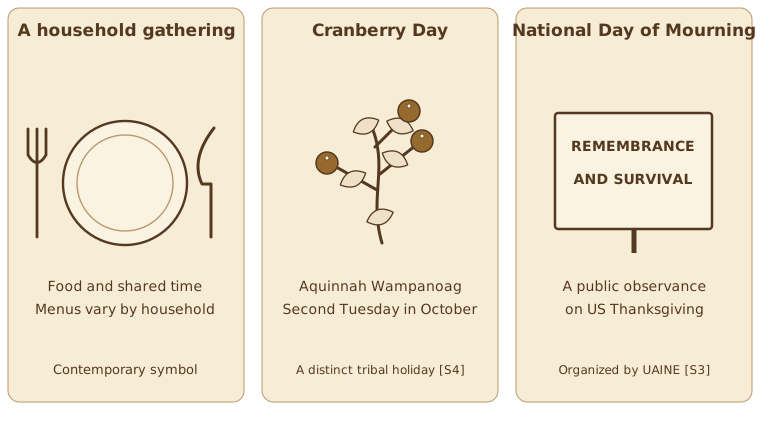
Original symbols, not photographs or reconstructed ceremonies. Cranberry Day is a separate tribal holiday; its October date is shown to prevent conflating it with US Thanksgiving.
A household meal is one layer. Food and shared time can express gratitude or family continuity, while menus and participation differ. The source record’s roast-bird shorthand describes one familiar image, not every household or the entire meaning of the national holiday.
Aquinnah Wampanoag continuity. The tribe’s own account describes Cranberry Day on the second Tuesday in October: elders and young people harvest together, share stories, and later gather for a community meal, singing and dancing. This is living cultural practice, not a reenactment of 1621. [S4]
Mourning is also an active public tradition. UAINE presents the National Day of Mourning as remembrance and resistance, honoring Native people while challenging a story that excuses dispossession. Hearing that account changes how the national celebration is understood; it is not merely an alternative menu. [S3]
Names make a more accurate history. Wampanoag communities are not a generic stand-in for all Native nations. NMAI’s account centers named people, alliances, land and survival. Distinct histories can be read alongside a family’s gratitude without pretending that everyone experiences the date in the same way. [S1]
The cranberry branch is a simple botanical symbol drawn for this sheet. No tribal artwork, sacred design or private ceremony has been copied.
Where to learn more
- https://apiarybee.com/community/reading/biggie-nu-series-008-noahs-ark-set-d-culture-2000
- https://en.wikipedia.org/wiki/Thanksgiving_%28United_States%29
Sources and rights
- S1 · National Museum of the American Indian Thanksgiving timeline — Wampanoag history, the 1621 encounter, colonial conflict and continuing communities.
- S2 · Library of Congress Thanksgiving classroom materials — 1863 last-Thursday proclamation and 1941 fourth-Thursday legislation. Search-index text consulted; direct fetch returned 403.
- S3 · United American Indians of New England Historical information — The organization’s account of Wamsutta Frank James and the National Day of Mourning begun in 1970.
- S4 · Wampanoag Tribe of Gay Head Aquinnah Ancient Ways — The tribe’s own account of Cranberry Day and intergenerational harvest traditions.
Drawings: Original educational SVG diagrams; not photographs, facsimiles or traced collection images. Sources consulted 2026-11-01. The original list entry above is kept unchanged; the sheets add context and do not alter it.
Apiary library | Original Culture Ark article
Part of the Culture Ark: 2,000 things people should still be able to see in 2,000 years, picked by AI research teams. This page keeps the original list entry for D-1639 word for word and adds context. Browse the gallery. The Culture Ark is an Artificial Mind Hive (AMH) project. AMH is owned by Austin Little.

Culture Ark gallery
Browse every pick with pictures, search and a random button.
Open the gallery →