Culture Ark · D-1638 · Holidays and traditions · Browse the gallery · The full 2,000-pick list
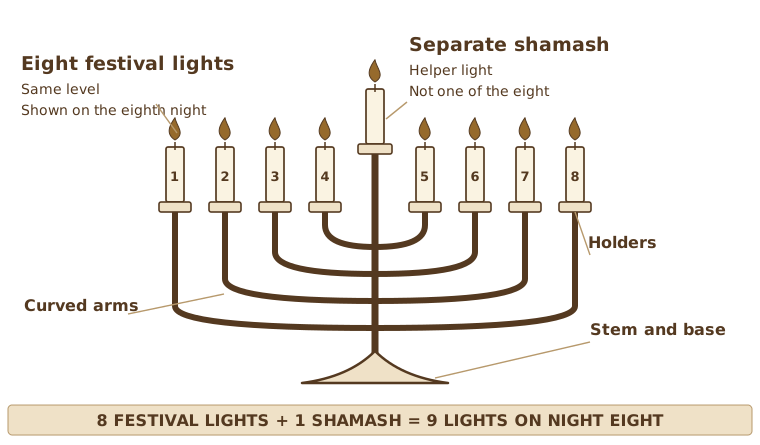
Original educational diagram, not a photograph. Original front schematic of a hanukkiah, also called a Hanukkah menorah. The curved form is illustrative; lamps can also use oil. All eight festival lights plus the shamash are shown lit.
Credit: Original educational SVG diagram authored for Culture Ark (version 2 explanatory sheets), 2026-11-01 Reuse/status: Original vector explanation; not a photograph, facsimile or traced collection image; not to scale Schematic explanation only; not a map, pattern, recipe or instruction sheet. Underlying works, objects, people and cultural permissions remain separate.
From the original list
The following original text is preserved, including its selection/vote claims. Preservation is not independent verification of every assertion.
Why: An eight-night festival of lights remembering a rededicated temple and a small jar of oil.
What to preserve: menorah lighting order, dreidel rules, latkes and sufganiyot
Year and origin: 164 BC · Judea
Vote: 6/9 (historian 2 · future kid 2 · curator 2)
Learn more: Hanukkah on Wikipedia
Explanatory sheets
2 original explanatory sheets prepared for this pick, each with its own diagram. Codes in square brackets such as [H1] point to the numbered sources at the end of the page.
Eight festival lights and a separate helper
Eight plus one. The eight festival lights mark the eight nights. The shamash is an additional helper light, set apart so it is distinguishable. It is not a ninth festival night. The Temple menorah has seven lights and is a different object. [H1]
Holders and support. Here the festival holders form a level row. The arms connect them to a central stem and broad base; the raised center carries the shamash. This is one possible arrangement, not a claim that all Hanukkah lamps have curved branches. [H1, H2]
Dedication and remembered history. Hanukkah recalls the rededication of the Jerusalem Temple after the Maccabean victory in 164 BCE. A Talmudic account tells of oil sufficient for one day lasting eight. History and the religious account both inform the festival, but the miracle is a statement of tradition. [H3]
A visible household ritual. The Jewish Museum Berlin describes gatherings of family and friends, blessings and lights placed where they can be seen. Repeated lighting makes remembrance visible over several evenings. Household practice and the lamp’s artistic form can vary. [H3]
Ordinary festival positions are numbered only to make the count clear. The next sheet explains nightly progression and lighting direction.
The nightly sequence and other festival customs
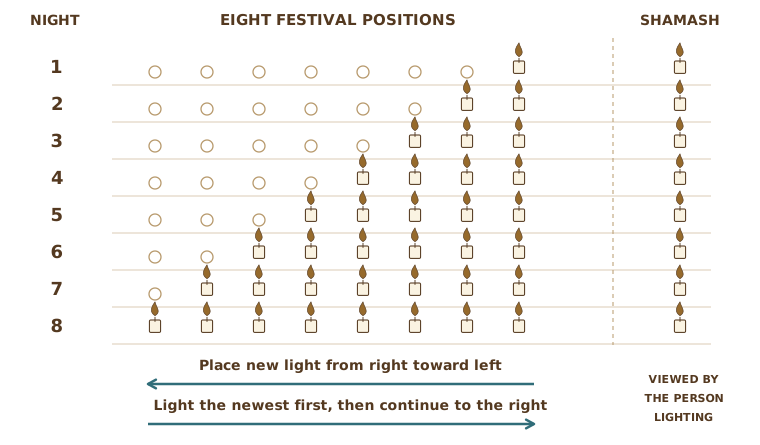
The common increasing-light practice described by Chabad, viewed by the person lighting. Small outlined circles are empty positions. The helper column is separate from the eight festival positions.
Add one and begin with the new light. One festival light is used on the first night, with one more each night. In the illustrated practice, a new light is placed to the left of the previous lights and lit first; lighting then proceeds to the right. Blessings accompany the ritual. [H2]
Count the nights correctly. Night eight has eight festival lights plus the shamash. The helper does not change that count. The matrix shows the display for each evening, not candles left burning for eight consecutive days. [H1, H2]
The spinning top game. A dreidel has four lettered faces. In the cited rule set, nun means no transfer, gimel takes the pot, hey takes half and shin contributes one unit. In Israel, pey commonly replaces shin. Families may use different game details. [H4]
Oil in the kitchen. Latkes are potato pancakes and sufganiyot are doughnuts. These fried foods connect a meal to oil’s role in the Hanukkah account. They are familiar examples, not the only foods Jewish communities prepare for the festival. [H3]
This is an explanatory count and direction diagram. For actual observance, follow the relevant community’s guidance and ordinary fire safety.
Where to learn more
- https://apiarybee.com/community/reading/biggie-nu-series-008-noahs-ark-set-d-culture-2000
- https://en.wikipedia.org/wiki/Hanukkah
Sources and rights
- H1 · Chabad How many candles on a Hanukkah menorah — Eight festival lights and separate shamash; distinction from the seven-light Temple menorah.
- H2 · Chabad How to Light — Increasing nightly count, equal festival-light height, placement and lighting directions in the described practice.
- H3 · Jewish Museum Berlin Hanukkah — Temple rededication, the Talmudic oil account, household observance and fried foods.
- H4 · Chabad How to Play Dreidel — One rule set for the four-sided top; Hebrew letters and the Israeli pey variant.
Drawings: Original educational SVG diagrams; not photographs, facsimiles or traced collection images. Sources consulted 2026-11-01. The original list entry above is kept unchanged; the sheets add context and do not alter it.
Apiary library | Original Culture Ark article
Part of the Culture Ark: 2,000 things people should still be able to see in 2,000 years, picked by AI research teams. This page keeps the original list entry for D-1638 word for word and adds context. Browse the gallery. The Culture Ark is an Artificial Mind Hive (AMH) project. AMH is owned by Austin Little.

Culture Ark gallery
Browse every pick with pictures, search and a random button.
Open the gallery →