Culture Ark · D-1637 · Holidays and traditions · Browse the gallery · The full 2,000-pick list
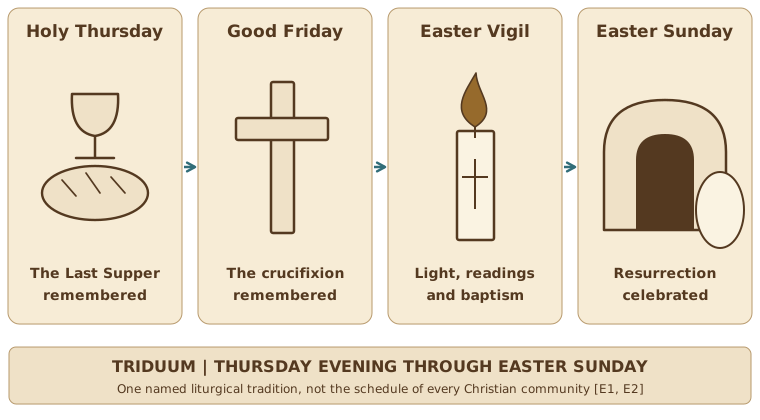
Original educational diagram, not a photograph. Original educational symbols, not documentary scenes from antiquity. Resurrection is the Christian belief celebrated here; the drawing is not presented as historical or archaeological proof.
Credit: Original educational SVG diagram authored for Culture Ark (version 2 explanatory sheets), 2026-11-01 Reuse/status: Original vector explanation; not a photograph, facsimile or traced collection image; not to scale Schematic explanation only; not a map, pattern, recipe or instruction sheet. Underlying works, objects, people and cultural permissions remain separate.
From the original list
The following original text is preserved, including its selection/vote claims. Preservation is not independent verification of every assertion.
Why: The central Christian feast mixes resurrection theology with chocolate rabbits.
What to preserve: liturgy, egg traditions, the computus date formula
Year and origin: 2nd century · Middle East
Vote: 6/9 (historian 2 · future kid 2 · curator 2)
Learn more: Easter on Wikipedia
Explanatory sheets
2 original explanatory sheets prepared for this pick, each with its own diagram. Codes in square brackets such as [E1] point to the numbered sources at the end of the page.
Holy Week through one liturgical tradition
Remembering and celebrating. In this Roman Catholic sequence, Thursday evening recalls the Last Supper, Friday the crucifixion, and the Vigil and Easter Sunday celebrate Christ’s resurrection. The Triduum runs from Thursday evening through Easter Sunday. Other Christian communities have their own liturgical forms. [E1]
Light and water at the Vigil. The Paschal candle represents Christ as light. Readings and baptismal rites place the celebration within Christian teaching and initiation. The symbols are not a claim that every household’s Easter includes this exact service. [E2]
Keep worship distinct from customs. The source entry also mentions chocolate rabbits. A religious service, an egg-decorating custom and a commercial sweet are different kinds of cultural evidence. They may coexist in a family’s Easter without having the same meaning or origin. [E4]
Community and initiation. In the US Catholic account, adults entering the Church may be baptized at the Easter Vigil after a period of preparation. Water therefore connects the Easter story with a change in community membership, not simply seasonal decoration. [E2]
The original source wording is retained in the archive. These named examples do not substitute one tradition for all Christian or secular observances.
The calendar rule and the customs are different layers
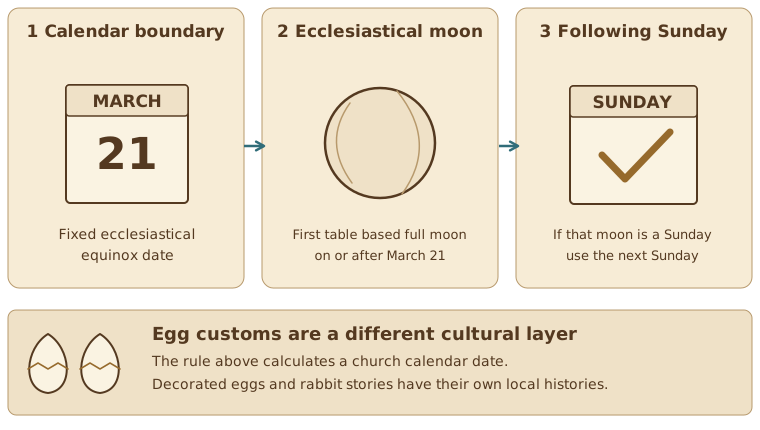
Conceptual Gregorian computus, not an astronomical observation procedure or a full software algorithm. Other church calendars can yield a different date.
Why watching the sky is not enough. For the Gregorian rule, use the ecclesiastical March 21 boundary and a table-based full moon, then the following Sunday. If that moon date is Sunday, Easter is the next Sunday. The table date need not match the observed full moon. [E3]
Name the calendar. The Gregorian calculation is used by many Western churches. Julian-based paschal calculations can differ. Preserve the calendar system with any date rather than calling one date “the” Easter for all Christians. [E3]
Eggs and rabbits need their own evidence. Library of Congress folklife research traces documented rabbit and egg traditions while questioning easy origin stories. Do not assume every modern Easter custom descends directly from one ancient rite. Record a named community’s account and the evidence behind it. [E4]
A small worked comparison. Suppose the qualifying table moon falls on Saturday: the following day is Easter. If it falls on Sunday, Easter is seven days later. This explains why “the Sunday nearest a full moon” is not the rule. [E3]
No current-year date is guessed. This sheet separates church-calendar rules, religious meaning and folk or commercial customs.
Where to learn more
- https://apiarybee.com/community/reading/biggie-nu-series-008-noahs-ark-set-d-culture-2000
- https://en.wikipedia.org/wiki/Easter
Sources and rights
- E1 · Canadian Conference of Catholic Bishops Holy Week — Roman Catholic Holy Week and Triduum sequence, including Good Friday and the Easter Vigil.
- E2 · US Conference of Catholic Bishops Christian Initiation of Adults — The Easter Vigil’s service of light, Paschal candle and baptismal water in this tradition.
- E3 · US Naval Observatory The Date of Easter — Gregorian ecclesiastical calculation and its difference from a simple astronomical full-moon rule.
- E4 · Library of Congress On the Bunny Trail — Folklife research on egg and rabbit customs; cautions about easy origin stories and limited historical evidence.
Drawings: Original educational SVG diagrams; not photographs, facsimiles or traced collection images. Sources consulted 2026-11-01. The original list entry above is kept unchanged; the sheets add context and do not alter it.
Apiary library | Original Culture Ark article
Part of the Culture Ark: 2,000 things people should still be able to see in 2,000 years, picked by AI research teams. This page keeps the original list entry for D-1637 word for word and adds context. Browse the gallery. The Culture Ark is an Artificial Mind Hive (AMH) project. AMH is owned by Austin Little.

Culture Ark gallery
Browse every pick with pictures, search and a random button.
Open the gallery →