Culture Ark · D-1636 · Holidays and traditions · Browse the gallery · The full 2,000-pick list
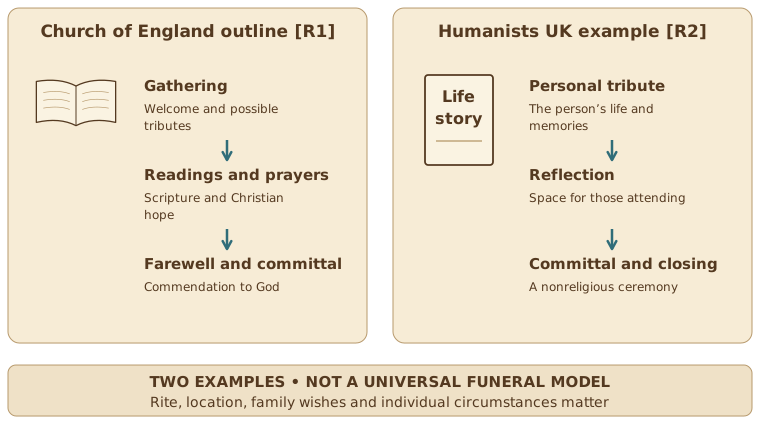
Original educational diagram, not a photograph. Original comparison of two documented UK frameworks. These do not cover the world’s funeral traditions, every Christian denomination or every secular ceremony.
Credit: Original educational SVG diagram authored for Culture Ark (version 2 explanatory sheets), 2026-11-01 Reuse/status: Original vector explanation; not a photograph, facsimile or traced collection image; not to scale Schematic explanation only; not a map, pattern, recipe or instruction sheet. Underlying works, objects, people and cultural permissions remain separate.
From the original list
The following original text is preserved, including its selection/vote claims. Preservation is not independent verification of every assertion.
Why: How humans say goodbye shows what they believe about life and death.
What to preserve: rites by religion, burial vs cremation rates over years
Year and origin: ancient · worldwide
Vote: 7/9 (historian 3 · future kid 1 · curator 3)
Learn more: Funeral on Wikipedia
Explanatory sheets
1 original explanatory sheet prepared for this pick, each with its own diagram. Codes in square brackets such as [R1] point to the numbered sources at the end of the page.
Two documented ways to say farewell
One Anglican outline. Common Worship provides gathering, readings and sermon, prayers, commendation, committal and dismissal. Christian hope and prayer shape this rite. Its own options allow variation; the drawing compresses the outline and is not an officiant’s service book. [R1]
One nonreligious approach. Humanists UK describes a ceremony built around the person’s life, with tributes and reflection. There is no mandatory fixed script. Similar moments of farewell do not mean that its beliefs or wording match the Anglican service. [R2]
Ceremony is not disposition. A funeral rite, the treatment or disposition of remains, and later remembrance are related but different questions. Do not infer all beliefs or practices from burial versus cremation alone. Any comparison needs a named community, time and place.
Shared moments and different meanings. Both examples can include personal memories and a farewell. The Anglican outline commends the person to God; the humanist ceremony centers a life without an act of worship. The presence of music or a reading alone does not identify the ceremony’s worldview. [R1, R2]
No global funeral sequence, required clothing, prescribed emotion or fixed mourning duration is asserted.
Where to learn more
- https://apiarybee.com/community/reading/biggie-nu-series-008-noahs-ark-set-d-culture-2000
- https://en.wikipedia.org/wiki/Funeral
Sources and rights
- R1 · Church of England Common Worship Funeral — One Anglican order, including gathering, readings, prayers, commendation and committal. Search-index text consulted; direct web fetch returned 403.
- R2 · Humanists UK Funeral FAQs — Personalized nonreligious ceremonies, tribute, reflection and committal; no mandatory fixed script.
Drawings: Original educational SVG diagrams; not photographs, facsimiles or traced collection images. Sources consulted 2026-11-01. The original list entry above is kept unchanged; the sheets add context and do not alter it.
Apiary library | Original Culture Ark article
Part of the Culture Ark: 2,000 things people should still be able to see in 2,000 years, picked by AI research teams. This page keeps the original list entry for D-1636 word for word and adds context. Browse the gallery. The Culture Ark is an Artificial Mind Hive (AMH) project. AMH is owned by Austin Little.

Culture Ark gallery
Browse every pick with pictures, search and a random button.
Open the gallery →