Culture Ark · D-1630 · Holidays and traditions · Browse the gallery · The full 2,000-pick list
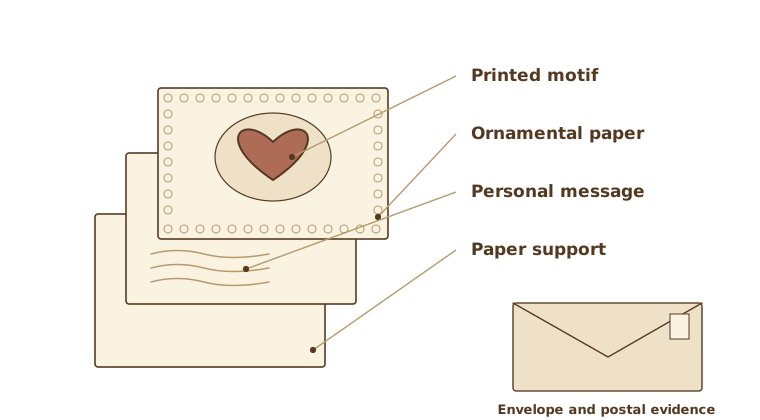
Original educational diagram, not a photograph. The exploded card is an original imaginary example. It separates common material roles without copying a museum object or its written sentiment.
Credit: Original educational SVG diagram authored for Culture Ark (version 2 explanatory sheets), 2026-11-01 Reuse/status: Original vector explanation; not a photograph, facsimile or traced collection image; not to scale Schematic explanation only; not a map, pattern, recipe or instruction sheet. Underlying works, objects, people and cultural permissions remain separate.
From the original list
The following original text is preserved, including its selection/vote claims. Preservation is not independent verification of every assertion.
Why: One day a year, love is measured in roses, chocolate and cards.
What to preserve: card designs over centuries, flower and chocolate sales by year
Year and origin: 14th century · Europe
Vote: 7/9 (historian 2 · future kid 2 · curator 3)
Learn more: Valentine's Day on Wikipedia
Explanatory sheets
2 original explanatory sheets prepared for this pick, each with its own diagram. Codes in square brackets such as [V1] point to the numbered sources at the end of the page.
A card combines materials and a message
A small object can be elaborate. Nineteenth-century valentines included handwritten notes, printed images, decorative paper and complex moving or expanding structures. The V&A’s examples include mechanical cards and paper cages as well as simpler forms. Layering and movement could make opening the message part of the experience. [V1, V2]
Not every valentine was affectionate. “Vinegar valentines” carried mocking or insulting messages, complicating the familiar picture of tender cards. Anonymous sending and postal exchange helped circulate very different sentiments. The decoration alone cannot reveal a sender’s intention: words, format and surviving context matter. [V1, V2]
No historic verse, private message or collection image is reproduced.
Post and printing changed the scale of exchange
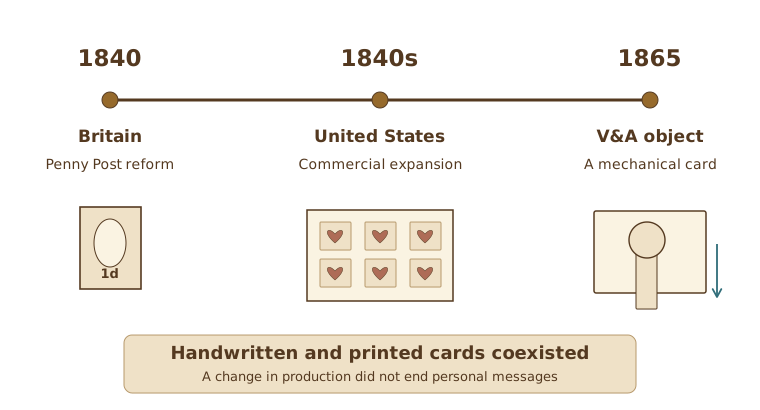
These are selected milestones, not a claim about the holiday’s single origin. The stamp and moving card are original symbols rather than replicas.
A cheaper channel for messages. Britain’s 1840 postal reforms reduced the cost of sending letters and encouraged valentine exchange. Paper and printing developments supported a growing card industry. The V&A records an 1865 mechanical valentine, showing how commercial paper objects could also offer novelty and interaction. [V1, V2]
Handwork and commerce together. The American Antiquarian Society’s 1830–1900 collection contains both manuscript and printed cards. Its account places an American fashion for exchanging valentines in the 1840s and describes Esther Howland’s Worcester business. Commercial production and personal handwriting were overlapping practices, not mutually exclusive stages. [V3]
The card industry is one history within Valentine’s Day, not a measure of anyone’s love or a universal expectation to buy gifts.
Where to learn more
- https://apiarybee.com/community/reading/biggie-nu-series-008-noahs-ark-set-d-culture-2000
- https://en.wikipedia.org/wiki/Valentine's_Day
Sources and rights
- V1 · Victoria and Albert Museum — A brief history of Valentine’s cards — Decorative and mechanical formats, vinegar valentines and the dated 1865 example.
- V2 · Victoria and Albert Museum — Victorian Valentines — Paper, printing, postal reform and handwritten or insulting cards; official indexed text consulted.
- V3 · American Antiquarian Society — Valentines — The 1830–1900 collection, American 1840s fashion and Esther Howland’s business.
Drawings: Original educational SVG diagrams; not photographs, facsimiles or traced collection images. Sources consulted 2026-11-01. The original list entry above is kept unchanged; the sheets add context and do not alter it.
Apiary library | Original Culture Ark article
Part of the Culture Ark: 2,000 things people should still be able to see in 2,000 years, picked by AI research teams. This page keeps the original list entry for D-1630 word for word and adds context. Browse the gallery. The Culture Ark is an Artificial Mind Hive (AMH) project. AMH is owned by Austin Little.

Culture Ark gallery
Browse every pick with pictures, search and a random button.
Open the gallery →